- JEDDAH: Eleven days after the flood that devastated central Jeddah, criticism is mounting over the lack of action to clean up the city.
- Although the city authorities say that in addition to 620 of their own staff involved in the cleanup they have contracted an extra 4,080 cleaners, the response on the ground in many of the affected areas, notably Al-Ruwais and Sharafiyah, is “we've seen nothing yet.”
Madinah Road is the most important and one of the busiest thoroughfares in Jeddah, connecting the city’s business district to the northern suburbs. The northbound lane between King Abdullah Street (old Wali Al-Ahad) and Palestine Street remains choked with water. Although only 20 centimeters or so deep, it is enough to hide potholes and tire-ripping debris. Because of the continued flooding, the section is reduced to two lanes in places with motorists attempting to avoid unseen hazards. On Saturday evening — not in the rush hour — it took one of Arab News’ reporters 50 minutes to drive the one-kilometer stretch. During that time at least one car ended its journey nose-down in a concealed pothole, further slowing up the traffic.
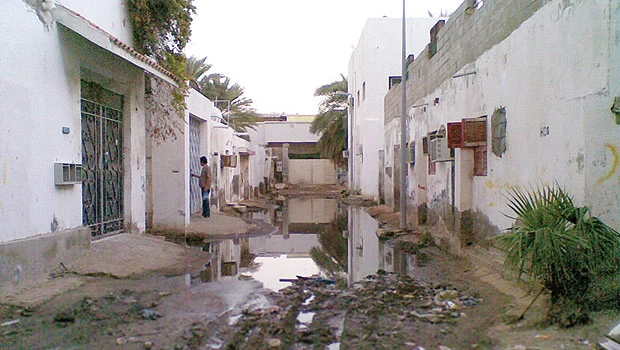
A number of side streets remain under water or blocked by rubbish. In Sharafiyah district, just south of Palestine Street, the filth and rubbish on some of the side streets is worse than in the slums of South Asia or Africa. At one workshop, access to which is almost blocked by a lake of water and debris, the manager said: “We have seen no one. Nothing is being done to clear it up.” Across the road is a school. “Look at the fifth. It's is a major health hazard. No parent is going to expose their kids to it.”
A European manager, who wished not to be named, located in a high-rise office block on Madinah Road described the environment “third world and very frontier.”
“Eleven days on and we still have no land-line telephones, no running water in the building and no mains electricity and therefore no lifts in the 15-floor building,” he said. “We invested SR15,000 in a couple of generators to give us power to the computers but the basement, still knee-deep in water and that houses the electrical switchgear, is jammed with wrecked cars.”
He said the company's management had done nothing at all to address the situation. “We lost several company cars when our basement flooded, the exit ramp is still jammed and the whole building seems to have been abandoned.”
There were other problems too. “The guys who bring fresh water bottles we use have stopped delivering and reasonably so. Climbing ten floors with several of those is a tiresome task. We have been reduced to flushing lavatories with what remains of the cleaning fluid and the last of the water.”
Outside the building, mosquitoes are in their element breeding in the stagnant sewage water. The smell is intensifying daily as the effluent rots.
Following questions on Sunday to the municipality about the state of the roads, it put out a statement saying it had 200 people cleaning up in Bani Malek, 200 in Briman and 220 in the University district.
Sources in the municipality agreed that Madinah Road needed to be pumped dry and repaired without further delay. Even before the flood it was full of potholes and a source of constant complaint from drivers, despite being one of the busiest thoroughfares in the city.
The sources revealed that there are proposals to construct more bridges linking the northern part of the city with the south to take the pressure off major thoroughfares such as Madinah Road. The inference, however, was that nothing would be done to Madinah Road until a decision on this was made.
In Al-Ruwais district, the stagnant rainwater is making life difficult for residents. In some areas the dirty water was giving out nauseating stench.
The residents are resigned to their fate because most of them think that this problem is related to the city’s infrastructure, a lot of urbanization and the latest changes in climatic conditions due to global warming.
Akmal, an Indian who has been living in this area for 26 years, says that he has never seen Al-Ruwais district nor Jeddah facing such stagnant water problem during his long stay.
He suggested municipal officials take a trip to low-lying areas after pumping rainwater from the main streets to have a look at the problem. In some cases, the toxic mix of raw sewage, ordinary rubbish and stagnant rainwater has flowed into underground water tanks, posing serious health hazard.
Last year, the governorate unveiled plans to bulldoze and redevelop much of Ruwais. They aroused considerable opposition at the time from residents who said that the money would be far better used improving existing streets and buildings. “Will that happen now or will this be used as an excuse to push ahead with the redevelopment?” one concerned Ruwais resident asked.
A trip to the sea-front upscale Al-Hamra district, where many five-star hotels are located, exposes the same problem. Abul Waleed Al-Baji Street and Mahmood Al-Farsi Street are still waterlogged.