- JEDDAH: One of the more harrowing parts of reporting is the ghoulish necessity of staring through the lens of a camera and asking probing questions to people who have just suffered a disaster.
It is not something anyone becomes immune to; it is always upsetting and it is where training or professional determination kicks in and the job becomes the thing. One handles it.
So when the tables are turned and the observer becomes the observed, on the receiving end of a significant event, the foolish questions and peering lenses take on an entirely new perspective. This time two things are different; my family and I are victims; and it is the first time in 11 years writing for Arab News I have used the personal pronoun in an article, because this time it is personal.
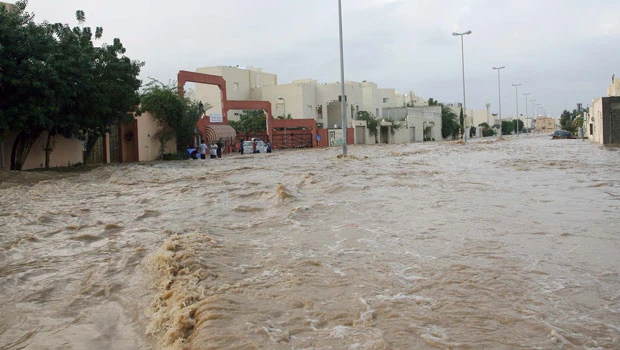
A week ago, the Um Al-Khair check dam failed as many millions of tons of water added its weight to the already flooded wadis in east Jeddah. Palestine Street became the main conduit, sending floodwater into Al-Hamra district. Thousands of homes were destroyed, hundreds of millions of riyals of personal property was ripped away. Lives were lost. Again.
Everything we had built up over 11 years in Jeddah was gone — furniture, clothes and appliances washed away by a flood of stinking, sewage-tainted water. Much of this can be replaced with money. It will not be, of course as the traditional “Insurance Gavotte” and “Actuarial Sidestep,” the legal-but-revolting gyrations of money-men who have already begun with finger pointing and blame being passed from institution to institution.
Things that are — were — infinitely more valuable to our family than physical things are now so much pulp forming the next layer of Saudi Arabia’s sedimentary strata. Every original press clipping and copies of every magazine that I have written for; a decade of pre-digital photographic negatives; odd souvenirs from important people, including a first edition of Wilfred Thesiger’s “My Life” signed for me during the very last interview he ever gave (published in Arab News) just before he died at 93. All pulp.
Yet we are very lucky. My wife survived thanks to the swift action of an anonymous Saudi man — and an old man at that — on Palestine Street who grabbed her backpack as she stumbled into the raging river that previously had been a street. Another man grabbed him and together they hauled my wife out of harm’s way. I owe these modest, brave individuals a debt I could never repay. They didn’t give their names. Instead, they apologized for touching my wife. It is circumstances such as these that polarize people; the best and the worst emerge.
“Apres le deluge, moi,” to turn the phrase around. We survived. There are those who did not. It is not a heroic style of ending to your life to drown in diluted excrement, but such was the fate of too many of Jeddah’s citizens.
Neither did we have to cope with small children distraught at having the security of their homes shattered and then having no understanding of why men in bio-hazard masks were shoveling their toys into plastic rubbish sacks. It is easy to say, as Sartre did, that he did not wish to be possessed by his possessions; it is much harder to understand when you are four years old.
As the cleanup by the compound staff began, another kind of generosity of spirit emerged: Filipino staff selflessly mucked in to clear the villas in 12-hour shifts. Poignantly, they then returned to their wrecked accommodations to put their own shattered worlds back together. Their resolve and unflagging good humor was a lesson to anyone who felt like a little self-indulgent sorrow. I am happy to report that some of our fellow residents noticed this as well and help was freely forthcoming to the staff.
Yet out of the stinking turmoil emerged the unexpected kindness of strangers. A Saudi we barely knew offered the choice of his three cars and a spare villa; another one offered cash. A Yemeni family opened their house to us. A true global compassion flowed with touching gestures from a quiet, phlegmatic Canadian; from the outgoing, “no worries, mate!” Australians; from the neat, organized Dutch; and from understated but solid British offers of assistance. There were others, too; a positive upwelling of genuine goodwill that transcended national and ethnic boundaries.
One no-nonsense Scottish mining geologist, with the determination and build of a tank (and vehicle to match), barged his way with us into the flooded compound on the first day after the flood and unstintingly offered practical help. And one wonderful woman who has had a tough life stretching back to her days as a farmer in Kenya knew exactly what was needed to reinforce the resolve to rebuild.
An hour into our first assessment of the damage, while standing thigh-deep in the disgusting fluid inside the remains of our house, a beaming Indian driver turned up bearing in a plastic bag lined with a pure white-napkin tea, digestive biscuits and a box of Harrod’s finest chocolates.
Strangely, we had to learn something about sympathy and goodwill as well. Many people called to ask how we were doing — was there anything they could do? The calls were made with the very best of intent and genuine concern and, although unsaid, a feeling of helplessness but a very human need to be involved. We learned that there are times when all you want is to sit quietly, reflect on the scene and marshal whatever emotional reserves you can to build sufficient resolve to tackle the task ahead. Just a little space, please! I learned that takes a very great deal out of you to shovel a decade of the work that defines you into a plastic bag.
This is the third time in two years that floods have devastated parts of Jeddah. In an entirely unsurprising move, insurance companies now throw up their corporate hands and claim “act of God” and therefore denying claims. Whether the rain was the result of climate change or not, I do not know.
But I do know that human beings were very much the agents of this disaster. It was men who built the dam out of sand and covered it with little more than slabs of concrete that couldn’t hold back the deluge. (Any child who has played on the beach knows what water does to sandcastles.) A video showing the weak construction of the Um Al-Khair check dam and footage of the moment the dam failed were posted on YouTube minutes after it happened.
It was also acts of men who failed to ensure that the overflow channels that might have prevented the dam from breaking were not clear.
It was men who did not put in sufficient drainage and pumps to handle the stinking man-made sewage that drowned people and shattered families and homes.
It is men who are held to account for the failures of their infrastructure. And it is men who trusted God but did not tie their camels.