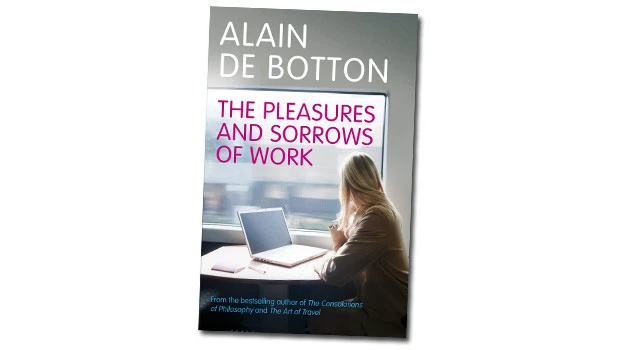
- Alain De Botton is a sharp observer of the way we live.
- He notices the smallest details and detects the slightest changes.
He is the co-founder of the School of Life () and has previously written on important topics that touched us all. His bestsellers include an in-depth case study on why so many of us suffer from anxiety, “Status Anxiety,” and an uplifting lesson on the way to travel, “The Art of Travel,” which have been translated in more than 25 languages. In his latest book, “The Pleasures and Sorrows of Work,” De Botton attempts to understand the relationship we have with our jobs.
Until we retire, work occupies most of our time. We are subsequently, often stressed, overworked and exhausted, and we might not even enjoy our job. Yet, the prospects of losing it are far worse. For the vast majority, financial security essentially depends on a well-paid and secure job.
“The Pleasures and the Sorrows of Work” takes us on a trip around the world. De Botton invites his readers to visit a selected number of workers in their respective working environment. Each one makes up for the books’ 10 chapters, which focus on engineering, accountancy, transport and packaging industry, aeronautics, entrepreneurship, the art of painting and biscuit manufacture.
The opening chapter introduces us to the cargo ship spotters, a hobby predating the habits of modern travelers, according to the author. He admits that he was inspired by these men in order to describe the intelligence, peculiarity, beauty and horror of the modern workplace and to provide us, alongside love, with the principal source of life’s meaning.
One of the greatest contradictions of our times is that unlike our forefathers, who knew the origin of the limited things they ate and owned as well as the way they were produced, we are surrounded by a plethora of items. Yet, we know little or nothing about their manufacture and how they reach us. To make matters worse, most factory workers have such specialized jobs to perform that they don’t even see the object they are making.
Vilfredo Paredo, an Italian economist, wrote a century ago that a country’s wealth would grow if its citizens would forfeit general knowledge and focus on specialized fields. We have indeed reached a point where the division of work is reaching its peak, but is that good? How does it make us feel? A job is said to be meaningful when it gives us satisfaction or helps us reduce suffering in others. Yet, our modern societies are based on economies, which favor trade, luxury and the hoarding of material goods at the expense of the attainment of the pursuit of higher goals.
“Exceptional fortunes are built up in industries with very little connection to our sincere and significant needs … and where we are hence prone to fall into crises of meaning at our computer terminals and our warehouses, contemplating with low-level despair the banality of our labor while at the same time honoring the material fecundity that flows from it,” writes De Botton.
Work defines who we are. We all know that when we meet a new acquaintance, we first tend to ask what they do and vice versa. However, it was not always that way. De Botton lets us know that in the fourth century BC in Greece, the philosopher Aristotle declared that a paid position couldn’t provide satisfaction. To enjoy the higher pleasures of life, citizens need to have a private income and lead a life of leisure. Twenty-five centuries later, thinkers in Europe declared that work is a source of satisfaction. In reality, many of us are not fulfilled by our jobs and we often feel that we have not chosen an occupation that suits our capacities. Tempted to find out the dream work, we often end up in a career counseling office.
The career counselor mentioned in the book, a certain Symons, reveals that most of the people who seek his help are convinced that through some stupid error they missed out on their “true calling.” Nevertheless, he quickly reassures his patients by quoting the psychologist Abraham Maslow: “It isn’t normal to know what we want. It is a rare and difficult psychological achievement.”
However, we often confuse dream and talent and “the great writer, like the contented worker, remains an erratic and anomalous event,” says the author.
Fame, however, does not guaranty happiness. The happiest person in the book, a certain Taylor, is a shop assistant, who paints in his free time. Consumed by his art, he often loses track of time and forgets to eat when he works on his canvas. Creating a work of art with his own hands exudes an indescribable medley of emotions, which the artist imparts to the painting and are subsequently felt by the viewer. A painting can arouse feelings surreptitiously tied to “forgotten aspects of our psyche.”
Even if we do not enjoy our job as much as Taylor, work distracts us and it provides “a perfect bubble in which to invest our hopes for perfection, it will have focused our immensurable anxieties on a few relatively small scale and achievable goal, it will have made us respectable, tired, it will have put food on the table. It will have kept us out of greater trouble,” concludes De Botton.