- CAIRO: Libya’s oil chief said on Monday that production had been cut by around 50 percent, and argued it was “safe” for foreign oil workers to return after a mass exodus sparked by Muammar Qaddafi’s violent campaign to retain control of the country.
The assurances by Shukri Ghanem, the head of the state-run National Oil Company. and Libya’s de facto oil minister, came as uncertainty swirled about the state of the OPEC member’s production and who was actually in control of the brunt of the nation’s oil. Libya sits atop Africa’s largest proven reserves.
The country is the only OPEC member so far seriously affected by the protests in the Arab world, and unrest there has sent shudders through global oil markets.
Ghanem claimed that the government in Tripoli remained firmly in control of the country’s oil installations — from fields to refineries and pipelines. He rejected an assessment put forward by EU Energy Commissioner Guenther Oettinger on Monday that Qaddafi had lost control of the country’s main oil and gas fields.
“He does not control the oil,” Ghanem said, referring to Oettinger.
“You can believe who you want, but I am the chairman of the National Oil Company and I know what we produce,” he said in a telephone interview.
Ghanem conceded, however, that production at some fields, including in the Hamada area, had been halted, but attributed the disruption to the departure of foreign workers.
“Of course there is a drastic cut” in production, he said.
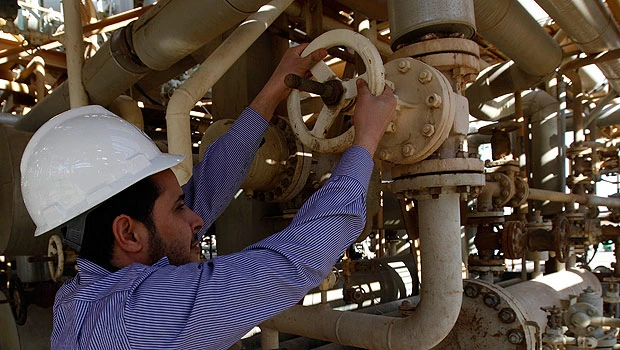
“The main reason for the oil production to come down is the panic of foreign laborers, who felt they had to leave. I think all laborers will be safe if they return.”
The comments came hours after officials in Libya’s east, which has thrown off Qaddafi’s rule, said the Tobruk port had reopened and one China-bound tanker was being loaded with 1 million barrels of crude. Another tanker, destined for Italy, was waiting to pick up its cargo of 600,000 barrels of Libya’s light sweet crude — a refiner’s favorite.
“The terminal (at Tobruk) is working at 100 percent,” Rajab Sahnoun, an official with the Arabian Gulf Oil Company, which is based in the eastern city of Benghazi, said.
Sahnoun also said at least two of the major eastern fields, Sarir and Misla, were still producing, though at slightly reduced capacity. He was not able to say how much production was down at those fields, but noted that the 34-inch pipeline to the terminal was operating normally.
The terminal can store four million barrels of crude, he said.
Another Agoco official, Ali Faraj, who works in the emergency operations room at the facility, said the company’s production of roughly 220,000 barrels per day was largely unaffected.
“A drop of 5,000 or 6,000 barrels per day, in our experience, is not a drop, really,” Faraj said.
Libya produces about 1.6 million barrels per day of crude oil, and about 85 percent of its exports are Europe-bound.
Aside from uncertainty about a drop in Libya’s exports, oil markets are also panicked over unrest in some Arab countries.
The head of Saudi Aramco said on Monday his company had already stepped in to offset the drop in Libyan exports.
But Iran cautioned Riyadh against “hasty” steps by injecting new volumes into the market, the IRNA news agency reported.
Oil markets have rallied over the past couple of weeks and spiked late last week because of Libya.
The Saudi Aramco official's comments on Monday helped cool the futures market slightly, with the US crude futures benchmark holding at around $98 per barrel while its London counterpart, Brent, clung to a precariously high level of $113 per barrel.
The spread between the two contracts reflected the fears about Libya. Crude from that country is of roughly the same quality as Brent, and questions about how much control Qaddafi had over his key export unnerved global markets.
EU Energy Commissioner Oettinger said during a meeting of EU energy ministers on Monday that control over much of the oil and gas fields is in the hands of regional families or provisional regional leaders that have emerged from the revolt and chaos.
But he also spoke out against a proposal put forward by Germany’s foreign minister that the EU should consider a total ban on payments to Libya including for oil deliveries.
Oettinger argued that since Qaddafi already lost much of the control over the oil and gas fields, imposing a ban on oil imports would be bad.
“We’d be punishing the wrong people potentially and we would be discarding the regional aspects if we just stopped imports altogether,” he said. “We might actually be punishing people who have changed their ways, who are acting better.”
Ghanem, Libya’s de facto oil minister, said that tankers were loading at the various Libyan ports — indicating that all were operational though that could not be immediately independently confirmed.
“I cannot say its business as usual, or production as usual,” Ghanem said.
But he stressed that the NOC was firmly in control and coordinating the production, refining and transportation of crude oil in the country.
Ghanem said that for production to return to normal, the foreign workers needed to return.
But international companies, if they haven’t done so already, are still trying to pull their expatriate workers from the embattled nation.
Militias and mercenaries have made travel in the country unsafe, and few foreigners appear inclined to stay in the country to see how the political situation will play out.
Italy’s Eni SpA, which before the crisis produced 244,000 barrels of gas and oil equivalent a day in Libya, about a quarter of the country’s exports, said it was continuing to evacuate its employees.
The company last week announced that supplies of natural gas from Libya, through the Greenstream pipeline, had been suspended.
But Eni said it was able to meet its customers’ demand for gas. Up until the crisis, Libya supplied around 10 percent of Italy’s gas.
Oil workers for Britain’s OPS International oil field services company made it across the Egyptian border in a convoy of buses across the desert late on Sunday night, and another bus full of oil workers reached the Libyan port of Ras Lanuf Monday and boarded a ship bound for Malta, said company chairman Gavin de Salis.
Meanwhile, France’s Total SA said it evacuated all expatriate oil workers in the country, and their families, said spokeswoman Phenelope Semavoine. She said the company “continues to reduce some of our production” of Libya oil but declined to provide more detail.
Repsol spokesman Kristian Rix said on Monday that the company was now “declining to give production figures because the situation is unclear and communications are difficult.”
He said the company was able to get the rest of its employees and contractors out of remote Libyan desert production areas over the weekend. In all, about 200 employees have been evacuated since the crisis began.