- JEDDAH: As sports go, rugby does not have much of a presence in Saudi Arabia, either among Saudis or most expatriates.
- It is either football or, among the south Asians, cricket, or basketball among the Filipinos.
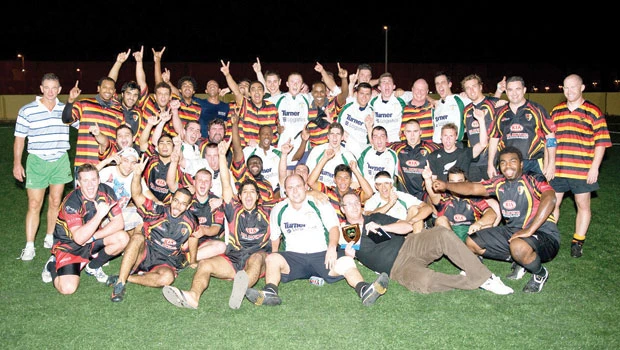
Most people would therefore be surprised to know that there is a Jeddah rugby club and that the sport is taking on among Saudis. They would be equally surprised to know that there have just been a couple of matches between the club and a team from the visiting French naval vessel Mistral.
Given that France is one of the top rugby nations in the world, they would be astounded to know that the Jeddah club surprised the French both times. In both matches, on Sunday and Tuesday, Jeddah Rugby Football Club (JRFC) was represented by a mixed expatriate/Saudi team.
Abdulaziz Al Abdullah, vice chairman of the Saudi Rugby Centre (SRC), said that Sunday’s match was confirmation that young Saudis had both the ability and attitude to play and enjoy rugby. “It was inspiring to see these young men playing a game relatively new to them to take the game to much more experienced players, take the hits and come back to a win and a draw,” he said. “They did themselves and the game a great deal of credit.”
The SRC was formed to attract partners to sponsor the formation of a Saudi national rugby team to compete in domestic, regional and international competitions.
That in itself is an ambition worthy of note as the connection between a small railway town in the English midlands best known as the eponymous source, at the famous public school it hosts, of the game of rugby. Nomadic desert people and a violent contact sport would seem to have little in common. Not so, said Scott McCarthy, chairman of JRFC.
McCarthy viewed the increase of interest as an example of cultural exchange at the most effective level, that of man to man. It tapped the human need for competitiveness and ritual combat. “Any team or contact sport is about competition, winning and establishing some kind of territorial dominance,” he reflected. “Rugby in particular is about allowing that competition with real physical contact but with very tight rules. The game has spread around the world through dozens of very different cultures — I see no contradiction at all in it appealing to Saudis as well.”
Matt Jay, the team captain, said he found that the Saudis he had encountered were very competitive. “That plus the unique camaraderie of the sport,” he said. “The guys are very happy with the strong friendships that come from hard training and playing a very physical and competitive sport together — it seems to fit well in a society that has a culture based on personal relationships, especially family.” He noted that it always surprised the Saudi players how the supporters mixed together and were not separated into partisan groups as in soccer. “Rugby and the people who support it are like a big family and that comes across strongly.”
For many years rugby was strictly an expatriate game, but that has changed over the last few years with the landmark visit of the Saudi Scorpions, several of whom coincidentally went to Rugby school, to the Dubai 7s. Since then rugby has developed in several international schools in Jeddah which has triggered a rapid development of interest in the game from young Saudis.
JRFC regularly fields teams that are more than 50 percent Saudi, as do clubs in Riyadh.
“The likelihood of a full Saudi 15 strong team to compete regionally is still some way off, but there is some very strong talent to make up a Saudi Sevens team from local players across the Kingdom,” said McCarthy. Seven-a-side rugby is an official Olympic sport for 2016 in Rio de Janeiro. “Seeing a Saudi team run out there would be something really special.”
The “Support Saudi Rugby” register is at www.ksarugby.com, where information on matches and training is regularly updated.