- LONDON: When radiation began to waft over the Pacific from Japan’s earthquake-damaged Fukushima nuclear power plant, Russia’s energy industry quietly sensed a windfall.
Russia, with energy resources to spare, is seen by analysts as among the best placed global gas powers to profit long term from Japan’s energy supply shortfall.
“The question marks raised over the future of nuclear energy also make gas a much surer option ... playing to Russia’s advantage,” Thierry Bros, senior gas & LNG Analyst at Societe Generale, said.
“So the first one that’s benefitting from this is Russia, is Gazprom.”
Japan’s supply gap could amount to five billion cubic meters in 2011, and a further 2 bcm the following year, SocGen estimates.
That gap could provide relief, for now at least, for one of Russia’s most intractable energy problems: flagging European demand for gas sold by export monopoly Gazprom.
Sales in Russia’s most lucrative export market slumped after the 2008 crisis as Europe’s economies contracted and consumers switched to cheaper alternative supplies, pressuring the link to oil prices written into Gazprom’s long-term supply contracts.
Even if Japan’s nuclear disaster fails to scare European countries away from nuclear power, it may help Russia fight the biggest spoiler for Gazprom in Europe: super-cooled liquefied natural gas (LNG) from exporters such as Qatar.
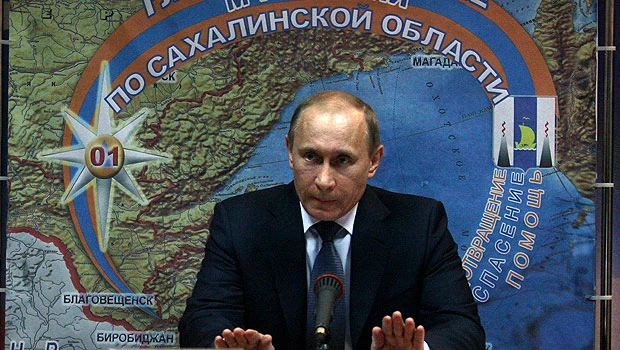
Russian Premier Vladimir Putin quickly stepped in with a fix aimed at helping to restore both Japan’s energy supplies and Gazprom’s dominance in Europe.
Putin offered Europe extra supplies through its network of export pipelines, allowing LNG suppliers to send their cargoes to Japan instead and enabling Gazprom to fill the gap.
The European Union has said the offer should be considered on a commercial basis, but Russian and European gas industry executives say it could make sense.
And if that comes to pass, Gazprom — wary of Europe’s competitive gas markets and struggling to defend its long-term supply contracts — could even enjoy a price-setting role on the spot market.
For now, Russia can act only through Europe, which is linked to its West Siberian production base by the umbilical cord of its westward-facing pipeline network.
But the world’s largest energy producer has energy reserves to spare almost within sight of Japan off of the Pacific island of Sakhalin. It has more gas in eastern Siberia, and has been waiting for the right moment to start developing those resources for Asia.
Industry sources say the Fukushima disaster could serve as a catalyst for new export corridors to the east, either via new pipelines or new LNG projects, although these projects would take up to a decade to complete.
“There is a realization within Gazprom, within other Russian oil and gas companies, that China is the biggest game in town,” Chatham House analyst Charles Emmerson said.
“A few years ago the idea of producing LNG, particularly in the Russian Arctic, was that it would be exported to the US. Perhaps now that would be exported to China instead.”
Beijing, which has driven a hard bargain with Moscow in price talks on future gas deliveries, must now confront the prospect of Russia’s eastern energy riches going to its Pacific neighbor and rival for resources.
“There is not a speedy solution,” said Alistair Ferguson, executive vice president for gas development at Russia’s No. 3 oil company, TNK-BP. “But the environment is now better than it has been in the last 10 years.”
The Fukushima shutdown, combined with the loss of Libya’s energy exports as a rebellion engulfs the North African energy exporter, is also a political windfall for the Kremlin a year before a presidential election.
In combination, they have sustained oil prices over $100 per barrel, helping the government toward a balanced budget and leaving room to hike spending as the March 2012 poll approaches.
But they also threaten to bolster Russia’s political and economic weaknesses for a little longer.
The World Bank on Wednesday warned that oil is driving Russia’s economic recovery but fueling inflation, while a poor investment climate is dragging down growth.
“While the Middle East and the post-Fukushima fallout are going to boost the attrractiveness of Russian national resources, especially gas, Russia needs to do more to insure investors’ rights and the rule of law,” said Ariel Cohen, senior research analyst at the Heritage Foundation in Washington.