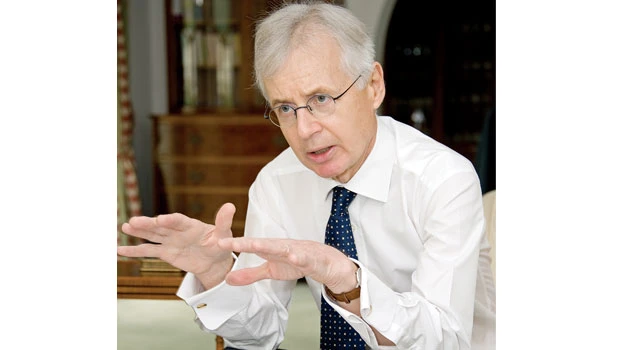
- JEDDAH: The political upheavals in the Middle East should not be regarded as all one and the same according to the British Ambassador Sir Tom Phillips.
There are common issues but each situation has to be evaluated separately. “Egypt is not Tunisia is not Yemen is not Bahrain is not Libya,” he said in an interview, marking his first six months in post.
Phillips warned that in the current preoccupation with the upheavals there was a danger of letting Palestine and Iran drop from view. Despite what is happening in the region there was still a “need to move forward on Palestine,” he insisted, and not to lose sight of the dangers of the Iranian nuclear program.
Although the situation in each country had to be evaluated separately, Phillips stressed the significance of high unemployment and large young populations, and concern about corruption, as important common factors driving events. The one common conclusion that could be drawn from the uprisings, he said, was that governments need public consent to rule.
In the case of Libya, where the UK took an early lead with France in opposing the regime of Muammar Qaddafi and supporting the Benghazi-based opposition, the British government had no intention of trying to dictate what should happen in a post-Qaddafi settlement. “The people of Libya must choose their own government,” the ambassador insisted. But it was difficult to imagine that they would be free to do so while Qaddafi remained in power.
He was keen to stress that Britain had no hidden agendas. Its stand on Libya, he said, had been part of the regional and global response to Qaddafi’s attacks on the Libyan people. In helping frame UN resolution 1973 authorizing a no-fly zone and all necessary means to protect Libyan civilians, Britain and France had responded to the Arab League’s specific request for such international action. The two countries had cotabled the draft resolution with Lebanon and the US. The UK saw collaboration with Arab governments as vital in its response to current events in the region. In that context Libya had, he said, been “very much on the agenda” in talks in London between UK Prime Minister David Cameron and Saudi Foreign Minister Prince Saud, four days after the British, French and Americans started taking on Qaddafi’s forces.
As regards the situation in Yemen, the UK saw it as different from what is happening in Libya. As one of the cochairs along with Saudi Arabia of the Friends of Yemen group set up to aid political and economic reform in the country , the UK took a “strong interest” in the country according to the ambassador. There were cogent reasons for concern — security concerns because of Al-Qaeda’s presence; humanitarian worries; and the fact that Yemen bordered two of the UK’s major allies in the region — Saudi Arabia and Oman. Nonetheless, the British saw reasons to hope that political stability could re-emerge. There had to be a “peaceful transition”, Phillips said. “We want to see a dialogue there”.
It had been intended to have a Friends of Yemen meeting in Riyadh in March he said, but events in the country overtook it. Nonetheless, Britain’s hope was that dialogue between the government and the opposition could still happen. That was “very important”, he said.
As to the situation in Bahrain, the British also saw dialogue as the answer. The communal divide made matters difficult but the authorities there had “a responsibility” to protect all the citizens. They also had a “legitimate right to ask its neighbors to come in and help it.” Now that that had happened, the UK’s hope was that a momentum could be developed “to get dialogue back on track”.
The situation in Saudi Arabia was very different, the ambassador said. There were reforms and there was dialogue between the governing and the governed. Phillips pointed to the National Dialogue as part of that. Equally important, in Saudi Arabia there was popular consent to the system of government. “There is an implicit contract between the Royal family and the people,” he said. It was based on consent — and “not seriously challenged”. It could be argued that the system “has to develop”. But Custodian of the Two Holy Mosques King Abdullah was “on the path” of reform. He believed there would be further developments. “ I am confident that the Saudi government will continue to meet the aspirations of the Saudi people,” he said.
Phillips’ view as to whether the British public had a clear understanding of Saudi Arabia beyond the image of an absolute monarchy presented in the UK media was that more needed to be done. He pointed out that there were many good people-to-people contacts, mainly as a result of Britons working in or doing business with Saudi Arabia, and Saudis visiting the UK or living there. But the effect was limited. He felt there was a need for “greater understanding”.
It is six months since Phillips moved from Tel Aviv to Riyadh as the UK’s ambassador. It had been a “fascinating time to be in the region,” he said. It had also been “a privilege to serve in Saudi Arabia.” The Kingdom was “a key strategic partner in the region” for the UK, he said. He pointed to the strong trading relationship but stated that ties went far deeper. Saudi Health Minister Dr. Abdullah Al-Rabeeah’s visit last week to London where he signed a memorandum of understanding with his British counterpart Andrew Lansley and, at the same time, British Energy Minister Chris Huhne’s presence in Riyadh were evidence of that. So too was the fact that last year about 100,000 UK visas were issued to Saudis, with them able to apply for ten-year multiple entry visas. Among the Saudis heading to the UK were students in record numbers.
It is a multilayered partnership. There was evident ambassadorial confidence that it would long remain so.