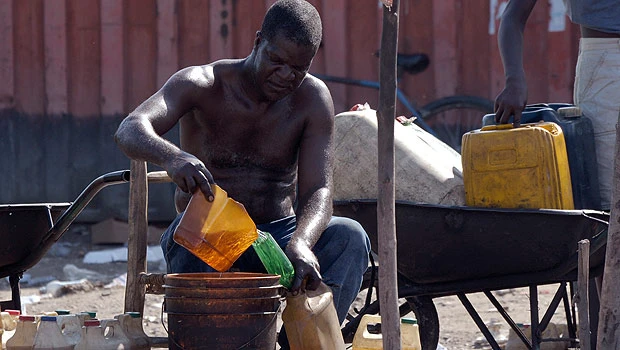
- MIAMI: Higher global oil prices are squeezing economies and family budgets in the Caribbean, one of the last regions in the world still struggling to bounce back from the global financial crisis.
Few Caribbean countries, most of them small, fragile and import-dependent, are oil producers, and sharp increases in oil prices send shudders across a region that spends billions of dollars a year on energy imports.
The recent climb in oil prices could put at risk the Caribbean’s hope of ending a lengthy economic slump from which only a handful of its countries have emerged.
“It is a troubling scenario,” said Heather Berkman, an analyst at the Eurasia Group risk consulting firm.
As in other parts of the world, rising gas prices are weighing on the lives of ordinary people across the region from Haiti to wealthier countries like Barbados.
In Haiti, which was battered by a devastating earthquake last year and where most people live on less than $2 a day, the cost of a gallon of gas has shot up to nearly $5.
“When I stop in traffic, I turn off the car to save gas,” said Adler Jean-Jacques, a 40-year-old school teacher in Port-au-Prince.
“I don’t turn on the air-conditioning — even though it’s hot.”
The higher prices come as many Caribbean nations are hoping their financial health will finally improve after several years of shrinking economies, budget deficits and ballooning debt loads.
Caribbean economies initially withstood the impact of the worldwide recession since many are not as financially integrated with the global economy.
But as economies in much of neighboring Latin America recovered, the Caribbean struggled because of its deeper ties to Europe and the US, the primary sources of remittances and tourists. These are the backbone of most Caribbean economies.
At the height of the financial crisis, several bigger economies like Jamaica and Dominican Republic were forced to seek help from the International Monetary Fund.
Prolonged high oil prices may push some cash-strapped countries to seek additional help from multilateral lenders or issue more debt to close financing gaps, Berkman said.
Dominican Republic, one of the Caribbean’s biggest and most diversified economies, has proven to be the region’s standout. In 2010, its economy expanded more than 7 percent and the government expects growth of at least 5.5 percent this year.
But the rise in oil prices is expected to force it to spend more on subsidies for its troubled electricity sector, further straining the country’s already fragile fiscal accounts.
Dominican Republic’s citizens also are feeling the pinch of higher gas prices.
“My family budget is being severely tested,” said Carmen Cabral, a state worker in the capital Santo Domingo.
The increased prices have led to calls for some Caribbean governments to lower taxes on gasoline and other fuels, a challenge as many try to narrow financing gaps.
Transport workers in the Dominican Republic recently threatened to hold a nationwide strike over fuel taxes but eventually relented after President Leonel Fernandez agreed to to make available more diesel fuel.
Last month, after protests by opposition groups and trade unions, Jamaica’s government was forced to lower an ad valorem tax on gasoline.
Oil imports will make up nearly a quarter of Jamaica’s budget this year with the government expected to spend about $1.6 billion on them.
“We need to find a way to wean ourselves from a single energy source,” said Patrick Dallas, a Jamaica-based economic analyst.
In Puerto Rico, which remains mired in recession, officials on the US Caribbean island also are trying to find ways to ease dependence on oil.
Every steep increase in world oil prices in the past 40 years has pushed the Puerto Rican economy into recession and it has failed to make up the lost ground even after prices came back down, said Elias Gutierrez, an economist at the University of Puerto Rico.
The one country that may benefit from higher oil prices is Trinidad and Tobago, the Caribbean’s leading oil and natural gas producer.
But Dr Dhanayshar Mahabir, an economist at the University of the West Indies, said its impact could be limited since Trinidad’s oil output has slumped in recent years.
“It is good news because we are an oil producer but the good news is tempered by the fact that oil production has been declining over the last three years,” he said.