- Celebrities always help create awareness,” avers Hatem Alakeel, the young Saudi designer behind the TOBY line of thobes.
- He is also the creative genius of the much-celebrated PEACE bracelet, which is adorned by many wrists from the bigwigs of the international entertainment industry to royalty, socialites and fashion-forward regulars across the continent and beyond.
“I always wanted to do something to give back to society. When the floods happened in January, we were all very hopeless. Schools like Dar-AlSalam and the Bangladesh International School English Section Jeddah (BISESJ) were severely damaged and needed to be taken care of,” he said.
This spurred him to develop the TOBY PEACE PEOPLE SERIES under the TOBY PEACE PROJECT banner, a homegrown initiative to raise funds for international children’s charities, along with Lulu Al-Sabah, founding partner of JAMM ART.
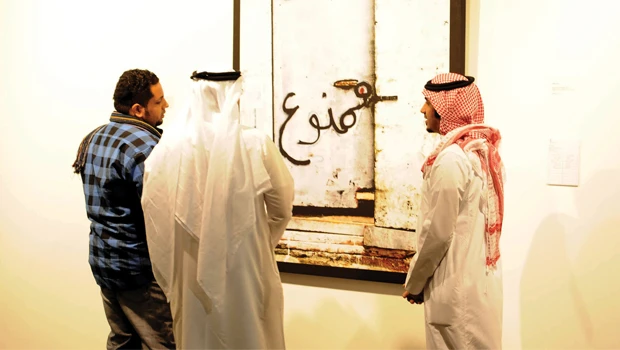
Their first creative/artistic project commenced last week at ATHR Gallery, rallying the support of emerging and celebrated Middle-Eastern artists in the likes of Michel Haddi, Reem Al-Faisal, Ibi Ibrahim, Joanne Tolner, Sara Bin Laden, Sina Ata, Aya Haider, Helmy Al-Sagaff, Sueraya Al-Shaheen and Sheikha Lateefa Bint Maktoum. The artists’ photographic works were auctioned to raise funds for the refurbishing and complete renovation of schools devastated in the floods caused by the torrential downpour last January in Jeddah. Ten percent of the proceeds from the auction will go to the Palestine Children’s Relief Fund.
“We are hopeful in raising a substantial amount to really help these schools, but I also want this to be the first step of many more events to come. It’s important to maintain a momentum, so that it just doesn’t happen once and remains a forgotten cause,” stated Alakeel.
BISESJ was tagged off by the Ministry of Education as one of the worst hit schools in the city, necessitating complete relocation that could amount to four million Saudi Riyals in setup and furnishing charges.
“Our school belongs to a very humble community. It’s not that we want to go out and look for charity, but the picture is very bleak. The devastation was nothing like how I imagined. I don’t even know how to gauge it,” said Dr. Nawell N. Mossalli, Principal of BISESJ.
“We received tremendous support from the parents and school faculty. The experience has brought us closer together as a community. The British Continental School has been especially generous by donating books and Basateen Compound provided us with some furniture,” she added.
The management undertook formal logistics by approaching the insurance company but does not expect receiving financial aid anytime soon or at all and had to resume routine functioning in either case.
Reem Al-Faisal, a self-professed Islamic artist and one of the exhibiting photographers said: “An artist’s work can affect the society either by inspiring and uplifting them or it can do the contrary. It can unveil a truth or spread lies.”
She is of the opinion that art can only arrive from the inspiration of the divine, and that realization brings the awakening of social responsibility.
“The concept of ‘sadaqah’ or charity is basically looking out for each other and supporting the community. It’s our seventh pillar. This shouldn’t just be an event; it should be a daily obligation.”
While most buyers were present at ATHR gallery on the first and second night of the auction, overseas bids for the photographic works were placed via e-mail and phone.
Lulu Al-Sabah who hosted the auction said: “The event is a success and we are very happy with the turnout and the positive response that we have received. Most importantly, it helped raise awareness, and that was the prime objective.”
“Our expectations were met. But, in such events you always hope for more. I think that the society is really not yet aware of the importance of supporting causes through art. We are still at the beginning of this awareness”, said Hamza Serafi, co-founder of ATHR gallery.
The auction may have scored brownie points by harnessing the support of buyers and serious art collectors from both Saudi Arabia and the Gulf (mainly Bahrain, Kuwait and Qatar), but it deeply underscored on raising the bar a little more than the market value placed on the photographs. It generated a total sale of just over SR 75,000, excluding post-auction sales and other donations.
“Yes, we raised money and we thank the people who participated in the event, but we wish that in the future they will be more enthusiastic and understand the idea of hosting an auction to support social causes, ” added Serafi.
Primarily with foreign buyers expressing interests in procuring art by Middle-Eastern artists, the novelty of art collection and appreciation may still seem in its nascent stages here. However, it is definitely going to show signs of developing, especially as the past year saw a tremendous emergence of local art onto the international scene.
“Art has no nationality, no borders,” quipped Hamza Serafi. “The base for Saudi art seems to be firmly planted now and people are slowly going to realize the value and role that art can play in society.”