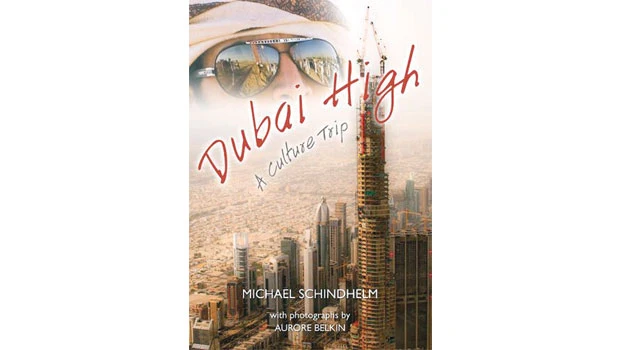
- A lively, sharp and humorous account of the author’s life in Dubai in 2008
The meteoric growth of Dubai leaves no one indifferent. In less than two decades and with billions of dollars, Dubai became a center of global commerce, a top tourist destination and a shopper’s paradise. However, Dubai’s ambitions to also develop into a cultural hub were seriously challenged by Abu Dhabi’s plans to open two museums in the Saadiyat Cultural District in cooperation with the prestigious Louvre and Guggenheim Museums.
When the author, writer and theater director, Michael Schindhelm, was appointed in 2007 as consultant on a projected opera house by the government of Dubai, it is obvious that government officials, were looking for a way to outshine their neighbor (despite claims that there is no rivalry between both emirates). Several months later, at the beginning of March 2008, Schindhelm was named director of the newly founded Dubai Culture & Arts Authority. Finally, on March 26, Sheikh Mohamed bin Rashid Al-Maktoum, the ruler of Dubai, presented the gigantic cultural development project: “Khor Dubai.” Plans for this mega-cultural zone included one opera house, more than 10 museums, 14 theaters, 11 galleries, nine public galleries, 72 cultural icons and seven cultural and arts institutes for local and foreign artists.
“Dubai High, A Culture Trip” by Schindhelm gives a lively, sharp and humorous account of the author’s life in Dubai in 2008. Written in the form of a journal, the book monitors Dubai’s dizzying descent into its worst financial crisis. As a result, a number of the cultural projects created by Schindhelm were put on hold.
This book, translated from the German original, “Dubai Speed,” focuses on the present moment of an extraordinary city where the fast pace of life tests people’s self-control to the limit:
“Roads are upgraded and new ones built as such speed that a GPS system is of little use. Maps are outdated as soon as they’re published… This is a city in frantic motion. It’s not just a race against time, it’s an objection to it. The people here really do live 24/7. Everything is in transit, taking off, on the move. People live and work on the go, they earn money on the go and spend it on the go.”
It is difficult to believe that the development of modern Dubai began in 1971 when the British withdrew and Dubai joined Abu Dhabi, Sharjah, Ajman, Fujairah, Umm Al-Quain and Ras Al-Khaimah to create the federation of the United Arab Emirates. Within 20 years of intensive development, Dubai became the third most important re-export center in the world right after Hong Kong and Singapore.
Thanks to a visionary leadership, high quality infrastructure, no taxes on personal and corporate income and low import duties, Dubai turned into a thriving business center. Foreigners enjoying its expatriate-friendly community have one thing in common, says the author: they are “transient” and always “on the move.”
“There is neither the opportunity nor the incentive to assimilate. Contemporary migrants are not only wary of committing themselves irrevocably, but are unable to do so. Everyone here lives in a state of impermanence, prepared to leave at a moment’s notice. This city has nurtured a new breed of economic nomad who, by choice or necessity, is constantly in transit, looking for the next best thing, as a way out of hardship or to get rich quick. Dubai’s legacy to the cities of tomorrow will be its people, a generation of culture hoppers,” writes Schindhelm.
After just a month, on Feb. 8, 1988, the author wonders whether cultural development is possible amidst such artificiality. A week later, he struggles to find time in a city always fleeing the present and rushing into the future. As the days go past, Schindhelm realizes the gap between his employers’ concept of the arts and his own.
In September, he is told that museums have to be developed as profit-making enterprises. In short, a museum has to make money. Although Schindhelm disagrees profoundly, he acknowledges that Dubai rewrites the rules and wants to show how culture can be built without financial support as if to prove that something that is not profitable in the West can be reinvented as profitable.
By November, signs of the crisis are ominously visible:
“Abandoned cars, apartments, buildings, boats, evacuated offices and silent accounts: these days, the siren song of capitalism might be playing everywhere on the globe but nowhere it is more raw, honest and radical than here. The city has gorged itself on whatever it could gulp down. Now it’s spitting it all back out: businesses, materials, people.”
Despite conflicting views over the nature and purpose of the arts, Schindhelm acknowledges his fascination for Dubai. He is also convinced that the Gulf States offer some hope as a political and social alternative whose success will depend on an open dialogue. Most of all, the Gulf States can play the role of a cultural bridge leading to a better understanding between the Arab world and the West. “Dubai High: A Culture Trip” offers an eloquent and above all an intelligent portrait of one of the world’s most astonishing cities.