
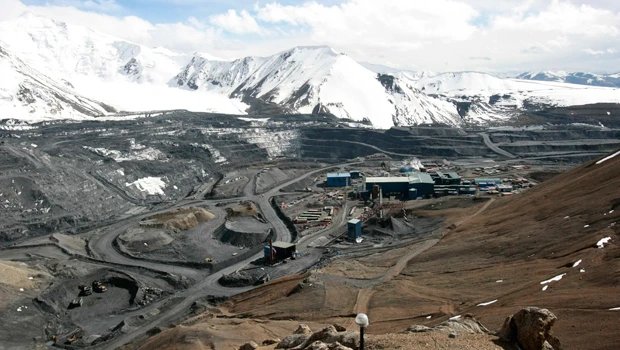
- BISHKEK: The leader of Kyrgyzstan’s coalition government vowed to weed out corruption in the mining sector to ensure proceeds from lucrative mineral deposits are used to rebuild the economy of the volatile ex-Soviet state.
Prime Minister Almazbek Atambayev, forecasting a return to growth for Kyrgyzstan’s economy this year, said the government would hold transparent auctions and tenders to allocate deposits of gold and other metals.
“We will make sure that deposits do not fall into the hands of swindlers,” Atambayev told Reuters. “From now on, all of Kyrgyzstan’s riches should be used not to line the pockets of certain families or leaders, but for the people of Kyrgyzstan.”
The fragile coalition government is now striving to subdue political rivalries and entrench the first parliamentary democracy in Central Asia, after a year in which the president was deposed and ethnic bloodshed killed more than 400 people.
It has pinned much of the blame for the country’s economic travails on the regimes of the first post-Soviet leader, Askar Akayev, and his successor, Kurmanbek Bakiyev, who was driven from power by a revolt on April 7 last year.
“Licences handed out for silly money, for $7, have been used for the sole purpose of resale. We will stop such outrages,” Atambayev said in an interview late on Friday.
“From now on, all licences will be distributed honestly and transparently at auctions or tenders, with the participation of parliamentary deputies and the media,” he said.
Kyrgyzstan’s economy relies heavily on production from the Kumtor mine, owned by Toronto-listed Centerra Gold. An agreement drawn up in 2009 under the Bakiyev government secured a 33 percent stake in Centerra for state company Kyrgyzaltyn. The state’s holding in Centerra entitled it to a $33 million payout when the company paid a dividend of 40 Canadian cents per share in May, including a special dividend of 30 Canadian cents to reflect higher production and gold prices.
This represented an eightfold increase on the previous year, Atambayev said.
Atambayev said he expected Kyrgyzstan’s gross domestic product to expand by more than 6 percent this year, reversing a 1.4 percent decline in 2010.
The International Monetary Fund is forecasting 5.0 percent GDP growth and the European Bank for Reconstruction and Development 3.0 percent for Kyrgyzstan this year.
Official data show Kumtor contributed 9.4 percent of Kyrgyz GDP and 48.4 percent of industrial production last year, compared with 2.7 percent and 20.8 percent respectively in 2007.
In the first four months of 2011, the percentages rose to 15.2 percent of GDP and 56.8 percent of industrial production.
“It’s a shame that this project has, from the very beginning, provoked many arguments,” Atambayev said. “It’s also a shame that for all these years most of the proceeds have not gone into the budget and not gone to the people of Kyrgyzstan.”
But he believed the situation was improving, he said, adding that Kyrgyzstan will increase its representation on Centerra’s board to three directors from two and will be able to nominate a company vice-president. Atambayev said his government, which has formed a commission to look into Kumtor’s operations, would seek to resolve any issues that may arise through negotiations. “We must respect our international agreements,” he said.
“All of our actions must be within the framework of legislation,” he said.
As well as gold, Kyrgyzstan holds significant reserves of copper, mercury, rare earth metals and coal, many of which have been explored by Soviet geologists.
The government is preparing projects to attract foreign investment in two coal deposits, Kara-Keche and Min-Kush.
Atambayev said that, in addition to mining, the government planned to create jobs in the clothing and hydroelectric power sectors to reduce the economy’s dependence on remittances from up to 800,000 citizens working abroad.
Last year, remittances contributed $1.7 billion to the national budget.