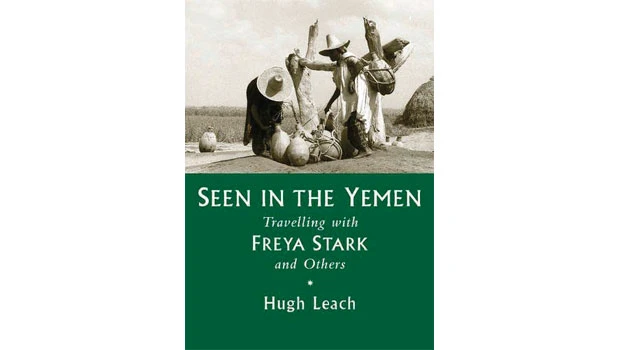
- ‘Seen in the Yemen’ is a tribute to Stark and an ode to the beauty of the Yemen
With Yemen very much in the news these days, Hugh Leach’s newly released book, “Seen in the Yemen,” offers the perfect introduction to a country still largely unknown.
The stunning photographs and the text, both, evocative and informative, create a magical blend, which truly brings out the spirit and beauty of this ancient land. This book exudes an atmosphere reminiscent of Freya Stark’s captivating travelogues. Leach is particularly fond of “Seen in the Hadramuth” (published by John Murray in 1938), a book which “not only breathed but, on being opened, but spoke.”
At an impromptu meeting at her Italian home in Asolo in the autumn of 1975, the 82-year-old Stark learns from Leach that his next posting is to Sanaa. The mere sound of the name rekindles her love for a life of adventure. The urge to relive the memories of her previous visit to Yemen in 1940 remains unabated, and with hardly any prior notice, she arrives in Sanaa the following year for two subsequent visits. In a letter following her first visit, she not only thanks her host, Leach, for the best holiday ever, but also tells him that she wants to return to improve her Arabic and “feel young again.”
Stark’s impressions of that second return visit to Yemen are expressed in her letters to the author where she reminisces “those lovely days” stating: “It all seems like a beautiful dream, those weeks in Arabia.”
Incidentally, Stark continued traveling. In 1977, at the age of 84, she was filmed by the BBC on a leaking raft, slowly sinking in the Euphrates. And, four years later, she was also caught on camera, riding a mule into the Himalayas via Langtang to the Tibetan border!
Sadly, the project of a book with the photos that Stark and Leach took on their journeys together, never materialized. Dame Stark died in 1993 at the ripe age of 100, but Leach never gave up on the idea: “I wondered whether this might be a last chance to resurrect the “Seen in Yemen” project, using my own photographs but dedicating the book to Freya,” writes Leach.
We are grateful that William Facey not only understood the author’s desire to emulate Stark’s classic, “Seen in the Hadhramut,” but also envisioned the book’s singular character and its originality. “Seen in the Yemen” is a tribute to Stark and an ode to the beauty of the Yemen.
Leach prefers black-and-white photographs to color photographs because he believes that “our imagination is stifled, stolen or supplanted when the eye is offered images brighter and glossier than reality…Those black-and-white photographs…conjure up a far more evocative image of distant lands than any modern color print.”
“Seen in the Yemen” oozes with life. The author has of course pictured the amazing architecture such as those extraordinary towers predating our modern skyscrapers and Bait Baws an astonishing village built on the crest of a rocky cliff and much more. Yet, I am mostly touched by that elusive present caught on paper, those timeless “instants of life,” showing people in their daily activities.
“The Winnowing Millet” shows the ancestral gestures of winnowing. The camera captures the movement of dried millet tossed into a gentle breeze, which surreptitiously blows away the chaff, leaving the grains de-husked.
I am also moved by the photograph of the old man carrying his bed on his head and a kettle in his hand. Is he on his way to meet some friends? The author usefully explains that beds in the region of Tihamah seem a personal possession, and men are often seen carrying them from one house to another.
There are also lively market scenes. In the mountain village of Thila, we surprise a vendor counting money and stretching his hand out asking for more. We also follow Leach in the beautiful village of Zabid. The rope and basketware shop is filled with what we now call, “eco-products,” such as eating mats, baskets woven from the fronds of the doum palm or from long grasses found in the Wadi Mawr.
I am also mesmerized by the beguiling picture (Stark’s favorite) of a woman gliding through a narrow alleyway lined with a most attractive brick wall embracing all the houses. Inspired by this photograph or the beauty of Zabid or both, Leach describes, with such perfection and so few words, the enchanting atmosphere, in the accompanying text. Affected by the town’s feminine character, he praises the beauty of Zabid:
“I suspect you are too coy and modest to think about it… There is a sort of faded grandeur about you but an activity that belies your age…Last night we slept out on one of your roofs and heard the gentle throbbing of distant water pumps. Soft sounds came from the house below. A girl’s laughter; the mother of the house gently chiding those in it, maybe for not hurrying to the evening meal. The Idhaan came and faded, occasioning a padding and shuffling in the streets…I slept contented feeling I was among friends, and woke only when a young man in the courtyard below made his dawn reading from the Book,” writes Leach.
From her first trip to the Yemen in 1940, Stark brought: The discovery of the site of ancient Cana, a valuable Arabic manuscript, silk gowns and daggers. True to her eccentric nature, she also packed a lizard, 13 inches long with blue gills and a crest like a dragon. She called him Himyar and fed him colorful and fragrant flowers particularly nasturtiums and violets. Crazy about this ugly creature, the flamboyant Stark took it everywhere, draped around her neck or kept warm under her jacket, causing surprise and panic when she traveled by train or went to restaurants!
No sign of a lizard in “Seen in the Yemen,” but the author’s symbiotic relation with this fascinating country gives us a stirring depiction and an amazing insight into this ancient land of the Arabian Peninsula.