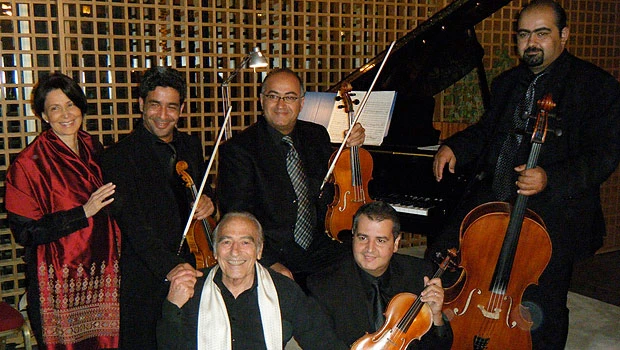
- Franco-Argentinean Maestro Miguel Angel Estrella is a world famous pianist who transformed the art he was best at, music, into a useful way to help people in need.
In his first visit to Saudi Arabia, the maestro performed three unique recitals at the French Embassy in Riyadh on June 8, 9 and 10.
Not only did people enjoy suburb music, but the event also turned into a good occasion. Maestro Estrella, who is also the Honorary President of the French Charity Association, “A Child, a Promise” was presented with a check for the amount of SR375,400 by the French Ambassador, His Excellency Bertrand Besancenot. The amount will be donated to Tania Sfeir, President of the charity association.
“A Child, a Promise” has been very active in Palestine for the past eight years. The funds will be used to build recreation centers in Gaza and West Bank refugee camps where Palestinian children will be offered educational help and psychological counseling.
Difficulties faced during the years of Argentinean dictatorship have turned Maestro Estrella’s innate sensitivity towards people suffering into an even more passionate desire to bring his music to world areas afflicted by international tragedies.
In the following interview, Maestro Estrella not only reveals more about his exceptional life, but he also inspires us to reflect on the purpose of human existence: sharing love.
My father was of Lebanese origin — Najem — and the Arab world had a strong presence in our education. It was completed when I met President Arafat at UNESCO in 1988. Since then, I gave priority in my concert tours to Arab countries. In that year of 1988, after a visit to a Palestinian camp, I made an improvised and unauthorized recital. It was during the blessed month of Ramadan and I spoke at length with several young couples who had many children. I then became aware of the Palestinian tragedy in the occupied territories.
Regarding Saudi Arabia, I have a colleague at UNESCO, a friend and poet, Saudi Ambassador Ziad Aldrees, with whom I share great affinities. His friendship made my desire to visit Saudi Arabia even grater.
There are too many and they change at different stages of my life. A constant in my life though is Johann Sebastian Bach, but I could not live without Beethoven. The same goes for Chopin, Brahms, Ravel, Fauré, Bartók, Mozart and many others that surround me... I am voracious about music and I'm passionate about popular music.
Since my childhood, solidarity was a constant practice in my family, especially towards poor people. My mother, a rural teacher, would bring youngsters from very poor backgrounds to live with us. My father, a poet, used to write along with other artists plays for puppet shows and took us to rural areas where they had never encountered the magic of them. I had a little toy piano and I invented music for the characters in the story they played. I was then between seven and 10 years of age. As a young man, at the age of 21, I used to go with Martha, my late wife who was a soprano opera singer, to make music in shantytowns and native communities. At 25, we were rebels against business music enterprises, so we decided to be "Social Musicians" while we worked in our international place as soloists. Business organizers wanted to "sell" us as the ideal couple, which we fully rejected. At 26, we traveled to France to pursue higher education. In that year of 1965, we learned about an important step made by the Church: Vatican II: option for the poor.
Since 1981, after my release, my action was always within Music Hope: 50 concerts per year for solidarity and 50 for living. We never got involved with commercial agencies and thus reaffirmed ourselves as social musicians.
For me, Che Guevara is a mixture — a collection of native leaders such as Tupac Amaru and great patriots who liberated the Latin American people, such as José de San Martín, Simón Bolívar, Francisco de Miranda, Sandino, Artigas, as well as major religious symbols like Jesus, the prophet Mohamed, Romero and Don Helder Camara. In short, there was love in Che, thirst for righteousness, rebellion and total devotion.
The Orchestra for Peace brings together the sons of Abraham. It is one of the best youth orchestras in the world. In addition to its artistic dimension, the Orchestra's musicians give testimony of how enriching a coexistence of different cultures and religions can be. They successfully perform at big and important venues, but they also dialogue with the public. Dialogue and music are also brought into poor communities of Europe, in schools, colleges, universities, hospitals, prisons etc. One of the richest experiences was in Brittany: the two universities in Rennes and the City Council, along with Music Hope and the Argentinean Embassy at UNESCO that I head, organized a mobilization of nine months around peace. Children, teenagers and college students were involved, as well as the entire association collective in the region, local press, etc.
For the last eight days, the Orchestra for Peace was invited, as well as a great number of witnesses from all over the world. Their messages and the Orchestra's music flooded Brittany. An amazing public accompanied all this. On the eve of the last act, something extremely unusual took place: the Jewish community in Brittany went for the first time to a mosque, loaded with gifts for their Muslim brothers. The next day, the Muslims organized a large couscous meal and invited their Christian and Jewish brothers and gave them gifts. This what we “gave birth to” after nine months.
So far, we have not succeeded. Last year, we almost did it in a festival of coexistence, but there were economic problems as well as political ones.
I appreciate very much the musical work and the contribution of ideas brought by Daniel Barenboim, which added to wide media coverage. As I said, I started to work on the construction of the Orchestra for Peace in 1988. Arafat then told me: "The idea is wonderful but it will not be easy. Always talk about the Orchestra with the children of Abraham, this will make negotiations easier."
I paddled for 10 years, and in February 1998, Federico Mayor, Managing Director of UNESCO, held two days of "Music and Peace", bringing together about 30 musicians from all over the world. I presented eight “Music Hope” programs, which were approved unanimously. My colleagues picked two of them as “Leading Programs for the XXI century:” the Orchestra for Peace and the Development of Social Musicians. On this occasion, I wrote to many of my fellow Christians, Jews and Muslims colleagues. I reiterated my mail to Barenboim three times, but he never replied. Shortly after, he created his orchestra. Many musicians play in both orchestras: his and the Orchestra for Peace of Musique Espérance.
This conflict has been going on for too long and has shed a lot of blood. Latin America has taken the first step for a Palestinian state. I think it will be joined soon by the European Union, Inshallah! Unfortunately, despite his determined position in favor of a Palestinian state, Obama has backed away many times. This long-lasting tragedy in a country under occupation must end. I hope that honesty will guide us to a Palestinian state with the 1967 borders and security for Israel.
I understand the situation of millions of youngsters humiliated by poverty and unemployment. I hope that the leaders who emerge from these movements are consistent with what young people ask. It is a movement for a fairer world; it doesn't belong to any religious fundamentalism or to the military. It is ours, men and women, who want to live without discrimination, in peace and freedom.