- JEDDAH: Prince Sultan bin Salman, president of the Saudi Commission for Tourism and Antiquities (SCTA), recently said that the time had come for restoration of Jeddah’s historical Balad quarter.
“This is the time for action, not for talk,” the prince said at a meeting last week, adding that agreements between the municipality and the company needed to be signed quickly.
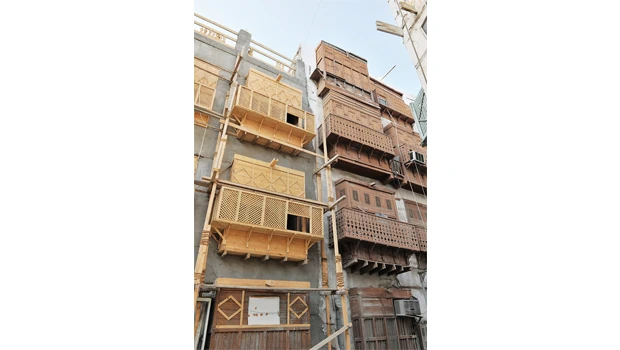
It seems that Prince Sultan’s words have been turned into action in remarkably short time, as teams of builders are at work on at least three of the many ancient coral-block houses, restoring them in the traditional fashion but using modern mortar instead of the friable original type.
Signs of future work lie about: piles of rough blocks with traces of plaster on them ready for dressing back into useable shapes, piles of wooden beams and poles ready for use as joists, and rolled plastic fencing to make temporary barriers to passersby. A 7 a.m. stroll through the quarter on Saturday found officials with clipboards inspecting lampposts, electrical connections; their immaculate thobes stark white in the early morning shadows of the Nassif House.
Around them, a flurry of blue-clad cleaners pressure hosed the cobbled pavements in Nassif plaza, cleaning off the detritus of the Friday evening market, while others swept the steps of neighboring buildings cleaning litter and dust.
A source intimately connected with the history and preservation of Saudi history speaking anonymously confirmed that moves were afoot to make an effort to preserve the area.
He noted that meetings, plans and developments were in train, pointing to action that was however mired by complex bureaucracy.
He agreed that something on the lines of the development and restoration of ancient Aleppo was needed, where owners of historical buildings were incentivized to help with the preservation and ongoing maintenance of their properties.
Their actions framed Prince Sultan’s comments on the restoration of Balad.
“We hope that the reaction of the owners will not be temporary, as interest died down when they heard the news that the nomination to make the area a UNESCO World Heritage Site was withdrawn. The historical city deserves people’s continuous attention,” he said.
Much of what characterizes Balad’s current state is inattention. Garbage litters the streets despite the energetic attention of the cleaners; the buildings are not maintained either by their owners or the thousands of low-income tenants.
Dense skeins of wires and power cables festoon facades of many buildings, water cascading onto them in many places from air-conditioning units perilously mounted in crumbling wooden roshans (shutters) — making perfect fire-hazards. “The fire was a result of an electrical fault” has become the standard litany of the fire department for the cause of fire in the area, and it is not hard to see why.
The sad carcasses of collapsed buildings, with signs of recent habitation still visible in the form of clothes or a cupboard nailed to a wall above a floor once was, form empty sockets in the gap-toothed rows of buildings.
There is, however, activity to see. Apart from builders constructing replacement houses, signs of activity on a smaller but meaningful scale are evident.
Most obvious are the gleaming newly crafted roshans, their unpainted virgin wood glowing pine-gold against older dark brown examples; streets leading into the area are cobbled and in first class condition for the first couple of hundred meters into the historic area and, judging by the piles of stone and sand apparent, will be continued when building work is complete; and shiny newly painted fire hydrants dot the area. Change for the better is coming to Balad, but it is slow and there is a huge task ahead, not least persuading the owners of the buildings that to preserve or restore their homes will profit them in a meaningful way.
The once beautiful “Bride of the Red Sea” is seriously in need of a professional makeover in her late middle age.
The long road to restoration appears to be under way, but keeping up the momentum will be a challenge even to the energy and persistence of the STCA, which already has a good record of getting things done rather than talked about.