- NEW YORK: Amy Winehouse hadn’t released an album in four years, hadn’t had a hit in just as long, and when she performed on stage, the headlines she usually drew were for atrocious performances.
- She was an addict who, like so many performers before her, let her talents fall prey to a drugged-up lifestyle.
Tabloids chronicled her many tribulations, and fans patiently waited for a third album, knowing that with that amazing voice, along with her bitterly honest lyrics, she could eventually return to form and be that riveting singer-songwriter who captured the world’s attention with the self-revelatory “Rehab.”
But on Saturday, as Winehouse’s body was removed from her London apartment, it became clear that that much-anticipated rebirth from the depths of ruin would not occur.
With Winehouse’s death at age 27 — joining the ranks of drug-addled rock stars Jimi Hendrix, Janis Joplin, Kurt Cobain and Jim Morrison, who died at the same age — she is in danger of being remembered as a caricature, a life embodied by one signature song, “Rehab.” But perhaps now, we can appreciate her for what she was — a dazzling, versatile singer blessed with a mind that produced lyrics that were coarse, hilarious, heartbreaking and revelatory, and always spellbinding.
Tabloids chronicled her drunken behavior, drug use, dramatic weight loss, and troubled love life — it was around this time she became involved with Blake Fielder-Civil, who would later become her husband, as well as her drug partner.
Although she was a musical triumph, she became better known to the masses worldwide for her precipitous decline into the depths of drug addiction. When she put out “Back to Black,” she declared herself sober: by the end of 2007, she was dealing with troubles with the law, failed attempts at rehab, erratic behavior, and canceled concerts.
Still, she was the belle of the Grammys in 2008 as she captured five trophies, including two of the night’s most prestigious trophies for “Rehab.” The fact that she could not attend the Los Angeles ceremony because she was in rehab — and performed from London after getting a brief reprieve from her facility — only crystallized her reputation as an extremely fragile, self-destructive persona.
The night, during which she won five trophies, was the highlight of her life, and a moment she could never recapture.
Instead of taking the path toward sobriety, Winehouse descended into more drug-induced madness. She appeared at concerts sporadically, and when she did, often gave incoherent, disheveled performances that angered the crowds. At times, she also flaunted her drug use in the media.
Musically, with the exception of an occasional recording here and there, she faded into the background, as other new talents — Adele, Lady Gaga — took her place as the sensation of the moment.
Still, many music fans were still waiting for her comeback. But with each moment that passed, it seemed unlikely that she would be able to get herself together for such an undertaking. Though a new album was teased for 2011, she clearly wasn’t in any shape to sing; In June, she checked into a clinic that treats drug problems. Later that month, she canceled her European tour after embarrassing herself yet again with another disjointed mess of a performance in Serbia.
So, like so many deeply disturbed performers, Winehouse’s life ends with no chance for another act: She becomes yet another cautionary tale that some will follow, and others choose to ignore.
According to her stage school principal, Winehouse was a “wild spirit” who followed her own path in life.
Winehouse attended the Sylvia Young Theatre School in London, earning a half-scholarship before leaving at the age of 15.
“She was a wild spirit, she was her own person, she would follow what she wanted to do, there was no question about that,” Young told BBC television.
“She was extremely bright and wrote brilliantly and that is why her lyrics are so clever and meaningful, apart from the fabulous voice.” Young said that everyone at the school was “devastated.”
US singer Carole King told BBC television that news of the star’s death as “really tragic.”
She said she was “very grateful” Winehouse had put her “wonderful talent” into recording a version of “Will You Love Me Tomorrow,” a song cowritten by King and Gerry Goffin.
“She did such a beautiful performance on it. I’m just grateful she gave that gift to Gerry and me and to the world. I just really hope that she’s found peace now wherever she is,” she said.
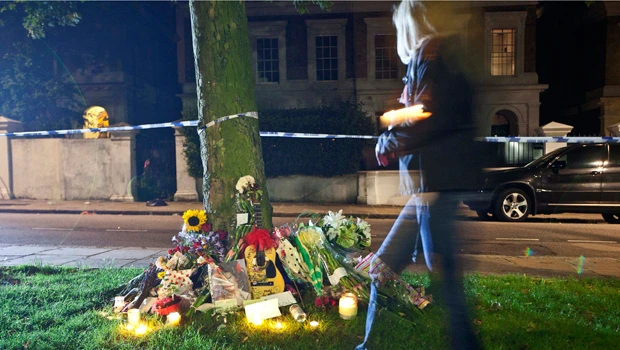
Grief-stricken fans flocked Sunday outside Winehouse’s home in a posh London square to place flowers and tributes.
Soon after the 27-year-old songstress’s death was announced Saturday, they started gathering in Camden Square, north London, to bid farewell to a star whose songs often reflected her tempestuous lifestyle.
Comforting one another, they lit candles and left flowers, notes, guitars, teddy bears and photographs of the singer as police officers stood guard at a cordon.
“Amy, we will miss your great talent. RIP,” read one note left in a bunch of flowers.
“Dearest Amy, I’m glad you made it home. Love and light to you, princess,” read another tied to a feather.
“Amy, you will not be forgotten by Camden — we all love you and will continue to love you. Your legend lives on,” read another note with nine signatories.
Ron Brand, the father of British comedian-actor Russell Brand, who had known Winehouse, said: “It’s a tragic loss. She was beautiful, talented of course, and gentle. I loved her.”
Local restaurant owner Ze Silva, 56, said Winehouse would come in as often as twice a week. She saw her last Tuesday and said she had stopped drinking.
“She had nothing to drink. She said to me ‘Darling, don’t give me any alcohol, I’m not drinking any more’, Silva said.
“She was normal. She would speak to everyone, have pictures taken with the kids, give autographs to the kids.
“She was a good girl. I’m very sad.” Winehouse would go to the restaurant with her bodyguards and would send them to get her takeaway fried breakfasts.