- NALUT, Libya: Rebels in Libya’s Western Mountains launched an offensive against Muammar Qaddafi’s troops on Thursday and the opposition won diplomatic recognition from Portugal, which joined some 30 states to have made such a move.
With prospects fading of a swift negotiated settlement, both sides seem prepared for the five-month war to grind on into the Muslim holy month of Ramadan in August.
A rebel official said no deal was worth talking about unless Qaddafi and his powerful sons were to leave Libya, while the veteran leader vowed to fight on “until victory, until martyrdom.”
The first dead and wounded from the fresh offensive were brought to Nalut, the nearest rebel town. Hospital sources said they received two dead rebels and 18 wounded, as well as nine wounded Qaddafi soldiers, during the morning.
“We have started attacking Ghezaia with rockets and tanks,” rebel spokesman Mohammed Maylud said of a town near the Tunisian border held by the government since the conflict began and from which it controls an area of the plains below the mountains.
“The revolutionaries (rebels) closed the crossing this morning after violent fighting broke out in Ghezaia,” Ali, who lives on the Tunisian side of the border some 17 km (10 miles) from the town, told Reuters by telephone.
“We are hearing loud explosions in Ghezaia.”
Tunisian TV also said the border had been closed.
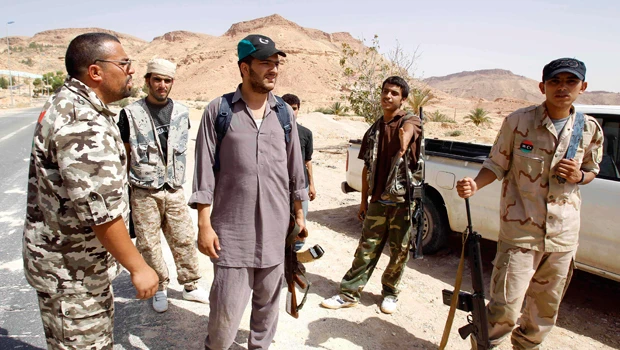
At a checkpoint outside nearby Nalut, young rebel fighters sounded optimistic as the fighting began, chanting “God is great” as they sped in jeeps to and from the front.
“We can beat Qaddafi now, we have captured more weapons from the Libyan army, mostly rockets and AK-47s,” said Mohammed Ahmed, 20, a market trader turned fighter.
Rebels said they had taken control of some villages. They said about 500 of their fighters were taking part.
Sustained bombardments could be heard from Nalut, where a captured government soldier, whose hand had been blown off, was led to a hospital bed next to wounded rebel adversaries.
“We don’t want to keep fighting. Everybody is against us,” the soldier, who gave his name as Hassan, told Reuters.
Rebels have taken swathes of Libya since rising up to end Qaddafi’s 41-year rule.
They hold northeast Libya including their stronghold Benghazi, the western city of Misrata and much of the Western Mountains, their closest territory to the capital.
Yet they remain poorly armed and often disorganized.
Despite four months of NATO strikes, they have failed to reach Tripoli and appear unlikely to do so soon.
Both sides spent the day attacking each other with missiles and mortar bombs, in the kind of fighting that usually just extends the stalemate.
Qaddafi has weathered a rebel advance and NATO air raids on his forces and military infrastructure.
A recent flurry of diplomatic activity has yielded little, with the rebels insisting Qaddafi step down as a first step and his government saying his role is non-negotiable.
Western suggestions that Qaddafi might be able to stay in Libya after ceding power appeared to fall on deaf ears.
UN envoy Abdel Elah Al-Khatib visited both sides this week with plans for a cease-fire and a power-sharing government that excludes Qaddafi, but won no visible result.
“Any political initiative that does not include Qaddafi and his sons leaving power and Libya is not worth talking about,” Guma Al-Gamaty, London-based coordinator for Libya’s rebel National Transitional Council (NTC), told reporters on Thursday.
Qaddafi appeared defiant on Wednesday, urging rebels to lay down their arms or suffer an ugly death.
“We all lead this battle, until victory, until martyrdom,” he said in a broadcast message.
At a briefing to the UN Security Council in New York, Lynn Pascoe, who heads the body’s political department, said both sides had been posturing since discussions began, and added:
“Both sides are willing to talk, but they are still emphasising maximum demands at this point, and patience is clearly required before detailed discussions can begin.”
Britain expelled Libya’s diplomats on Wednesday and invited the NTC to replace them, saying it now recognized the rebels as Libya’s government. It unblocked 91 million pounds ($149 million) in frozen assets. Portugal followed suit on Thursday.
Qaddafi’s government said the British move was “illegal and irresponsible” and a “stain on the forehead of Britain.”
The United States and about 30 other nations have now recognized the opposition, potentially freeing up billions of dollars in frozen funds.
Austria said it wanted to unfreeze up to 1.2 billion euros ($1.7 billion) of Libyan money and transfer it to the rebels, but needed legal papers to show that a financial body set up by the NTC amounted to a valid central bank “identical to the one in Tripoli” to whom the money had belonged.
The cash-strapped rebels, who control Libya’s oil-rich east, have been selling fuel to raise urgently-needed funds, but are unable to pump new supplies because of war disruption.
A tanker carrying crude oil has sailed from Benghazi for Italy, as the rebels sell the last of their stockpile, industry sources and ship tracking data said on Thursday.
An NTC official said senior rebel leader Mahmoud Jibril was on a visit to Qatar but declined to say what he was doing there.
Captured government soldiers brought to Nalut told Reuters army morale was low and said they were being forced to fight.
“I don’t want to fight any more. I don’t want blood,” said one wounded man.
“But a senior officer looked me straight in the eye and warned me and other men in my unit. He said, ‘either you go to the front and stay there or we will kill you’.”