- BEIRUT: Anti-government protesters in the Syrian city of Hama set up barricades and took up sticks and stones to defend themselves Monday after one of the bloodiest days so far in the regime's campaign to quell an uprising now in its fifth month.
The protesters vowed not to allow a repeat of 1982, when thousands of people were killed in Hama after President Bashar Assad's father and predecessor ordered a massacre.
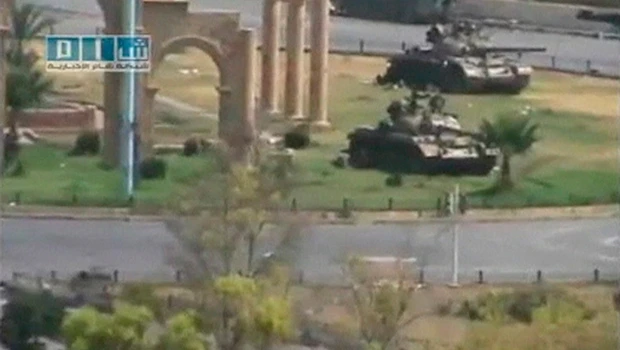
Syrian troops backed by tanks renewed shelling of Hama for a second day in an attempt to subdue the city. Six people were killed across Syria, four of them in Hama, residents and rights groups said.
The current crackdown appears aimed at preventing the protests from swelling during Ramadan, which started Monday. Sunday's violence left 74 people dead throughout the country, 55 of them from Hama and neighboring villages, according to a statement issued by six Syrian rights groups.
The attacks drew harsh rebukes from the US and Europe, which expanded its sanctions against Syria, imposing asset freezes and travel bans against five more military and government officials Monday.
"We find these violent attempts by the Syrian regime to target civilians on the eve of Ramadan to be despicable and abhorrent," said US State Department spokesman Mark Toner.
The international community has grown increasingly outraged by the Assad regime's attacks against civilians, but has so far refrained from calling on him to step down. On Monday, Britain's Foreign Secretary William Hague said there would be no international military intervention in Syria.
The UN Security Council scheduled closed-door consultations on Syria late Monday at Germany's request.
Germany, Britain, France and Portugal have tried unsuccessfully since April to get the UN's most powerful body to condemn Syrian attacks on unarmed civilians. The United States strongly supports their efforts and a draft resolution the Europeans circulated in late May, but they have faced opposition from veto-wielding Russia and China as well as South Africa, Brazil and India, which holds the council presidency this month.
In unusual criticism of the Assad regime, Russia voiced concern Monday over the loss of lives in Hama. The Russian Foreign Ministry urged the Syrian government to stop violence immediately and give up provocations and repressions.
It appeared the regime was making an example of Hama, a city of about 800,000 people some 210 km north of Damascus. The city largely has fallen out of government control since June as residents turned on the regime and blockaded the streets against encroaching tanks.
Early Monday, tank shells slammed at a rate of one every minute into the northeastern Hamidiyeh neighborhood of Hama, killing two people, including a man whose ceiling collapsed as he slept with his family, residents said.
A resident said there were about 50 tanks in roundabouts at the entrances to the city. Pro-regime snipers were shooting randomly, he said.
"It's not an official curfew, but in effect, anyone who goes out risks being shot at," he said.