
- ‘A society grows great when old men plant trees whose shade they know they shall never sit in.’
The national symbol of Saudi Arabia — the desert Kingdom, to use the hackneyed media phrase — is a date palm. It is through a single palm. When planted in regimented groves or randomly scattered around a water source, that thoughts of the hot aridity of desert melt as a mirage in the cooling day.
Much of Saudi Arabia’s one-million-tons-per-annum date production comes from small farms — from a few scores of trees to a couple of thousand. Almost exclusively the groves are simple affairs with the minimum of technology, a steady water supply and cultivators with simple tools and a persistence of application that manifests itself in a life of weeding, trimming, netting and tending the palms.
The romance of the noble desert palm growing in an inhospitable desert yielding nourishment to passing nomads is true in part. However, they are open to disease and insect infestations, drought and running to excess foliage that restricts fruit production. Palms in groves respond bountifully to a little but constant attention yielding anything from 50 kgs of fruit a year to 150 kgs, depending on variety.
At the southern end of Wadi Hanifa, west of Riyadh, lies a medium-size farm of 1,500 trees and 10 different varieties. It is semi-commercial and staffed by a full time labor force of just a few men. It is a quiet place, the susurration of palm fronds scraping gently over each other at the behest of a hot breeze broken by the muted tinkling of water from neatly cut channels cuts between the standing palms. Most of all in the 50-degree summer heat of the Najd, it is cool — a full 10 degrees lower than the shimmering road outside.
The rhythm of life in the grove is set by the palms. Trimming dead fronds from the crown of the tree, clearing weeds competing for water at the foot of the palm, mulching and fertilizing the ground and evenly distributing the scare water. Often, the weeding is restricted to the shallow bowl of raised earth around the base of each tree. Large commercial enterprises have cleared weed-free aisles, ruler straight and stretching for sometimes a kilometer or more. Not so in Wadi Hanifa, where the weeds form a green carpet that attracts the occasional roaming goat but otherwise simply provides a cooling environment to work in.
To get the best from a date palm it needs simple but constant attention through the season.
Date palms are either male or female. Early in the year, when the flowers on male date palms appear, pollination of the female fruit bearing palms is the focus of the grove’s activity. Pollen from the male flowers is smeared over female flowers by hand to ensure thorough pollination. In the wild, wind borne spores that do not travel very far carry out pollination. Hand pollination means both that there need be very few male trees in a grove which makes for more room for fruit-bearing female trees and that a rich crop follows.
During maturation as the dates begin to grow, regular inspection for pest threats is needed. Infestations of the major threat, red weevil are treated as soon as signs appear. If the weevil is not eliminated early, the crown of the palm dies and takes on a scorched and blackened look as if they have been in a fire.
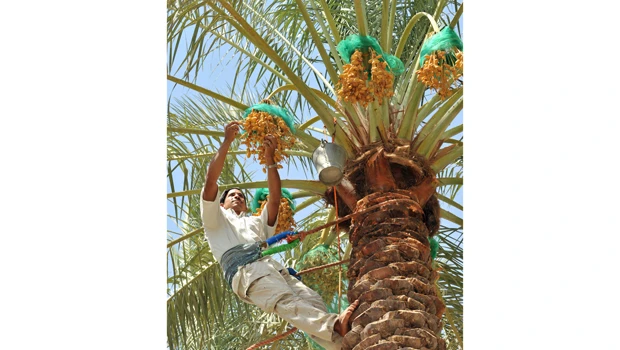
As the dates begin to accumulate sugar, the sweet odor attracts other insect and bird interest. This signals the time to bag the fruit clusters with netting or similar material to keep the unwanted guests away.
Eventually when harvesting the dates begins — and each variety has a slightly different ripening time, the wise farmer picks only the ripened fruit from the palm stalk, not the whole stalk. In the race to get a swift return, stalks bearing both barely ripe and over-ripe dates reach the market, there because the cost of visiting a tree several times for phased picking is too labor intensive. The palm grove may be profitable but it is not efficient and the commercial dates that appear at local markets encounter the pressure of competition from similar farming setups where price is the prime factor.
On an even smaller scale is the family farm a hundred kilometers southwest of Al-Kharj of a few hundred trees and part of the family endowment. Staffed by live-in farm hands it makes little attempt to be commercial. A weekend or hobby-farm it provides a living for the farmhands, dates for the local village and a place of peace for the owner who has a pressurized position in a government ministry in Riyadh.
Nonetheless even this small farm provides a valuable service to the local community and perhaps to the date industry. Ninety-five percent of date production in the Kingdom is consumed locally and the entire output from small farms of this sort never leaves the community it is grown in. It provides food, employment and acts as a keeper of the traditional skills of date production. Less obviously it provides diversity in the species.
When a date palm grows from seed, it does not produce a tree identical to the parent tree. That only happens in a cutting that is taken from a palm (a cultivar) and is propagated. This genetic variation in each generation allows the species to customize itself to a particular location very quickly and accommodate change. Thus even tiny one-man farms are genetic warehouses for the development of new species.
In the small family farm in the center of a remote village another benefit surfaced. Surrounded by mature heavily laden palms, some planted by the owner’s grandfather, the wisdom of a Greek proverb became clear. “A society grows great when old men plant trees whose shade they know they shall never sit in.”
Sitting by the babbling irrigation channel eating fresh-cut Khalas and Sufri dates, local grapes and green pomegranate, watching the tea percolate, the function of the grove as a social center for the village became apparent.
A passing shepherd wandered in and gently scolded the animals for taking a quick meal out of the lush carpet of weeds under the trees. Pausing for a hospitable dish of dates, washed and cooled in the natural spring water that irrigates the field, and tea, he exchanged local gossip with the city bound ministry official not as supplicant to official, but as villager to villager, their families tied by history, geography and the palm grove itself.
The grove acted as a central part of the community and a link with the roots of Saudi culture, an information exchange and a powerful reminder that only one man’s lifetime ago this style of life and interpersonal relationship was the norm, not the exception.
And it took only a day in a date grove to understand that.