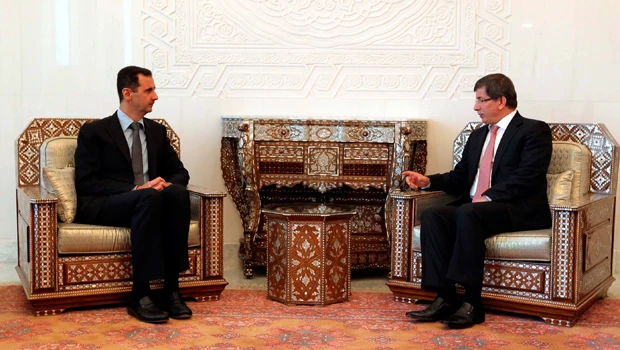
- BEIRUT: The Syrian army launched raids on restive areas Tuesday, defying growing international reproach over the regime’s deadly crackdown on a 5-month-old uprising as Turkey’s foreign minister met with President Bashar Assad to express his concern.
Envoys from India, Brazil and South Africa also headed to Damascus to press for an end to the violence, which activists say killed 22 people Tuesday and some 1,700 since March.
The visit by Turkish Foreign Minister Ahmet Davutoglu is significant because Ankara until recently had close ties to Damascus. But Turkey has become increasingly critical of its neighbor over the bloodshed. Assad and Davutoglu talked for a little more than two hours, according to Turkey’s state-run news agency. Neither leader spoke after the meeting.
Syria’s state-run SANA news agency said Assad told Davutoglu the Syrian government will be relentless in its pursuit of “terrorist groups” to safeguard stability and security in the country. He also pledged to press ahead with reforms.
Syrian authorities blame the unrest on extremist and terrorist groups seeking to destabilize the country, as opposed to true-reform seekers. The largely peaceful demonstrations started out with demands for reforms, but now protesters say they want nothing less than the downfall of the regime.
Assad’s promises of reform have rung hollow, especially since they have been coupled with a bloody campaign against unarmed protesters, and opposition leaders say they have lost confidence in the regime and are demanding an end to the military crackdown before anything else.
Human rights groups said Tuesday that at least 22 people, including several children, were killed across Syria Tuesday.
Tanks stormed villages outside the besieged city of Hama and two towns in Idlib province, which borders Turkey, activists said.
A rights activist near Hama said military operations in the town of Tibet el-Imam just north of the city killed at least five children, four of them from the same family.
“They were playing in the fields when they were struck by gunfire,” the activist said on condition of anonymity for fear of reprisals.
There was heavy machine-gun fire and reports of at least three deaths in the eastern city of Deir el-Zour, which also has been a flashpoint in recent days. Four people were also killed in the town of Binnish in the north, and several others in the central city of Homs.
The reports were confirmed by the activist network the Local Coordination Committees and the London-based Syrian Observatory for Human Rights.
The LCC said a total of eight children were killed across the country Tuesday.
Syria has blocked nearly all outside witnesses to the violence by banning foreign media and restricting local coverage that strays from the party line that the regime is fighting thugs and religious extremists who are acting out a foreign conspiracy.
In Washington, State Department spokesman Mark Toner lauded Davutoglu’s visit and said Secretary of State Hillary Rodham Clinton had spoken with the Turkish foreign minister.
“They did talk about the situation in Syria, you know, and we believe it’s another opportunity to send yet another strong message to Assad that this crackdown on peaceful protesters cannot stand,” Toner said Monday.
India’s UN Ambassador Hardeep Singh Puri said his country’s representative is scheduled to arrive in Damascus on Tuesday and will join representatives from Brazil and South Africa for a meeting with Syria’s foreign minister to appeal for an end to the crackdown and to promote democratic reforms.
The Syrian regime has shown no signs of scaling back its crackdown despite Damascus’ increasing diplomatic isolation. Saudi Arabia, along with Bahrain and Kuwait in the Gulf, recalled their ambassadors this week.
In an editorial published Tuesday, the Al Baath newspaper of Syria’s ruling Baath party said the regime was hopeful that Turkey and the Gulf Arab nations will “quickly correct their stands.”
The latest wave of bloodshed started a week ago, on the eve of the Muslim holy month of Ramadan, when tanks and snipers laid siege to Hama, which had largely freed itself from government control earlier this year.
Residents were left cowering in their homes, too terrified to peek through the windows. The city is haunted by memories of the regime’s tactics: In 1982, Assad’s father and predecessor, Hafez, ordered the military to quell a rebellion by Syrian members of the conservative Muslim Brotherhood movement there, sealing off the city in an assault that killed between 10,000 and 25,000 people.
Since the start of Ramadan, more than 300 people have been killed in cities including Hama and Deir el-Zour, an oil-rich but largely impoverished region known for its well-armed clans and tribes whose ties extend across eastern Syria and into Iraq.
On Monday, Assad replaced his defense minister with the army chief of staff, saying Gen. Ali Habib was being removed from his post because of health problems.
But some analysts said the general was unhappy with the crackdown.