- MAJER, Libya: Libyan authorities accused NATO of a “massacre” of 85 villagers in air strikes in support of opposition fighters, whose political leadership was in crisis after the sacking of its top officials.
The accusation, denied by NATO, came as Canada ordered Muammar Qaddafi's diplomats to leave the country within five days and cut off access to the embassy’s bank accounts, Foreign Minister John Baird said.
He spoke as the British Foreign office announced that the Transitional National Council (TNC) had taken over the London embassy. previously staffed by appointees of Qaddafi’s government.
Qaddafi said Tuesday world powers would be held responsible for the “ugly massacre committed by NATO” on the village of Majer, 10 km south of Zliten, the JANA news agency reported.
NATO insisted the raids near the western town were “legitimate” and that it had no evidence of the civilian deaths.
“We do not have evidence of civilian casualties at this stage,” the NATO spokesman for the alliance’s Libya campaign, Col. Roland Lavoie, said from his Naples, Italy headquarters.
NATO raids south of Zliten were against two former farms used for military purposes by Qaddafi forces, he said. “This was a military facility clearly ... NATO takes extreme precaution not to harm innocent civilians living or working nearby.”
Lavoie’s remarks came as an EU official in Brussels said the European Union will widen sanctions against Qaddafi this week by adding a Libyan oil firm and a government administrative department to a blacklist.
The Al-Sharara oil company and the Organization for Administrative Affairs would both join a list of organizations facing asset freezes, the official said.
Libyan government spokesman Mussa Ibrahim, meanwhile, claimed that Majer was attacked to try to help rebel fighters enter the government-held city from the south.
“After the first three bombs dropped at around 11:00 p.m. (2100 GMT) on Monday, many residents of the area ran to the bombed houses to try to save their loved ones. Three more bombs struck,” he said.
Thirty-three children, 32 women and 20 men from 12 families were killed in the “massacre,” Mussa said.
Reporters attended the funerals of victims and saw 28 bodies buried at the local cemetery where hundreds of people gathered and vented their anger against NATO “the spies and the traitors,” a correspondent said.
Journalists also saw four destroyed buildings, as local officials said more casualties were still buried under the rubble. A single bulldozer at the scene, however, stood idle.
In the hospital morgue, 30 bodies — including two children and one woman — were shown along with other bodies which had been torn apart.
JANA said Qaddafi sent a message to the heads of state of UN Security Council members saying “they should bear responsibility for the ugly massacre carried out by NATO in Majer at dawn Wednesday.”
He was quoted as saying “there has never been such a massacre throughout the history of wars.”
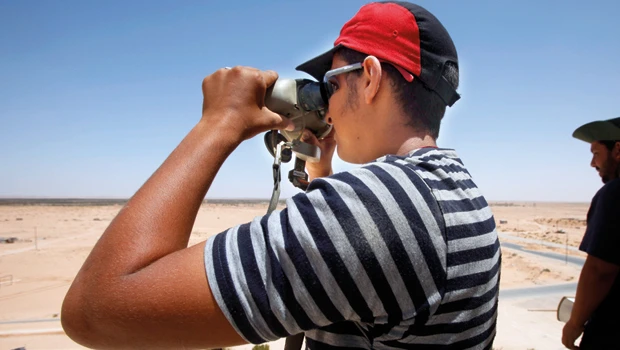
Rebels fighting around Zliten, 120 kilometers east of Tripoli, said earlier they were running low on ammunition as they struggled to hold off an assault by loyalists.
Abdul Wahab Melitan, a rebel spokesman in the nearby port city of Misrata, said Qaddafi loyalists had launched an assault on their positions around Zliten on Sunday.
The rebels, advancing from Misrata, a week ago punched into the center of Zliten, sparking fierce clashes. But they later pulled back to the edge of the city of 200,000 inhabitants.
On another front, at least two rebels were killed in fighting on Tuesday around the oil town of Brega in eastern Libya, a rebel spokesman said.
And explosions rocked the Fernej district of southwest Tripoli between 1:00 a.m. (2300 GMT) and 2:00 am, sending flames shooting into the night sky, an AFP correspondent in the capital said.
They were followed by a series of smaller blasts, suggesting an arms depot had been hit. Two other explosions followed at around 6:00 am, he said.
Meanwhile, in the rebel capital of Benghazi in eastern Libya, Mustafa Abdel Jalil, chairman of the National Transitional Council (NTC), sacked the entire executive office of his government.
NTC officials said he dismissed several top ministers — including those responsible for finance, defense and information — while calling for root and branch reform.
“Mr Mustafa Abdel Jalil has disbanded the executive office,” spokesman Shamsiddin Abdulmolah said, adding that prime minister Mahmud Jibril would be tasked with creating a reformed body.
It was the latest dramatic phase in the turmoil sparked by the assassination of rebel military commander General Abdel-Fatah Yunis in late July.
The NTC has come under fire for its role in events leading up to Yunis’s death, as well as its handling of the aftermath.
Although details are sketchy and still under investigation, it is known that an arrest warrant was signed by senior NTC executive member Ali Essawy, raising allegations that the NTC unknowingly helped facilitate his murder.
The council has faced angry and sometimes violent protests from Yunis’s tribe, as well as demands for reform from groups that were at the forefront of the uprising against Qaddafi that erupted in mid-February.
Abdel Jalil has vowed that an internal investigation into the NTC’s management of the crisis would not flinch from apportioning blame. “No one is above the law, starting from the top of the NTC,” he said.
Since the general’s death, tribal tensions have come to the surface in a country where clans for decades have formed the basis for solving disputes in the absence of functioning judicial institutions.
Insiders have reported frequent clashes between the NTC, whose members were largely Libyan-based lawyers and former members of Qaddafi’s regime, and the executive branch, the majority of whom were exiles.