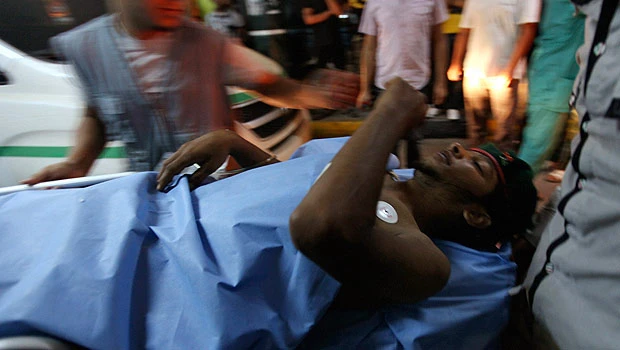
- AJDABIYAH, Libya: Libyan fighters on the eastern front of Libya’s civil war lost 11 men in the past 24 hours fighting to capture the strategic oil terminal and refinery at Brega on the Mediterranean coast, hospital sources said.
Sources at a hospital in Ajdabiyah to the northeast said about 50 were wounded on Thursday and Friday and one civilian in the all-but-deserted town was killed when a rocket fired by Libyan leader Muammar Qaddafi’s forces hit a house.
The fighters have taken the residential zone of New Brega. But that is 15 km (10 miles) from the terminal and port area.
They hope that capturing the port 750 km (466 miles) east of the capital Tripoli will be a tipping point in their nearly six-month campaign to oust Qaddafi. They want to begin exporting oil from Brega as quickly as possible.
But the battle for it has been going on for months.
“There’s close fighting in the oil terminal area this morning but maybe we can finish it off today,” said opposition fighter Mohammad Muftah.
Troops loyal to Qaddafi were holding onto the oil facilities, firing rockets at opposition positions.
Qaddafi is clinging to power despite a near five-month-old NATO air campaign, tightening economic sanctions, and a lengthening war with rebels trying to end his 41-year rule.
The fighters have seized large swathes of the North African state, but are deeply divided and lack experience, and Thursday’s gains in the east broke weeks of stalemate.
In the west, opposition forces driving north toward the town of Zawiyah, within striking distance of Qaddafi’s stronghold in the capital, have not moved up from Thursday’s positions.
Fighters said they had reached the village of Bir Shuaib, some 25 km (15 miles) from Zawiyah, which has unsuccessfully risen up against Qaddafi twice this year.
Reuters interviewed a captured intelligence officer who said Qaddafi had reinforced Zawiyah, which also has a coastal oil refinery, with about 1,000 conscripts. But there were no heavy weapons there and no African mercenaries as rebels insist.
Brig. Gen. Al-Hadi Al-Ujaili predicted the rebels would face a hard fight to capture the town. He said Qaddafi still enjoys strong support in Tripoli and among Libya’s main tribes, which he said was crucial.
The western battle is one of three widely separated rebel fronts against Qaddafi forces. In the east around the ports of Misrata and Brega, fighting had been bogged down in recent weeks while the western fighters have advanced.
Misrata, a port on the Mediterranean under rebel control for months, is about 500 km (300 miles) west of Brega.
Zawiyah lies less than 50 km (30 miles) west of Tripoli, on the main road to Tunisia, which has been a lifeline for Libya but has begun to crack down on rampant smuggling of gasoline.
Rebels in the western mountains can muster a few thousand men if their separate units join forces.
On the diplomatic front, a Tunisian government official said on Friday there had been contacts last week between US envoys and Qaddafi representatives on Tunisian soil. The official, who declined to be named, gave no further details.
US officials met with Qaddafi representatives last month to deliver a message that the embattled Libyan leader must go.
In an effort to pile economic and military pressure on Qaddafi, more countries are set to announce next week that they will free frozen assets for the fighters, a British official said.
“While it’s hard to predict when this will end, it’s easy to see the pressure is building on Qaddafi and it is only a matter of time before he’s forced to leave power,” the official said.
Britain is playing a leading role in NATO air strikes against Qaddafi’s forces, which have weakened his armory but have not enabled the rebels to deliver a knockout blow.
Tightening the economic noose around Qaddafi, Tunisia said on Thursday its troops were patrolling fuel stations to curb the flow of smuggled gasoline into neighboring Libya.
International sanctions and the effects of Libya’s civil war have disrupted normal supplies of fuel to parts of the country under Qaddafi’s control, but huge volumes of gasoline are instead being smuggled across the Libyan-Tunisian border.
“The armed forces are now conducting checks at fuel stations in the south of Tunisia ... so that neither Tunisians nor Libyans can fill up with large quantities,” Tunisian defense ministry official Mokhtar Ben Nasr told a news conference.
“These checks are aimed at preventing the smuggling of diesel and gasoline to Libya.”