- CAIRO: The judge trying ousted Egyptian President Hosni Mubarak on charges of complicity in the killing of protesters who toppled his regime ordered a halt to the live broadcast of his trial Monday after a chaotic session in which lawyers pushed, shoved and scuffled to get on television.
Showing the hearings live on state television had been a nod by Judge Ahmed Rifaat to activists who complained that the military rulers now in charge of the country were dragging their feet bringing Mubarak and stalwarts of his regime to justice.
“The aim is to remove the humiliation. Now, God knows how long it (the trial) will take,” said best-selling novelist and prominent rights activist Alaa el-Aswany.
The decision was met with suspicion by Ramadan Ahmed, father of a 16-year-old protester killed during the 18-day uprising that toppled the regime.
“This is not correct. How can I be reassured and feel the justice,” said Ahmed, who was refused access to the courtroom. “I want to see justice realized before my eyes.”
Rifaat said his decision to stop the broadcasts was designed to “protect the public interest.” He did not elaborate, but the presence of cameras, television commentators and journalists interviewing lawyers had given the trial a circus-like atmosphere.
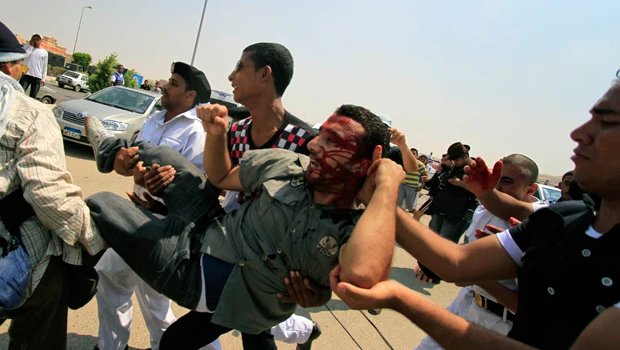
Lawyers for the victims’ families bickered over their turns to address the judge and came close to exchanging blows with Mubarak supporters, all in front of the television cameras. Some among them just waved and smiled to the cameras.
“The decision is meant to stop the lust (that) people in the courtroom are showing for getting on television,” said lawyer Mukhtar Noah, who represents the families of more than 200 victims.
“It was not a political decision.”
Mubarak, who ruled Egypt unchallenged for 29 years, also faces charges of corruption together with his two sons — one-time heir apparent Gamal and wealthy businessman Alaa.
He could face the death penalty if convicted of complicity in the killing of 850 protesters thought to have been shot or run over by security forces during the uprising. The trial was adjourned until Sept. 5.
Mubarak is the first Arab leader in modern times to be put on trial by his own people, a feat that many see as a warning to authoritarian Arab leaders. Saddam Hussein was tried and hanged after his 2003 ouster, but the proceedings were supervised by US officials.
“This is a historic event regardless of whether the trial will be shown live on television or not,” said defense lawyer Khaled Abu Bakr, who represents a wounded protester.
Many Mubarak supporters see his appearance in court, bedridden and inside a grim metal and wire defendants cage, as humiliating for a former head of state and decorated war hero. They applauded the decision to ban cameras.
The ailing, 83-year-old Mubarak occasionally dozed off and answered with a curt “present” delivered with a deep voice when Rifaat called his name out as part of a roll call.
Nermine Nabil, 21, was wearing a T-shirt that read: “I am an Egyptian. I am against the humiliation of the nation’s leader.” She carried a portrait poster of Mubarak that was passed out to his supporters along with the T-shirt.
“When I was a baby, Mubarak was in the desert fighting. Now we are in the desert fighting for him,” she said, alluding to the academy’s location on Cairo’s desert outskirts.
Clashes between Mubarak loyalists and victims’ families left 34 people wounded, of whom seven needed to be hospitalized, according to the Health Ministry.
___
Associated Press Aya Batrawy and Sarah El Deeb contributed to this report.
----------
4th Ld-Writethru : AP: Somalia famine aid stolen; UN investigating
KATHARINE HOURELD | AP
MOGADISHU, Somalia: Thousands of sacks of food aid meant for Somalia’s famine victims have been stolen and are being sold at markets in the same neighborhoods where skeletal children in filthy refugee camps can’t find enough to eat, an Associated Press investigation has found.
The UN’s World Food Program for the first time acknowledged it has been investigating food theft in Somalia for two months. The WFP said that the “scale and intensity” of the famine crisis does not allow for a suspension of assistance, saying that doing so would lead to “many unnecessary deaths.”
And the aid is not even safe once it has been distributed to families huddled in the makeshift camps popping up around the capital. Families at the large, government-run Badbado camp, where several aid groups have been distributing food, said they were often forced to hand back aid after journalists had taken photos of them with it.
Ali Said Nur said he received two sacks of maize twice, but each time was forced to give one to the camp leader.
“You don’t have a choice. You have to simply give without an argument to be able to stay here,” he said.
The UN says more than 3.2 million Somalis — nearly half the population — need food aid after a severe drought that has been complicated by Somalia’s long-running war. More than 450,000 Somalis live in famine zones controlled by Al-Qaeda-linked militants, where aid is difficult to deliver. The US says 29,000 Somali children under the age of 5 already have died.
International officials have long expected some of the food aid pouring into Somalia to go missing. But the sheer scale of the theft taking place calls into question aid groups’ ability to reach the starving. It also raises concerns about the willingness of aid agencies and the Somali government to fight corruption, and whether diverted aid is fueling Somalia’s 20-year-civil war.
“While helping starving people, you are also feeding the power groups that make a business out of the disaster,” said Joakim Gundel, who heads Katuni Consult, a Nairobi-based company often asked to evaluate international aid efforts in Somalia. “You’re saving people’s lives today so they can die tomorrow.”
WFP Somalia country director Stefano Porretti said the agency’s system of independent, third-party monitors uncovered allegations of possible food diversion. But he underscored how dangerous the work is: WFP has had 14 employees killed in Somalia since 2008.
“Monitoring food assistance in Somalia is a particularly dangerous process,” Porretti said.
In Mogadishu markets, vast piles of food sacks are for sale with stamps on them from the World Food Program, the US government aid arm USAID and the Japanese government. The AP found eight sites where aid food was being sold in bulk and numerous smaller stores. Among the items being sold were corn, grain, and Plumpy’nut — a specially fortified peanut butter designed for starving children.
An official in Mogadishu with extensive knowledge of the food trade said he believes a massive amount of aid is being stolen — perhaps up to half of aid deliveries — by unscrupulous businessmen. The percentage had been lower, he said, but in recent weeks the flood of aid into the capital with little or no controls has created a bonanza for businessmen.
The official, like the businessmen interviewed for this story, spoke on condition of anonymity to avoid reprisals.
The AP could not verify the official’s claims. WFP said that it rejected the scale of diversions alleged by the official.
At one of the sites for stolen food aid, about a dozen corrugated iron sheds are stacked with sacks. Outside, women sell food from open 110-pound (50-kilogram) sacks, and traders load the food onto carts or vehicles under the indifferent eyes of local officials.
Stolen food aid is not new in Somalia — it’s the main reason the US military become involved in Somalia during the country’s 1992 famine, an intervention that ended shortly after the military battle known as Black Hawk Down. There are no indications the military plans to get involved in this year’s famine relief efforts.
WFP said in a statement that it has put into place “strengthened and rigorous” monitoring and control in Somalia.
“However, given the lack of access to much of the territory due to security dangers and restrictions, humanitarian supply lines remain highly vulnerable to looting, attack and diversion by armed groups,” WFP told the AP.
Somali government spokesman Abdirahman Omar Osman said the government does not believe food aid is being stolen on a large scale but if such reports come to light, the government “will do everything in our power” to bring judicial action.
The AP investigation also found evidence that WFP is relying on a contractor blamed for diverting large amounts of food aid in a 2010 UN report
Eight Somali businessmen said they bought food from the contractor, Abdulqadir Mohamed Nur, who is known as Enow. His wife heads Saacid, a powerful Somali aid agency that WFP uses to distribute hot food. The official with extensive knowledge of the food trade said at some Saacid sites it appeared less than half the amount of food supplied was being prepared.
Attempts to reach Enow or his wife for comment were not successful.