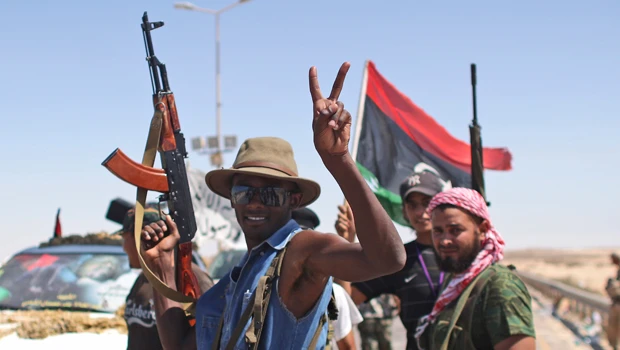
- ZAWIYAH: Libyan rebels said on Monday they had seized a second strategic town near Tripoli within 24 hours, cutting off the capital’s two main supply routes after the boldest advances of their six-month-old uprising against Muammar Qaddafi.
A defiant and apparently isolated Qaddafi urged his followers to fight the “rats” (rebels), in a barely audible telephone call broadcast on state television overnight.
Qaddafi’s forces fired mortars and rockets at the coastal town of Zawiyah a day after rebels captured it in a thrust that severed the vital coastal highway from Tripoli to the Tunisian border and could prove a turning point in the war.
Rebels said they had also captured the town of Garyan south of Tripoli. That could not be immediately verified, but if true, it would tighten the siege of the capital.
“Garyan is fully in the hands of the revolutionaries. They crushed the Sahban Brigade, the main command center for Qaddafi in the Western Mountains. They took the brigade’s heavy and light weapons,” a rebel spokesman, Abdulrahman, said by phone.
“Qaddafi has been isolated. He has been cut off from the outside world.”
Rebels probably lack the manpower for an all-out assault on Tripoli, but are hoping their encirclement of the capital will bring down Qaddafi’s government or inspire an uprising.
Rebels have frequently failed to hold gains in the past, and a fightback by Qaddafi troops yet could break the siege.
A UN envoy arrived in neighboring Tunisia, where sources say rebels and representatives of the government have been holed up in an island resort hotel for negotiations. A senior Qaddafi security official arrived in Cairo with his family, in what could be a sign of more defections if the government crumbles.
Talks could signal the endgame of a conflict that has drawn in the NATO alliance and emerged as one of the bloodiest confrontations in the wave of unrest sweeping the Arab world.
Qaddafi’s government denies talks with rebels are taking place. A spokesman dismissed reports of negotiations about the Libyan leader’s future as part of a “media war” against him.
“The leader is here in Libya, fighting for the freedom of our nation. He will not leave Libya,” the spokesman, Moussa Ibrahim, said.
After months of only incremental gains in their struggle against Qaddafi, rebel advances in the last two days have transformed the situation, beginning with the capture of the town of Zawiyah which cut Tripoli’s main lifeline road west.
Reuters reporters in the town say Qaddafi’s forces still hold an oil refinery and have sniper positions on rooftops, but the highway linking Tripoli to the Tunisian border is shut.
At a hospital, medics said six rebels had died and 26 were wounded. They also said firing by Qaddafi forces killed three civilians. One man was shot in the head and a 15-year-old girl died of shrapnel wounds.
A woman lay in the hospital unconscious with shrapnel wounds to her neck. Her brother, who gave his name only as Waleed, stood over her holding up a drip. His T-shirt was drenched in blood. Qaddafi’s forces are “shooting at us indiscriminately,” he said.
Zawiyah has risen up twice in the past only for its revolts to be crushed by Qaddafi loyalists.
But this is the first time rebels have been able to link up with other fighters advancing from the mountains in the south, preventing Qaddafi’s forces from encircling or bypassing the town to keep the strategically vital coastal highway open.
On another front, the rebels’ capture of Garyan would close the main highway south out of the capital, over the mountains and into the desert. That route is used to bring in supplies from Algeria and link the capital with the east.
Qaddafi’s officials in Tripoli did not respond to a request for an update on the military situation on Monday.
Sources in Tunisia say Qaddafi’s officials have been meeting rebels on the Tunisian resort island of Djerba for talks. Previous attempts at negotiations have been fruitless.
Abdel Elah Al-Khatib, the UN envoy for Libya, arrived in Tunisia and met its prime minister. He told Tunisia’s state TAP news agency that the United Nations was making a push for peace.
Egyptian sources said a senior Libyan security official, Nasser Al-Mabrouk Abdullah, had flown to Cairo with nine relatives from Djerba. He told officials he was on holiday.
Qaddafi officials in Tripoli said he was a former public security minister and now held a top security position. They said his travel was unofficial. A source at the Libyan embassy in Cairo said he had not made contact with the embassy there.
The rebel advances are a relief for NATO allies, especially France and Britain, which have been in the vanguard of a bombing campaign since March that they say will not end until Qaddafi leaves power. The UN mandate which authorizes NATO to use force to protect civilians expires next month.
A spokesman for British Prime Minister David Cameron, said Britain was aware of reports of rebel progress. “We think the NATO operation is proving successful in eroding Qaddafi’s ability to wage war against his own people.”
Libyans fleeing south in their cars reported gunfire in a place called Harsha, between Tripoli and Zawiyah.
“I heard fighting there today on our way here,” said one man who declined to give his name. He also said rebels clashed with Qaddafi’s security forces inside Tripoli on Sunday night.
“There is no gasoline, no electricity, food prices are up 300 percent. We just cannot live like this anymore,” he said.
Qaddafi’s overnight speech was delivered over a poor-quality telephone and broadcast by state TV in audio only, giving the impression the leader was in a bunker or another remote hideout.
“Move forward, challenge, pick up your weapons, go to the fight for liberating Libya inch by inch from the traitors and from NATO,” the 68-year-old leader said. “The blood of martyrs is fuel for the battle.... The end of colonialism is near. The end of the rats (rebels) is near, as they flee...”
In Zawiyah, rebel fighter Khalid Al-Zawi said: “Qaddafi is crazy. He’s capable of absolutely anything. That’s one thing we have to keep in mind.”