
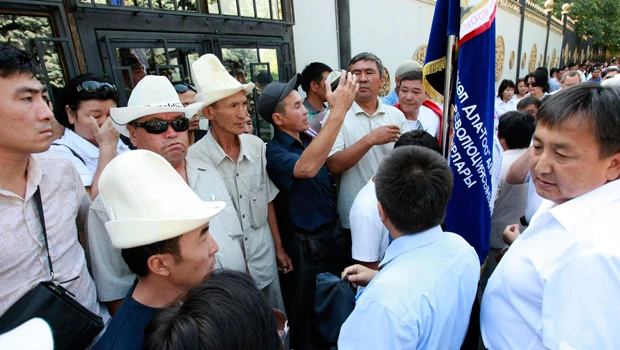
- BISHKEK: Kyrgyzstan’s Central Election Commisision says 83 candidates have put their names forward for the country’s presidential election, setting the stage for a lively and aggressive political contest.
Only a handful, however, have any chance of winning the Oct. 30 vote in the turbulent former Soviet Central Asian nation.
The expected front-runners are Prime Minister Almazbek Atambayev, who leads the Social Democratic Party, nationalist Ata-Zhurt party leader Kamchibek Tashiyev, and the left-leaning Ata-Meken party chief Omurbek Tekebayev.
Kyrgyzstan has struggled for stability since last April, when President Kurmanbek Bakiyev was toppled in a popular uprising amid growing anger over corruption, abuse of power and a stagnating economy.
The role of the president has been watered down as a result of constitutional reforms implemented last year, but some candidates, such as Tashiyev and rival nationalist politician Adakhan Madumarov, have promised to reverse those measures.
That scenario would be eagerly welcomed by Russia, which wields substantial influence over the impoverished nation’s economy and has an air base in the country. Russian President Dmitry Medvedev has said a strong-parliament system could leave the country vulnerable to takeover by extremists.
Meanwhile, the United States, which also has a strategically important air base in the country, has been active in its support for the parliamentary model of government.
Whoever takes over as president for a six-year term will become the country’s fourth head of state since independence in 1991.
The first president, Askar Akayev, was overthrown in 2005 as the public grew frustrated with his lack of accountability and increasingly authoritarian style. He was succeeded by Bakiyev, who soon dashed hopes the country would take a more democratic direction.
“The world is watching to see if we can peacefully transfer power like a civilized state,” said Emil Kaptagayev, head of the presidential administration. Caretaker President Roza Otunbayeva, who took over from Bakiyev, is not eligible to run in the upcoming election.
With such a large number of candidates taking part, a run-off between the two biggest vote-winners appears inevitable.
Atambayev is a political ally of Otunbayeva and is seen as having the best chance of winning.
Political power bases in Kyrgyzstan are traditionally strictly aligned along regional lines and there are fears the elections could deepen the historical fissure dividing the country’s north and south.
“The main criteria for voters will remain tribalism and regionalism,” said political analyst Aidar Mambetov.
Tashiyev can expect to garner the bulk of his support in the south, where nationalist feelings have been running high since last June, when clashes between the ethnic Kyrgyz and minority Uzbeks left around 470 people dead.
Atambayev, a northerner, will expect to attract most ballots among voters in the capital, Bishkek, and in surrounding provinces.