
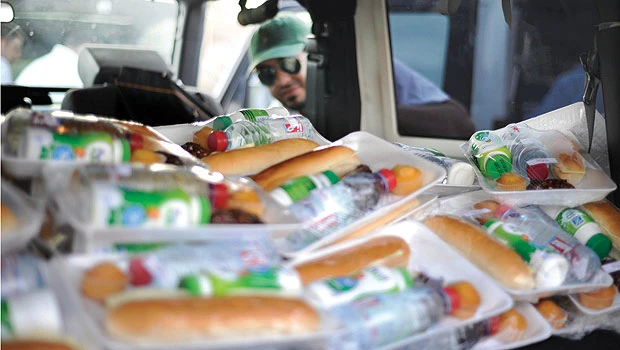
- For the second year running, the Young Initiative Group (YIG) is carrying out a Ramadan project involving the handing out of iftar meals to the less fortunate across Jeddah.
- During the holy month, members of the voluntary group are buying food and packing them in boxes for distribution, a project known as Iftar Sayem.
Iftar Sayem 2, a YIG project, is held and run by volunteers. The project is continuing due to its success last year. This year the group is armed with double the number of volunteers and food supplies.
“Iftar Sayem is not about distributing food to deserving individuals, it is about connecting with all types of individuals making up our society, joining our efforts and working as one family with the aim of improving our society one meal at a time,” said YIG Co-founder Mohammad Al-Bakri.
Over 70 volunteers unite to pack and distribute 2,500 meals to poor areas in the south. Volunteers vary from 12-year-old kids to older parents all working hand in hand for the common good. Volunteers are increasing daily and their personal contributions as well; therefore YIG expect to reach 4,000 meals a day by the last week of Ramadan.
Generous companies such as supermarket chain Danube, Tala dates, Al-Tazej and Serafi Mall contributed to this noble cause this year and Al-Rabie and Sunbula last year. Female volunteers gather at 2 p.m. every day at one of their houses and spend two hours packing almost 500 Iftar Sayem meals which contains dates, water, juice, bread and yogurt.
At 4 p.m. male volunteers drop by the house with their jeeps to pick up the bags and another male group picks up 1,700 cooked meals donated by restaurants. The hot meal consists of rice, chicken, samboosa, cooked beans (foul) and more.
The group of male volunteers later meet in a huge parking lot where they start organizing themselves into six groups. Each group is responsible for distributing its quota of meals in its assigned location.
2,500 Iftar Sayem meals are distributed daily to six deprived areas, including Karentina, Nuzla Yamania, Balad, Hai Al-Jama’a, Quwaiza, Harazat.
“It seems that the poverty situation in the south and east of Jeddah has reached a critical level. We can’t pretend that we don’t see it anymore. We can’t say there’s nothing we can do, because there is plenty we can do,” said Ali Al-Banawi, YIG co-founder.
However, YIG decided to focus on one neighborhood, Al-Misfah, when distributing 1,250 arzag boxes — baskets containing a whole month’s food supply.
“This neighborhood was specifically chosen because it is the poorest area in Jeddah. It is home to 6,000 people and their sewage system is obsolete and clogged so sewage flows into their homes,” said Maha Taher, another YIG co-founder. “There is waste and trash dumped in front of the neighborhood’s homes. There are also overgrown rats and the local animal control is ineffective. Their houses need renovation, cleaning and refurnishing. Food is the least thing we can offer to this poor neighborhood during the holy month of Ramadan.”
Giving back to the community is what drives the volunteers to lend a hand to whoever needs it. “Iftar Sayem is changing the lives of everyone rich and poor, as we engage both groups to empower, change and to achieve better youth development. It’s not about the means, it’s a vision,” said Mayyar Saleh, logistics manager of YIG.
The voluntary group challenged themselves last Ramadan to continue to make volunteering a part of their continuous obligations toward society and they have successfully met the challenge.
YIG has started a cleaning campaign where they gathered more than 400 volunteers to clean Jeddah’s historical area. They later started a project where they renovated and cleaned houses in poor areas in Jeddah and also helped financially support patients who couldn’t afford their surgeries.
YIG has also carried awareness campaigns in shopping centers and on the Internet to enlighten people about the danger of diabetes and introduce them to the unknown story of autistic children.
YIG welcomes anyone who is willing to be a volunteer for the Ramadan project.