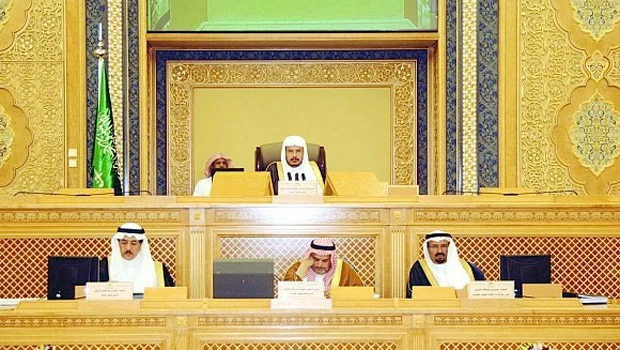
- RIYADH: Shoura Council Chairman Abdullah Al-Asheikh appointed a special committee on Tuesday to implement the decision of Custodian of the Two Holy Mosques King Abdullah allowing women to serve on the council as full members.
Al-Asheikh made the announcement following a meeting of the Human Rights Committee at the council’s headquarters in Riyadh on Tuesday.
The committee meeting was attended by citizens who came to present petitions on various human rights issues.
Al-Asheikh said the new committee for women’s affairs body would make necessary arrangements for the appointment of women members to the Shoura Council.
“All arrangements to accommodate the women members will be made by the committee at the sixth session of the council,” Al-Asheikh said, adding that administrative staff to assist the women members would also be appointed.
The number of new women members is yet to be announced.
The council has 150 men members at present. Their tenure of office is four years.
The council's sixth session will start after 17 months.
Besides the committee for women’s affairs, the chairman also appointed another team of members to find out ways and means of implementing the decisions announced recently by King Abdullah.
While retaining the existing committee on family and social affairs, the chairman also appointed another separate committee for youth affairs.
The chairman said 12 women consultants are currently serving the Shoura Council.
“The enrolment of women as members to the council will represent a qualitative shift in the function of the council,” Al-Asheikh said.
Al-Asheikh pointed out that the council is strictly based on Islamic law, coupled with its rich traditions.
Therefore, he said all activities of the council will be carried out within the framework of Islamic principles.
According to a recent announcement made by the king, Saudi women would be allowed to stand and vote in municipal elections and also become members of the Shoura Council.
During the first session following the speech, Al-Asheikh pointed out that the landmark decision amply demonstrated King Abdullah’s support for the welfare of women in the Kingdom.
“Saudi women have excelled in education, health, economics, administrative and social fields in society,” Al-Asheikh said, adding that they have made remarkable achievements in research studies and some have served the council as consultants.
He said women’s entry to the council would bring new blood to an institution where national and international problems are discussed to achieve the Kingdom’s goals.
Al-Asheikh pledged that the council would follow the guidelines laid out by the king to work for national unity, the nation’s progress and for regional security and peace.