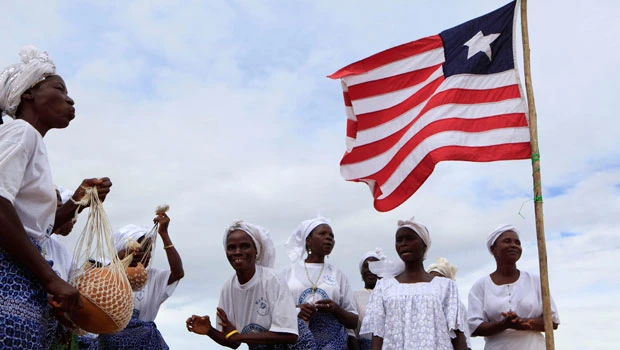
- MONROVIA: Liberians queued in the rain on Tuesday for the West African state’s second presidential election since its civil war, with incumbent Ellen Johnson-Sirleaf bidding for a second term.
The election pits the newly named Nobel peace laureate against former UN diplomat Winston Tubman and 14 others. It comes at what could be a watershed moment for Liberia, with investors ready to sink billions of dollars into its mining sector and potential emergence as an oil nation.
“We’ve had a difficult past, too hard, but today we are voting for peace,” said Monrovia resident Benjaman Nimley as he queued with others to cast his vote at a high school converted into a polling station in the seaside capital.
Pointing skywards to the latest downpour of the steamy rainy season, he added: “It is the rain that helps you appreciate the sunshine.”
Passions have run high in a contest some forecast will go to a second-round run-off between Johnson-Sirleaf and Tubman, and many voters recall how a dispute over the outcome of the 2005 election led to days of rioting in the capital Monrovia.
“If they give us exactly what was put in there, we will accept it,” said Victor Freeman, a Monrovia local who lost five family members in the civil war, referring to the ballot boxes.
“We don’t want fighting, we want a better Liberia,” he said of Africa’s oldest republic, whose name reflects its founding in 1847 by freed US slaves.
Eight years into peace, Liberia has seen growing investment in its iron and gold mines and has convinced donors to waive most of its debt, though many residents complain of a lack of basic services, high food prices, rampant crime and corruption.
Unemployment remains rife, war-wounded beg on the streets of the seaside capital and average income stands at $300 a year — below the $1-a-day benchmark for extreme poverty.
Johnson-Sirleaf initially ruled out a second term, but has since said she needs one given the huge challenge. Her jocular campaign slogan — “Monkey Still Working, Baboon Wait Small” — urges Liberians to have a bit more patience.
Campaigning for the election has been mostly calm, though scuffles erupted between rival supporters in Monrovia during final rallies at the weekend.
The election will be Liberia’s first locally organized presidential poll since the end of the 1989-2003 conflict that killed nearly a quarter of a million people. Johnson-Sirleaf became Africa’s first freely elected female head of state in the 2005 election that was organized by the United Nations.
Tubman, whose running mate is ex-soccer star George Weah, is expected to give Johnson-Sirleaf her toughest challenge.
Analysts say Johnson-Sirleaf’s Nobel Peace Prize, awarded jointly with Liberian activist Leymah Gbowee and Yemeni rights activist Tawakul Karman last week, could give her the edge by galvanizing the female vote in her favor.
A Harvard-educated former adviser to former UN Secretary General Kofi Annan, Tubman told Reuters on Saturday he is certain he will win and issued a veiled warning that his supporters could make it “difficult to govern” for anyone else.
“We have expressed some concerns about innuendos about violence, encouraging people not to support the results of the election,” said US Ambassador Linda Thomas-Greenfield.
“We’ve had conversations with all of (the political parties) about that. It only takes a few. It doesn’t take thousands to cause problems,” she told Reuters.
The United Nations said the return of homegrown mercenaries from a four-month civil war in Ivory Coast this year could be a threat. Several weapons caches have been seized, but there has been no evidence of plans to disrupt voting.
Citing violent crime, instability in Ivory Coast and trafficking of drug and arms across the region, the UN Security Council extended the mandate of the 9,200-strong peacekeeping mission UNMIL last month.
A peaceful, free and fair election could bolster growing investor confidence in the country, which is rich in iron ore deposits and has promising agriculture and energy sectors.
Miners ArcelorMittal and BHP Billiton and oil companies Anadarko, Tullow and Chevron are already active in the country.
The head of Liberia’s National Oil Company, Christopher Neyor, predicted an offshore oil find is likely “pretty soon” and said majors Exxon Mobil, France’s Total, and Brazil’s Petrobras had made inquiries about acreage.