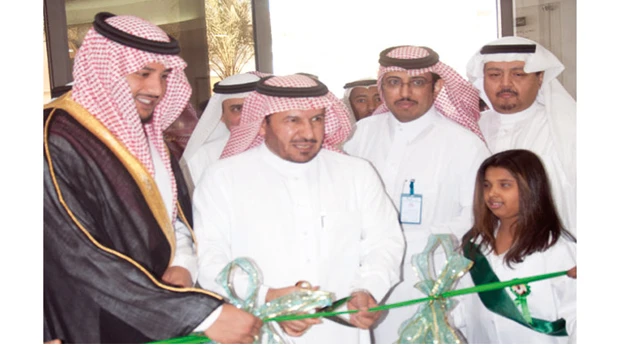
- RIYADH: Health Minister Dr.
- Abdullah Al-Rabeeah commended on Tuesday the voluntary efforts of Saudi philanthropists who help the Kingdom in its health care initiatives as he opened a SR35 million diabetes center at the Prince Salman bin Abdulaziz Hospital in Riyadh’s Badiyah district.
Director for Health Affairs Dr. Adnan Abdul Al-Karim and the hospital’s Director Dr. Ali Al-Amri were also present at the opening ceremony.
The center, dubbed Sheikh Abdul Mohsin bin Abdul Malik Al-Asheikh Center, was built by Sheikh Abdul Mohsin in memory of his father Abdul Malik Al-Asheikh. The complex, which covers 5,500 square meters, has four floors.
The minister said that it is encouraging to note that Saudi philanthropists are actively involved in the social welfare of the community.
The diabetes center is part of the Health Ministry’s plan to set up 20 centers in all the health regions in the Kingdom.
Thanking the donor for his magnanimous gesture, Al-Karim said the scheme is a symbol of social responsibility that aimed to improve the quality of health care services.
“The new center is a pleasant addition to health care facilities provided by the government,” he said, adding that the facilities, equipment, personnel and other services are offered by the Health Ministry.
Speaking to Arab News following the function, Director of the Center Abdulaziz Al-Dhukhail said the building opened informally early this year.
“It has attracted a large crowd from the Badiyah district and those diagnosed with diabetes have been getting the best of services from the center,” Al-Dhukhail said.
The director said the center provides comprehensive health care for diabetics.
“We have three separate clinics for women that include services for pregnant diabetics,” he said, adding that health officials working in the center are involved in preventive and curative care.
Besides these services, he said the center also provides health awareness on the disease, which is the third highest cause of death in the world. “We want to make this a center of excellence and an institution for reference.”
The center also has a separate unit for children and adolescents who are diabetics.
“We have plans to provide insulin pumps for this group if they are type 1 diabetics, who are insulin-dependent. There are around 50 health officials in the center, which include 22 doctors and 20 nurses. We also hope to offer refresher courses for the officials to keep them abreast of the recent advances in the field of diabetes.”
Diabetes related ailments such as obesity, hypertension, ophthalmic, renal, nutritional and mental diseases are also diagnosed and treated at the center.
“We also treat patients with sexual disorders arising from diabetes,” he said, assuring a high degree of confidentiality.
The director said that it is an important duty of medics and paramedics to empower diabetics by helping them adopt their lifestyles to cope with the disease. He stressed that the goal of diabetes education is to help the patient self-manage their conditions.
“Complications from diabetes can lead to blindness, kidney failure, heart disease, nerve damage, limb amputations and even death,” he said.
Non-communicable diseases (NCDs), known as lifestyle diseases, are increasing at an alarming rate in Saudi Arabia as a result of increasing prosperity and socioeconomic transformation.
The epidemiological profile of the Kingdom includes high incidences of obesity, hypertension and diabetes, particularly type-2. The latter has been the leading cause of cardiovascular disease, kidney failures and amputations. The complications caused by these diseases will increase long-term costs, further burdening an already over-stretched health care system.
According to the outcome of a survey released by the Saudi Diabetes & Endocrine Association (SDEA) in 2010, over 70 percent of the Saudi population is alarmingly obese. The WHO determined that both men's and women's estimated mean Body Mass Index (BMI) in the Kingdom scored 26.6 kg/m2 and 28 kg/m2, respectively in 2010. A BMI score above 25 kg/m2 is indicative of an overweight populace and that above 30 kg/m2 denotes obesity.