
- In recent years, there has been a surge of books concerned with India’s growing economic power.
- Both Indian and Western writers have discussed at length the impact of consumerism in the sub-continent and its importance for the West.
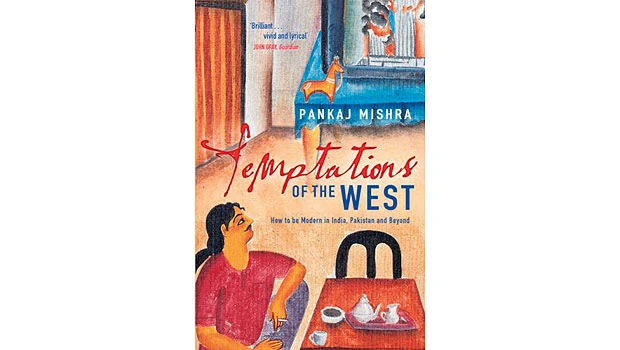
Although “The Rediscovery of India” by Meghnad Desai (Bloomsbury) and “India: A Portrait” by Patrick French (Allen Lane) have just been released, I prefer the not-so-recent but brilliant “Temptations of the West” written by Pankaj Mishra, who is the author of “Butter Chicken in Ludbiana: Travels in Small Town India.” Mishra also writes for several publications, including The New York Review of Books, The Times Literary Supplement and The Guardian.
Unlike Meghnad Desai, professor emeritus at the prestigious London School of Economics, and Patrick French, Pankaj Mishra presents a balanced assessment on the effect of the global economy in India. This lively and entertaining travelogue gives us a suave mix of memoir, narrative history, politics, religions and philosophy.
“Temptations of the West” describes countries, which despite their profound differences, “experience the same dilemma: How do people with traditions extending back several millennia modernize themselves?” The author swiftly acknowledges that these countries (India, Pakistan, Afghanistan, Tibet and Nepal) have already tackled Western ideologies “with the same challenge: modernize or perish.”
In the prologue, the author born in north India in 1969 and now living in London, remembers the atmosphere of old Benares that was still intact in the late 1980s:
“In less than two years, most of this solid-seeming world was to vanish into thin air. The old city was to be scarred by a rash of fast-food outlets, video-game parlors and boutiques, the most garish symbols of the entrepreneurial energies unleashed by the liberalization of the Indian economy, which would transform Benares in the way they had already transformed other sleepy small towns across India.”
Patrick French’s book, “India: A Portrait,” hails India’s rise to consumer capitalism. French makes no qualms about his admiration for the Indian entrepreneurs who made that possible. He praises the low prices of shampoo sold in individual packets, an opportunity for poor people to have access to glamorous beauty products seen on flashy posters. However, French fails to address important issues such as the revival of communism in parts of central India, the collapse of water tables as well as the poisoning of cultivable land, which are plunging hundreds of millions of poor Indian farmers in total despair.
In “The Rediscovery of India,” Desai voices his concern that when the benefits of the global economy are shared only by a happy few, there is the risk of a massive dissent and deep resentment amongst the greater part of the population.
Pankaj Mishra also makes the same point when he asserts: “The gap between the 200 million-strong middle class and the other 800 million Indians has widened, but the consumer economy has grown steadily, along with India’s foreign exchange reserves.” He reminds us that until recently, India was seen in the West as a poor and spiritual country, but it is now seen as a huge consumer market for Western goods. The desire to sell global brands, and the media’s focus on India’s billionaires and Bollywood stars, draw an image of India in stark contrast with its 421 million destitute people and nearly half of the country’s children who are malnourished.
Both Desai and Mishra acknowledge that India’s caste system has also survived the ideals of Gandhi and his liberal-minded disciple, Nehru. They also blame Nehru for failing during his rule to strengthen liberal democracy based on the rights of the individual. However, knowing Nehru’s character, this is not surprising. Nehru was the author of an anonymous analysis published in 1937 in “The Modern Review” in which he wrote about himself: “He has all the makings of a dictator in him, vast popularity … an intolerance of others and certain contempt for the weak and inefficient … His overmastering desire to get things done, to sweep away what he dislikes and build anew, will hardly brook for long the slow process of democracy.”
Despite its mesmerizing complexity, India never fails to move and leaves no one indifferent. “Temptation of the West,” in particular, helps us look beyond clichés. This travel book, unlike any other, familiarizes us with the conflicts and dilemmas at the heart of the modern world.