- Last Sunday, the women of Jeddah’s elite fashion scene were invited to attend the most-talked about event of the year: The Carolina Herrera and Zahra Breast Cancer Association’s Gala Dinner at the Park Hyatt.
- Instead, replacement attendees showed up, making mediocre attempts to appear fashionable and conducting themselves in a manner that was anything but elite.
If this opening sounds too harsh for an awareness event with only the best of intentions, it’s really not. In fact, it’s rather sugarcoated due to the fact that the initiative is for one of the most relevant issues affecting Saudi women today. Sadly, the reality is that perhaps such a high-caliber event was too soon for some women in society who obviously have yet to acquire the proper decorum for such functions.
The Herreras and Zahra Breast Cancer Association team, from Princess Haifa bint Al-Faisal and the committed doctors to the selfless volunteers and administers, were class personified. Unfortunately, the compliments stop there. Dedicated guest speakers addressed a brazen audience, who filled the ballroom with cancer-causing second-hand smoke and vulgarly chatted amongst themselves while cell phones rang incessantly. Aside from this probably being the first cancer awareness event where smoking was not only accepted, but encouraged with ashtrays conveniently set out among the tables of women, the event garnered a crowd that seemed more eager to be seen than see the seriousness of the issue at hand.
“I think their biggest mistake was trying to make money by selling the tickets through the wrong people,” stated one of Jeddah’s known fashionistas, Bayan Abuzinadah. “Maybe if they had exclusive invitations only, they would’ve made more money from the auction and donations! And speaking of the auction?” she added, referring to the promise of the auction of exclusive Carolina Herrera New York designs that never happened.
“When the lady called to invite me, she said that the invites were to very selective people, but when she called back to ask for recommendations, I realized that might not be the case,” revealed industry-insider Nour Kelani, “When I worked for Al-Sawani, the CEO say that people like us represent 10 percent of the society. After yesterday’s event, I’m guessing we’re less than 5 percent!”
As the kind and brave, Ola Al Marzoky took the stage to courageously tell her personal battle with breast cancer, the lack of etiquette and obnoxious behavior of the crowd reached its peak. A few tables, including Herrera’s, which included her daughter, Carolina Herrera Baez, the benevolent Princess Haifa and her sister, Princess Ola, stood apart from the sea of unabashed women.
In fact, there were people there to support the cause. There were even people interested in learning more about the disease, which plagues women in Saudi Arabia at an even younger age than most countries (more than 40 percent of diagnosed cases are women under 40, while in the US, the number is only 5 percent). Unfortunately, these women were probably unable to decipher much of anything due to the inconsiderate behavior of the majority of the women present.
Dr. Mona of Zahra Breast Cancer Association presented the clinical side toward the initiative and encouraged women to routinely do self-examinations and have regular check-ups with a medical professional, while Princess Haifa humbly revealed the uncompromising dedication required to chair one of Saudi Arabia’s most important associations. “It is a great pleasure to have Carolina Herrera, and her daughter here to support our cause,” thanked Princess Haifa.
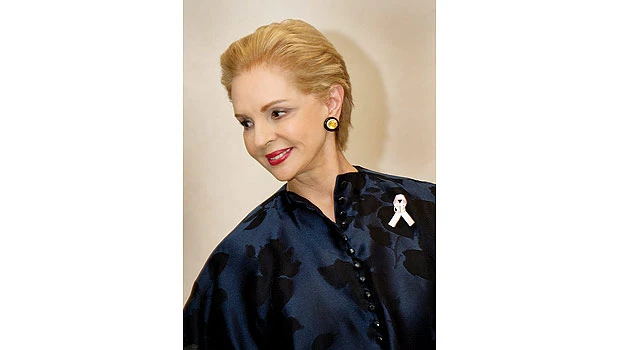
Geoffrey Beene Lifetime Achievement Award winner Carolina Herrera spoke of her happiness to finally visit Saudi Arabia and her personal mission to use her legendary status for good.
“This cause is very close to my heart,” stated Herrera. “I am very happy to be part of this special collaboration with the Zahra Breast Cancer Association and especially, Princess Haifa.” She went on to say that such initiatives were important tools to spread “strength, love and hope” to women and their families affected by the disease. “And, if we plan to fight this, I hope that we can all come together, from all over the world, as one,” concluded Herrera.
Overall, collaborative initiatives, such as this one are a step in the right direction. They attract people, who wouldn’t necessarily attend such functions, and help facilitate these initiatives’ advancement into the mainstream. Unfortunately, the concept for them is still very new in our female society, which is only familiar with pure social gatherings. Hopefully, this event acts as a learning curve to future philanthropic collaborations. The organizers should firstly filter invitees by slowly introducing new echelons of society, while indirectly coaching the proper protocol of such functions.
The Zahra Breast Cancer Association, Princess Haifa, and the Herreras should be applauded for their efforts. But if this event is a litmus test of how we women in Saudi Arabia are progressing in the realm of appropriate conduct, we have quite a journey ahead of us.