- Packing a suitcase is what you do before you travel.
- However, many Lebanese people from Baal’s generation who lived the days of civil war packed their suitcases with what once touched and wrapped their fearful bodies in the past as the sound of the bombings and shootings chased them.
Painter Mohamad-Said Baalbaki, or Baal, is one of the Lebanese people who experienced the bitter taste of horror, loss and displacement — the mixed feelings that come with every war and conflict.
“These experiences influenced how we, as many artists, viewed our lives. An artist cannot be separated from himself as a person,” Baal said. “What I suffered is reflected in my artwork.”
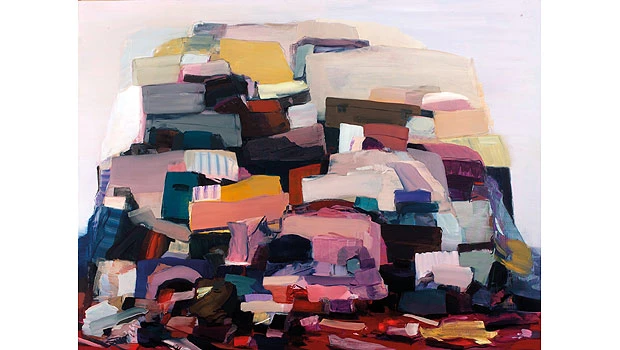
Baal’s first solo exhibition in the UK, titled “Sense of an Ending,” which was launched on Oct. 7 at Rose Issa Projects Gallery in London, displays paintings of piles of abandoned suitcases. It is an image that reminds viewers of these objects’ absent owners…those who left their country at a state of war, looking for better days.
His paintings reflect the sense of instability that children of his generation felt in the days of the Lebanese civil wars that lasted for 15 years between 1975 and 1990.
“The civil war played a major role in forming our personalities as a generation that was born in Beirut between the 70s and 90s.”
Baal who was born in 1974, packed his suitcase in 2003 and left to Berlin where he studied painting until he obtained a Master of Arts in 2008 and stayed there. The artist, who was born in Beirut, goes there as a visitor since then.
He started painting suitcases in 2005 when he was in Berlin where his art was born and flourished. He said that the suitcase accompanies every traveler and it can be looked at in so many different ways. “There is a sense of misery and sadness in it because it represents departures and goodbyes.” It stands for a new journey, which starts by the ending of a past journey as well as meeting loved ones on the other side of the globe.
“The different interpretations of an artwork are what makes it rich in meaning. A painting should not be very direct and clear in that it stops the viewer from pondering. It is good to allow the viewer the chance and space to think and analyze.”
From how he sees it, suitcases symbolize immigration and departing. “I, myself, am an immigrant,” he said.
In some of paintings the suitcases look more random, while in others, they look more organized. “When someone decides to reside somewhere, theme changes from a heap to more organized suitcases, which emphasizes the decision to stay and settle.”
Many Lebanese artists migrated, looking for more opportunities abroad. According to Baal, what brings different generations of immigrants together is being heartbroken when looking at the condition of the Arab world.
“The lack of support for artists in the Arab world makes many of them fly away looking for wider horizons to feed their souls.” Yet, there is always hope and optimism, he said.
Baal’s art is influenced by Syrian artist Marwan Kassab Bashi, his friend and mentor. He is also influenced by other European artists, including Francisco Goya, Giorgio De Chircio, Alberto Savinio and the American artist Philip Guston.
Those who are interested in his art can visit the exhibition, which will continue until Nov. 5.