
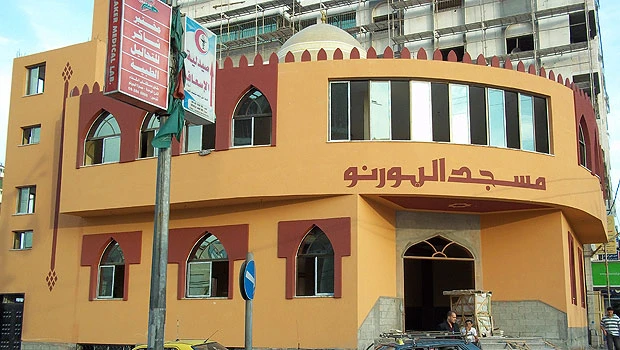
- GAZA CITY: An increased flow of essential building material — primarily cement, steel and aggregates entering the Gaza Strip via underground tunnels along the Gaza-Egypt border — has allowed reconstruction of hundreds of religious sites in Gaza to begin, destroyed during Israel’s Operation Caste Lead ending Jan.
- 2009.
Nearly a quarter of Gaza’s 850 mosques were affected by Israel’s 23-day offensive, characterized by an aerial bombardment and subsequent ground invasion. 45 mosques were totally destroyed, 107 sustained major damage, and about another 50 minor damages, such as smashed windows and doors from bombing, according to the Gaza public works and housing ministry, Awqaf and religious affairs ministry, and private mosque owners.
“Gaza is a religious society and mosques are the center of our communities,” says Awqaf ministry official Abdullah Abugrboah, and “Gaza’s population is 99 percent Muslim (predominantly Sunni), with a Christian population of less than 1 percent.”
It will cost about $25 million to reconstruct the 45 mosques, at an average cost of $500,000 per mosque, says deputy housing minister Yasser Shante, and about $10 million to repair the 157 that sustained damages, at an average cost of $100,000.
Israel claims the mosques were used by Hamas to store weapons and that Hamas operatives regularly fired rockets into Israel from within or near mosques.
Religious sites are separate from any activity related to security forces or resistance factions,” says Deputy minister of religious affairs, Hassam Seifi.
Freshly built tangerine and lime green mosques are appearing along Gaza City’s Mediterranean skyline, customary colors for Gaza buildings.
Reconstruction of Borno Mosque in Gaza City is privately funded by the Borno family and community members, using materials supplied by the tunnels. The new two-story mosque, to be completed in October, can accommodate 1,000 worshippers.
The original mosque, adjacent to As-Shifa Hospital, was bombed Dec. 28. 2009, shattering the windows to the hospital, already overwhelmed with trauma cases.
The next evening, rows of Palestinians stood shoulder to shoulder amid the ashes in a prayer for the city, reduced to breadlines and funeral marches.
Fathi Jerras, 60-years old, owns a tire shop near the mosque. “I am waiting for the new mosque to open, it’s bigger, with a place for women,” he says, a growing trend among the new mosques.
UN Development Program (UNDP) cleared rubble from 10 sites where mosques were totally destroyed as part of their massive post-war rubble removal project across Gaza.
About half of the destroyed mosques have been reconstructed, reports the religious affairs ministry.
About a quarter privately funded by mosque owners and community members, and the remainder from donations from charities in Arab nations, says deputy minister Shante.
Millions of dollars of funds promised by the Arab League for Gaza reconstruction in Feb. 2009 never reached Gaza.
Mosques are supervised by the religious affairs ministry, in accordance with Islamic law, under the Hams-led government, still branded by the international community as a terror organization by many western countries.
“Our communities lost a lot with the destruction of each mosque,” says deputy minister Seifi.
At least 50 libraries were totally destroyed, including thousands of books, reports Seifi, and the ministry now lacks 150,000 Qur’ans, unable to enter news texts due to Israel’s more than 4-year strict blockade of Gaza.
“We burned all partially destroyed Qur’ans and buried the ashes,” he said.
Five cemeteries were bombed, exposing the remains of bodies, causing over $1million worth of damage, says Seifi. Bones were collected by the ministry and reburied in one graveyard.
The ministry estimates damages to charities at about $2.5 million, education centers at about $250,000, and property owned by the ministry that was bulldozed at about $25 million.
According to international humanitarian law, there is no ban on destruction of religious sites that are used by the adverse party for military purposes, saysYuval Shany, chair in International Law at Hebrew University,although, thereis a presumption that religious sites are civilian targets and should be spared (According to article 52 of the 1977 First Additional Protocol, which reflects customary law on the matter).
The Israeli army maintains that its forces operated in accordance with international law, only launching proportionate attacks against military objectives.
According to the Goldstone Report, an Israeli strike on the Al-Maqadmah mosque near Jabilyah occurred when about 350 men and women were attending prayer. 15 people were killed and 40 wounded as a result of the attack.
Some 1,400 Palestinians were killed and about 5,000 injured in attacks by Israeli forces during the offensive, according to Amnesty International.
Reconstruction in Gaza is just gaining momentum as greater quantities of building material entering Gaza via tunnel has decreased market prices.
Israel only allows building material to enter Gaza via Israeli controlled crossings for approved projects funded by international organizations and UN agencies.
According to UN estimates, in Sept., 946 truckloads of authorized construction materials were allowed to enter Gaza via Israeli controlled crossings for approved projects, of which 665 truckloads (46,550 tons) of gravel, 232 truckloads of cement (9,195 tons) and 41 truckloads of steel bars (1,418 tons).
An average of 90,000 tons of cement, 90,000 tons of aggregate and 15,000 tons of steel bars are entering Gaza via tunnel each month, according to UN estimates.
Today one tone of cement costs about $135 in Gaza, down from about $340 per ton in January.