
- Philately as a means of comprehending the Arab world’s history and its present discontents
In the midst of the deepest tumults to engulf the Arab world and the West for many years, the London auctioneers, Spink, prompt reflection on the value of the austere science of philately (the collection and study of postage stamps) as a source of history with the sale of a major collection of Arab and Islamic world stamps, under the rubric Pearls of Arabia (Oct. 18-19, Spink, London). Impressive in its comprehensiveness in a plethora of ways, Pearls of Arabia shows extraordinary achievements of transportation in arduous circumstances, stamps of exquisite design, the harshness of Imperial rule, as well as the roots of the tensions that are an enduring legacy of the Middle East and North Africa.
The transport of mail is ancient in the region. Ibn Khurdadhbih, head of the ‘Abbasid postal service, left a 9th century account of the routes used to convey mail, and the Bab Al-Barid of the Great Mosque of Damascus was the departure point of the mail system instituted in the 13th c. by the Mamluk Sultan, Al-Zahir Baybars.
In modern times, the formation of a postal service in the region occurred under the Khedive regime in Egypt. A remarkable item marks the passage of a letter of 1867 from Jidda (Jeddah) via the Poste Vice-Reali Egiziani/Gedda to Suez where it arrived on July 6, 1867. This rarity of Arabian philatelic history is contemporary with , also sent through the Vice-Reali Egiziani/Cairo to Alexandria in a mere two days and thence to north Italy where it arrived after only seven days.
The expansion of postal services into North Africa and the Middle East stimulated the revival of old systems of delivery and the institution of new ones. A regular pigeon post was started by the French colonial government in Algeria in 1906 to communicate across the country’s vast spaces, and a private operation — Porte-Dépêches D. Dupont — advertised a service with a small message container attached to a birds foot, a hawk’s, rather than a pigeon’s .
In Sudan, fast camels were used to carry mail in a resurrection of ancient Arabian custom. From 1927 until 1941, a superbly drawn camel and rider appeared on the Sudan Postage series of stamps, inscribed in Arabic as Posta Sudaniya ). The piastre currency on the stamps was rendered as Arabic as “ghursh,” correctly qursh. By 1948, these Sudanese stamps were re-written with the classical Arab title “Barid Al-Sudan.”
Imaginative solutions to posting mail in emergencies are reflected in the Spink collection in . In an extraordinary survival, a letter from Ferdinand de Lesseps, the builder of the Suez Canal, was addressed to Port Sa’id and sent out of Paris by Ballon Monté, a manned balloon system used to counter the 1870 siege of the city by the Prussian army. Passing high over the Prussian trenches, the de Lesseps letter, like , destined for Tunis, escaped Prussian ground-fire, landed safely in French territory, transferred to the conventional French mail service and was sent on to its destination.
Ferdinand de Lesseps is recalled again in The Pearls of Arabia collection with his achievement of building the Suez Canal summoned up by , a rare Suez Canal Company stamped cover sent from Port Sa’id to Kantara in July, 1868, when the canal was still 18 months from completion.
Another experimental transportation system for Middle Eastern mail was started in 1933, when the Kingdom of Saudi Arabia and the Kingdom of Iraq both embraced the new German postal service provided by the Graf Zeppelin Line, using massive dirigibles, hydrogen-filled balloons that carried passengers and postage. These flew from Friedrichshafen in Germany across the Atlantic to the Americas.
Space and weight limits restricted how much could be carried. The Graf Zeppelin system was well organized with special envelopes issued at local agency offices. The were both sent in mid-1933, the first year of the Graf Zeppelin Atlantic flights, and to the same destination, the German Holz Co. at Pernambuco, Brazil.
The Graf Zeppelin letter from Baghdad would have traveled via the German-built railway track to Istanbul, to cross the Bosphorus by boat, and then to travel by train through the Balkans to Germany. It reached Friedrichshafen on June 2, 1933, and was loaded on one of the earliest Graf Zeppelin flights.
The letter from Saudi Arabia had to go by sea as the Hijaz Railway had been destroyed during World War I so it was sent from the Makkah Al-Mukarramah agency of the Graf Zeppelin Line via Jeddah and by sea through the Suez Canal to Germany where it was received at Friedrichshafen (Bodensee) Harbor on Sept. 30, 1933. Thence the letter joined the eighth Graf Zeppelin flight to Brazil. Unfortunately, the dangers of the Zeppelins were formidable, as was demonstrated when a Zeppelin crashed in flames in 1937 in New Jersey and the vast hydrogen balloons were abandoned as a means of transport.
During World War I, much changed in the Middle Eastern postal services through the exigencies and accidents of the war. A note from Sayyid Bin Ali Hashimi to the Sharif of Makkah, Al-Husain Bin Ali Al-Hashimi has a philatelic war trophy of September, 1917, in the form of two Turkish stamps taken “prisoner” at a station on the Sikkat Al-Hadid Al-Suri (the Syrian metal road), i.e. , the Hijaz Railway . One of the roles of the railway was to carry mail between Damascus and Al-Madinah and there were post offices along its route.
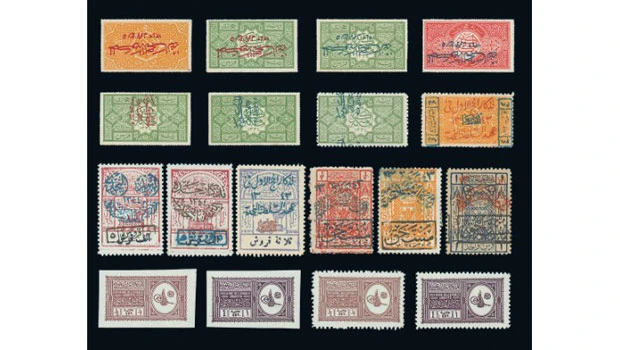
Shortly afterward, a rather baroque set of stamps were designed by T.E. Lawrence for Sharif Al-Husain of Makkah with fine Arabic inscriptions. An increasingly political tenor set in with Hijazi postage stamp designs in the next five years, beginning with a presentation set of Hijaz stamps made for the Sharif by the British of 1918 .
A complex Arabian postal history followed with numerous overprints as the political situation changed in the aftermath of World War I and the Ottoman Sultanate vanished. An exotic issue of the Hijaz was made for the use of the family of Sharif Husain b. ’Ali, marking his controversial adoption of the old Ottoman title of Caliph in 1921. These special stamps are inscribed with the Arabic words “Dhikr Al-Khilafa” (Remember the Caliphate), inscribed in gold powder, which was sprinkled into the wet black ink where it set hard.
With the expulsion of the Hashemites from the Hijaz by Sultan Abdul Aziz Al Saud of Najd, many changes took place in stamp usage with overprints in the name of the Sultan of Najd on old Hijazi stamps . This complex period ended with the proclamation of the Kingdom of Saudi Arabia, celebrated in 1934 with the name of King Abdul Aziz inscribed in the style of the old Ottoman Sultans’ tughras on a new issue of Saudi stamps .
Further north, when Aleppo was taken by the Arabs from the Ottomans in November 1918, there were no stamps and a Halab/Halep type had to be invented . The confusion of the times is also reflected in a cover sent from Damascus in 1918 by the Syrian company of ’Atalla and Jawkhdar to Beirut. Among stamps of diverse origins, it includes a stamp of the defunct Ottoman Sultanate showing a village, marked Khanat Posta .
These events during and after World War I have a longer ancestry as other stamps and covers in the Pearls of Arabia collection demonstrate. The Middle East’s current engagement with Western powers begin with Napoleon’s invasion of Egypt. This transforming event is summoned up in the Pearls of Arabia collection by an Arabic letter of December 18, 1798, translated into French and with Napoleon’s signature . Napoleon received it from the Egyptian Customs Director at Bulaq seeking the general’s help to recover debts owed to the customs office. Another letter of 1798 from Gen. Menou, Commandant des Provinces d’Alexandrie, Rosette, et Bahiré is stained with disinfectant, used by the Armée d’Orient in Egypt to ward off the plague that the French soldiers so rightly feared.
One of the features of the Pearls of Arabia collection is the degree to which it reflects the colonial impact on the Middle East and North Africa in the post-Napoleonic period. This shows itself in many ways, including a marked paucity of Arabic script in French stamp issues in North Africa.
This can be seen in stamps issued when the Protectorat Français was imposed on independent Sharifian Morocco on March 30, 1912. Before that date, under the Islamic government of the Sharifs, Arabic inscriptions on postage stamps still prevailed, even as European influence increased relentlessly in the country to bitter local resentment. The deeply Islamic Arabic nature of early Sharifian postage is shown in of 1904. This reflects an Islamic cultural tradition that had existed for centuries in Arab chanceries. The is written in a very fine Maghribi scribal calligraphy, descended from the script of 13th c. Andalucia. Islamic prayers are given in greeting for the well-being of Mawlay ‘Abdul Aziz b. Hasan (1894-1908), a descendent of a family of Hasanid Sharifs from Yanbu on the Red Sea coast. This Sharifian administrative tradition was all swept away with the French Protectorate Sharifian stamps, in which Arabic was replaced by French.
The French Protectorate administrators also issued stamps that could only offend a deeply conservative and hostile Muslim society. An example of this appears in the design of the Red Cross Fund Sharifian Post issue of 1914-1917 . In this, a classical female figure with a Red Cross sits above the word “Maroc,” reading a book inscribed “Droits de l’Homme. ” Fine stuff in Europe, perhaps, but it must have been read wryly by the Muslim tribes resisting the French armies as they enforced the Protectorate on Morocco.
Other discontent in Algeria is absent from the impressive Centenaire de l’Algérie. Emission speciale de Timbres-poste of 1930, printed on silk as an Epreuve de luxe in Paris. It is a beautiful piece of workmanship. Algerian coastal cities where the French colonists lived are juxtaposed to superbly executed portraits of Roman ruins and Islamic monuments. The minaret at Tlemcen (Tilimsân) is rendered with impressive accuracy. Yet, contrary to this idyllic celebration of a century of French rule, deep antagonisms existed between the local Algerian population and the French colonists and this was to lead to ever increasing violence.
The bitter resentment of the Algerians to French rule is demonstrated in Pearls of Arabia in , formidable documents of 1958-59, philatelic reflections of the ferocious final struggle of the Algerians for their independence. These two letters posted from Chartres and Paris to Constantine, Algeria were intercepted by French intelligence officers who wrote reports on them on the writers, Algerians suspected of being members of the Front de libération nationale (FLN). They are both marked “Secret/Confidential”. However, the FLN had infiltrated the French intelligence and removed these letters to pass them on to their own intelligence service. The two episodes are living testimony to the dangerous world of the Algerian liberation war that finally ended in 1962.
Other stamps in the Pearls of Arabia exhibition are relevant to the fighting of the present day in Libya. An older Libya, in its pre-Qaddafi time, had stamps stamps produced by the Italian Colonial authority . Others show the country’s later divisions into Cyrenaica, Tripolitania and Fezzan , and the Kingdom of Libya . These geographical divisions were rejected in the ideology of the early Gaddafi period although they seem to be echoed in the current revolution.
A philatelic record of the history of Palestine’s postal history from 1840 onward is contained in conglomeration collections, gathered together in the Pearls of Arabia auction , which Messrs Spink regard as a Gold Medal winning collection. This may be true, but it also raises a broader point, for while several important private collections of Arab world stamps exist, there is no comprehensive public collection of the Arab world’s historic philatelic materials in the Middle East. Given the wealth of information that philately provides, this is cultural deficit of high order.