- Given Saudi Arabia’s limited cultural scene, it is very rare to get the opportunity to enjoy a live performance, especially in classical music.
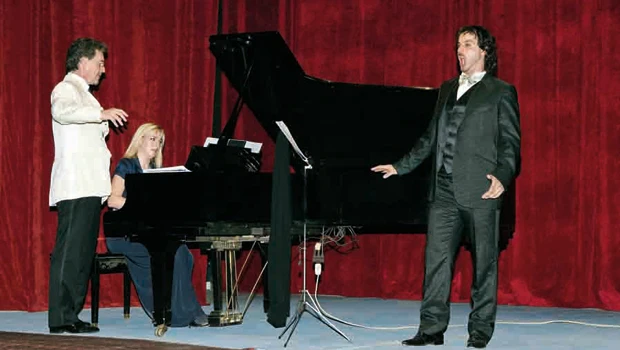
- Yet, last Sunday, Jeddah residents enjoyed just that in a night of opera at the Italian Cultural Center (CICER) where they took pleasure in hearing expertly interpreted pieces from great Italian romantic composers.
Soprano Sarah Agostinelli, tenor Adriano Gentili, trumpet player Mauro Maur and pianist Françoise de Clossey were invited by the Consulate General of Italy to open the celebrations.
Besides Jeddah, 19th century’s Italian Opera is in fact simultaneously reaching the world’s principal cities to celebrate the Italian Language in the World Week, which is running from Oct. 16-21. Sponsored by the Italian Ministry of Foreign Affairs, the week aims at promoting Italian language abroad and is dedicated this year to the 150th Anniversary of Italian unification.
“We travel all over the world,” explained trumpet player Mauro Maur. “However, performing in Jeddah for a public that is not used to lyrical music added a special flavor to our exhibition. Having to pay homage to the 150th anniversary of Italian unification, we chose heroic chants and passionate romances from Rossini, Bellini, Donizetti, Verdi and Puccini who were great poets but also patriots who nourished through their music the struggle for Italian independence.”
“Thanks to their talent the Italian language became a vehicle to build the spirit of national identity and a sense of belonging among people inhabiting Italian peninsula,” he added.
The soirée opened on the passionate notes of the Italian national anthem whose lyrics were written by poet and patriot Goffredo Mameli, a man involved in nationalist movements. Mameli died at a young age after having contributed, between others, to an insurrection in Milan (March 1848) with an expedition of 300 patriots.
“Mameli and most of the composers we chose are examples of political and moral virtue. We hardly had other models carrying such strong ideals after them,” explained Consul General Simone Petroni in his introductory speech. “Their effort to free Italy from the occupation of foreign powers went hand in hand with the promotion of democratic and national ambitions thus fostering similar movements in Italy other European countries.”
“The emphasis on imagination and extreme emotions typical of the romantic period represented an ideal context to encourage the patriotic ideals of Italian Risorgimento (1815-1861). Gioacchino Rossini (1792-1868) and his successors Vincenzo Bellini (1801-1835), Gaetano Donizetti (1797-1848) and Giuseppe Verdi (1813-1901) are all representative of the Romantic era,” said Petroni. “However, Giuseppe Verdi was the Italian composer who gave major relevance to patriotic themes and for this reason we decided to give ample space to his most successful operas within tonight’s program.”
Verdi’s most rooted composition in popular culture, such as the “Grand March” from Aida, “Un di, felice, eterea” and “Brindisi” from “La Traviata,” “Va Pensiero” from “Nabucco” and “La donna e’ mobile” from “Rigoletto” were performed by the quartet in duets but also vocal and instrumental solos. Always present on stage as main performer and accompanist, pianist Françoise de Clossey was able to maintain an intense and overwhelming level of participation throughout the entire concert. Particularly enchanting were Sarah Agostinelli’s and Adriano Gentili’s duets from Puccini’s “La Boheme” and Verdi’s “La Traviata.”
However, the quartet’s charismatic leader was undoubtedly trumpet player Mauro Maur, main coordinator on stage of this young and talented team and protagonist of an exquisite performance. The driving vigor of this conductor and composer for theater, television and cinema was particularly evident in his interpretation of “Va Pensiero” and “Mission,” an unscheduled piece dedicated to the figure of famous Italian composer Ennio Morricone.
Another unplanned performance was Maur’s interpretation of Nino Rota’s theme from “The Godfather” (Part II) that was originally conceived for a movie on Italian Risorgimento. Immediately after, Adriano Gentili’s superb vocal interpretation of “Nessun Dorma” (None shall sleep), a tenor aria from the final act of Puccini’s “Turandot,” closed the opera night event.
Having arrived a few days before their performance, the group had a chance to visit some of Jeddah’s characteristic places, including Balad district, Sami Angawi’s Al-Makkiah and various sea resorts and restaurants. For the second time in Jeddah, Françoise de Clossey hopes to have other chances to perform in the country and felt particularly fascinated by the humanity and beauty of Saudi women:
“I had demonstrations of affection, kindness and curiosity from my new Saudi friends and was impressed by the elegance and social engagement of some of them. I’m always more convinced that the West should look at Saudi society under new perspectives, cleansed of prejudices and conditionings,” said de Clossey.