- VAN, Turkey: Hundreds of Turkish commandos backed by helicopter gunships were attacking Kurdish militants in Iraq on Thursday, officials said as Ankara weighed a wider cross-border offensive after PKK fighters killed 24 of its soldiers.
Turkish security officials estimated their forces, numbering about 1,000 inside Iraq, had killed 21 fighters from the Kurdistan Workers’ Party (PKK) in the counterattack so far — 36 hours after its guerrillas mounted a series of deadly night-time raids on remote army outposts in Turkey’s mountainous southeast.
In a formal statement, the military said it had launched ground attacks in five different areas on either side of the border, and had also mounted air strikes.
Turkey’s leaders have pledged to avenge the PKK raid, amid swelling anger over one of the worst losses suffered by the army since the separatist insurgency began three decades ago.
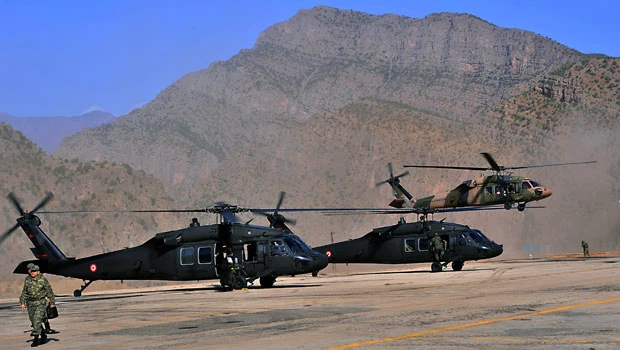
In the southeastern city of Van, soldiers carried Turkish flag-draped coffins one by one onto waiting military planes and helicopters to be taken to funerals across the country.
While military action so far has been limited to hot pursuit across the border and air strikes, there is speculation that the operation could herald a full-blown incursion, as happened in 2008 when some 10,000 Turkish troops swept into northern Iraq.
Such a prospect adds to concern over instability in the region, with US troops due to withdraw from Iraq this year, and mutual neighbor Syria in the grip of a bloody crackdown on pro-democracy protesters.
The strong stand taken by Turkey against Syrian President Bashar Assad’s crackdown has raised some speculation that Damascus could retaliate by stirring up Kurdish militants in Turkey, which possesses the second largest military in NATO.
Turkish Prime Minister Tayyip Erdogan has been careful not to blame the attack on any country. But the Radikal newspaper said on Thursday that a Syrian Kurdish commander, Fehman Huseyin, had led the attacks.
Both Syria and Iran have their own problems with restive Kurdish minorities, but nothing on the scale of the insurgency led by the PKK in Turkey.
More than 40,000 people have died since the conflict began in 1984, and Erdogan is under pressure to show decisive action in the wake of the latest attacks, jeopardizing efforts to reach a peaceful settlement.
After attacks like this, nationwide broadcasts of dead soldiers, referred to as “martyrs” by Turkish media and politicians, being laid to rest in flag-draped coffins whip up nationalist passions.
On Wednesday night, people demonstrated their hatred for the militant group, which has claimed responsibility, chanting slogans against the PKK at protests in several cities, including Istanbul and the capital Ankara.
Taxi drivers in Istanbul blocked one of two bridges across the Bosphorus Strait, blaring horns to mark their anger, and several newspapers on Thursday ran banner headlines quoting President Abdullah Gul’s words: “Our revenge will be great.”
Iraqi officials joined US President Barack Obama, Ankara’s NATO allies and the European Union in condemning the attack.
The Iraqi Foreign Ministry issued a statement on Thursday saying that the Iraqi government and the autonomous Kurdish Regional Government in the Iraqi north were committed to “maintaining border security and security cooperation with the Turkish government to prevent such acts being repeated.”
But in a sign of longstanding mistrust, Turkish Foreign Minister Ahmet Davutoglu was quoted by Turkish officials telling his Iraqi counterpart Hoshiyar Zebari — himself an ethnic Kurd — on Wednesday: “It is not time to condemn. It is time to take concrete steps.”
Iraqi officials in Baghdad say it is difficult for them to control the rugged area where PKK guerrillas have their camps. Turkish, Iraqi and US officials meet often on security.
Turkish commandos were believed, according to officials, to have surrounded a rebel group and there was sporadic firing in the battle zone near the Zab river several kilometers inside Iraq. Cobra helicopter gunships joined the fray from a base at Cukurca to strike militant targets early on Thursday.
Residents of Diyarbakir, the main city in southeast Turkey, saw half a dozen F-16 warplanes take off just before dawn from a base often used to launch air strikes on northern Iraq.
State-sponsored village guard militia were supporting operations in the region, according to the officials.
Erdogan, one of the most popular politicians in the Middle East for his harsh rhetoric against Israel and his championing of Palestinian rights, said he expects full cooperation from the international community in the fight against the PKK.
“Whoever provides implicit or open support to terror, whoever nourishes, protects, harbors it, whoever tolerates terror, tries to conceal the bloody face of terror or ignore the inhumane attacks of the terrorist organization, they should all know that the breath of the Turkish Republic state will always be on the back of their neck,” he said on Wednesday.
The European Union, which Turkey wants to join, has pushed the Turkish government to grant more rights to the Kurds.
But EU countries have also urged Kurdish lawmakers to distance themselves from the PKK, which is considered a terrorist group by the United States, the EU and Ankara.
Erdogan’s AK Party government has passed cultural and political reforms favoring ethnic Kurds with the aim of ending the violence fed by Kurdish grievances, and has pledged to work with the opposition, including the Kurdish bloc, to rewrite a constitution that was expected to address Kurdish demands.
But Wednesday’s violence might hamper efforts toward reconciliation between Turks and Kurds, who make up 20 percent of the population.