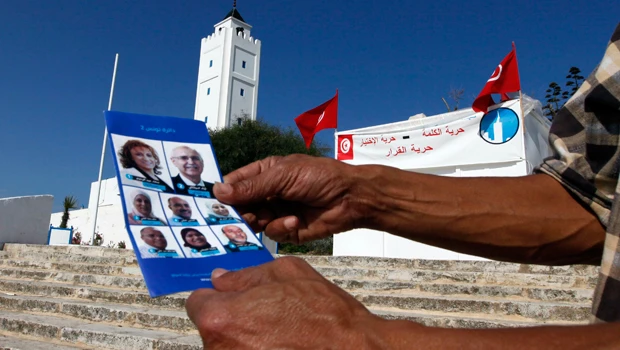
- TUNIS: Tunisians go to the polls today, Sunday, with a bewildering number of candidates to choose from.
- Some 117 parties have been authorized to stand — secularist, Islamist, socialist, communist, Baathist, center-left, center-right, green and more.
The moderate and well-organized Islamist Ennahda party led by Rached Ghannouchi is expected to win the largest number of votes with the centrist and secularist Progressive Democrat Party (PDP) coming second, but with so many parties involved and possible permutations of alliances, it was impossible on the eve of polling to predict whether Tunisia will remain on a secularist path, head down an Islamist one or end up with a grand coalition running the country.
It is to be Tunisia’s first free elections since independence in 1956 and, according to Tunisians and others, the first genuinely free contest ever in the Arab world. There were elections under Tunisia’s post independence President Habib Bourguiba and then his successor, President Zine El-Abidine Ben Ali who was overthrown in January, but they were not free and fair. Parties opposed to the ruling party were banned. Turnout was usually around 10 percent although it was always put much higher.
The vote brings to an end the initial transitional period that started with the January revolution. Technically, it is purely for a 217-member constituent assembly that will draw up a new constitution. In reality, the assembly can, and probably will, name a new head of state to replace acting President Fouad Mebazaa, and he in turn could appoint a new prime minister and Cabinet.
Despite the momentousness of the occasion, the last few days have seen complete calm in the capital Tunis despite the streets being plastered with party posters showing the local candidates and activists handing out campaign leaflets. Ordinary Tunisians are taking it in their stride. The news of former Libyan dictator Muammar Qaddafi’s death on Thursday produced far more excitement with convoys of hooting cars and cries of Allahu Akbar in the streets. Late Friday afternoon, the last day of campaigning saw some flag waving party convoys on the streets but they were quickly gone and did not arouse any attention.
On Saturday, with all the campaigning over, it felt like a normal weekend; shops and cafes were open and doing a brisk business. The only hooting was from drivers at the traffic lights wanting the cars in front to move. However, it was reported that large numbers of Tunisians were heading out of the capital in their hometowns to vote.
That suggests there will be a massive turnout. Although only 55 percent of potential voters have registered to vote, any adult can do so on presentation of an identity card at the voting station in his or her hometown.
There has been a massive campaign to get Tunisians to vote, from adverts on buses and in the media to mega billboards on the streets. Even ordinary adverts for products such as fruit juices exhort people to vote. The message from imams at prayers on Friday to the faithful was the same.
If there is a massive turnout, it may not be good news for Ennahda, whose name means “Renaissance.”
Opinion polls have been banned in the final weeks of the election but the most recent, in September, gave the party 23 percent of the vote, compared to 11 for the PDP. Observers believe that Ennahda could win anything between 25 and 45 percent of the vote. Everything they say depends on turnout.
According to Ziad Krichen, editor of the Tunisian daily El Maghreb, “the more people who vote, the smaller Ennahda’s share of the vote will be.” Other newspaper editors concur. “If there is a 55 percent turnout, Ennahda could get 50 percent of the vote,” explained one. “But if the turnout is more than 75 percent, it may win only third of the votes.” It is because Ennahda’s supporters are passionate and will turn out.
Last week, however, Ghannouchi who describes Ennahda as a democratic party based on Islam and similar to Turkey’s ruling AKP led by Recep Tayyip Erdogan, claimed that it will win more than 50 percent of the vote. Those claims were repeated at final rallies that attracted thousands of supporters — on Thursday in Kasserine in central western Tunisia and again on Friday in at a packed 15,000-seater sports stadium in Ben Arous, a low-income suburb of the capital.
The claims have raised concerns that Ennahda supporters may take to the streets when the results are announced on Monday if the party does not get the majority of votes it feels it deserves. On Wednesday, Ghannouchi claimed there would be vote rigging to prevent it winning and promised a new uprising if that happened.
That could create a backlash. Ennahda may be the most popular party in the most recent opinion polls but it is also the second most unpopular. In the same polls that gave it 23 percent support, 18 percent of those asked said that they reject it. Only 3.5 percent said they reject PDP.
Ghannouchi’s comment may have hurt Ennahda. It brought an immediate and stinging response from the Prime Minister Beji Caid Sebsi who said that the elections would be transparent and clean. “Rigging will not be possible. The ballot boxes will be open to everyone,” he said on national television on Thursday.
The comment also brought an attack from the party that is expected to poll third place, Ettakatol (also known as the Democratic Forum for Labor and Liberty). It called it “dangerous”. Any chance of the party joining in alliance with Ennahda, which it had earlier said it might do so, now seems remote. Ghannouchi seems to have realized the mistake. At Ben Arous on Friday, he backtracked, albeit with a sting in the tail, saying: “We will recognize the results of the elections, we will congratulate the winners, no matter Ennahda’s score.”
Ennahda generates strong emotions, both for and against. The party has repeatedly tried to reassure Tunisians that it has no intention of turning the country into an Islamic republic, that it is genuinely democratic. There will be no bans on alcohol or bikinis on the beach. Comparisons are made with Germany’s Christian Democrats. The party insists it fully supports women’s rights as stated in Tunisia’s present constitution. Nor has the party any intention to decriminalize polygamy, change the divorce laws, bring in Islamic inheritance laws or appoint Qadis to administer justice — leading to claims by more fundamentalist bodies, such as the local Hizb-ul-Tahrir, that it is not Islamic at all.
Despite Ghannouchi’s comments, all the evidence is that the contest will be free and fair. The independent ISIE election commission is being scrupulous. On Friday it announced it had removed the directors in charge of two polling stations for Tunisians voters abroad, in Lebanon and Qatar, for irregularities following complaints that they tried to influence voters — reportedly in favor of Ennahda. A complaint that the head of the polling station in Marseilles was helping Ennahda was rejected.
Whether most Tunisians have made up their mind who to vote for is unclear. It is reported that during the middle of the week that a third had no. Certainly, a number of people spoken to by Arab News over the past couple of days said that they were still undecided and would probably only make up their minds in the voting booth.
If Ennahda is right and it wins 50 percent of the vote, then the next stage will be clear. It has said that its members will not enter government; instead it will ensure that a technocrat government is appointed to deal with the country’s pressing economic problems. Another possibility is that it fails to win a majority but assembles one with two other parties that have said they would support it. They are the center-left and secularist Congress for the Republic, which is expected to be the fourth largest party in the assembly and the small neo-Maoist Tunisian Communist Workers’ Party — proof that even in Tunisia politics makes strange bedfellows. In fact, the latter may fail to gain any seats; the opinion polls show it as the most disliked party in the country.
The other alternative is a secularist alliance around the PDP. Three others groups have already signed up to it — the Tunisian Labor Party founded by the powerful trades union movement in April, the liberal Afek Tounes, and the Democratic Modernist Pole, itself an alliance of smaller parties. Last week, Ettakatol was thought still to be in two minds about joining but Ghannouchi’s talk of new demonstrations seems to have settled the matter.
The other outcome is a grand coalition involving Ennahda and the PDP and their allies.
There is undoubted public nervousness as to exactly where Tunisia is headed, whether it is Ennahda in control or the secularists. But there are no regrets as to the building of democracy. One Tunisian put it poetically. “A baby will be born on Sunday. We don’t know whether it is be a boy or a girl, but we do know that it will be human and it will grow up.”
Party political horse trading will begin Monday when the results are known. One particular result, however is already widely anticipated. The vast number of parties will soon whittle down to a more realistic scale as many merge or close.
Another expected result is that the assembly will contain more women than any other assembly in the Middle East or even further afield. Gender balance had been written into the rules. Voting is by proportional representation, with parties presenting a list of candidates for each of the 33 constituencies (27 in Tunisia itself and 6 for Tunisians abroad). Each constituency has up to a maximum of ten seats; some have less. But each list has to have men and women alternating; if the list is headed by a man, the second must be a women, the third a man, and so on.
It does not mean that the assembly will end up 50 percent women. In many instances only one member from a particular party will be elected in any constituency and that will be the person at the top of the list, in most cases a man. Just six percent of the more than a thousand party lists is headed by a woman. Ironically in this, if little else, Ennahda and the PDP (itself headed by a women, Maya Jribi) are of like mind. They both have just three lists headed by a woman. Even so, it is expected that the number of women on the assembly could be as high as 30 percent. That would be higher than in the British Parliament or the US Congress.