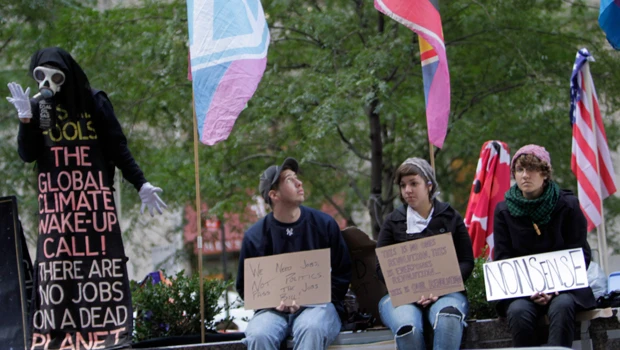
- PORTLAND, Oregon: When Occupy Wall Street protesters took over two parks in Portland’s soggy downtown, they pitched 300 tents and offered free food, medical care and shelter to anyone.
- They weren’t just building, like so many of their brethren across the nation, a community to protest what they see as corporate greed.
They also created an ideal place for the homeless. Some were already living in the parks, while others were drawn from elsewhere to the encampment’s open doors.
Now, protesters from Portland to Los Angeles to Atlanta are trying to distinguish between homeless people who are joining their movement and those who are there for the amenities.
When night falls in Portland, for instance, protesters have been dealing with fights, drunken arguments and the display of the occasional knife.
However, many homeless say the protests have helped them speak out against the economic troubles that sent them to the streets in the first place.
“The city wasn’t giving us what we needed,” said Joseph Gordon, 31, who trekked his way from Cincinnati two months ago and noted that there is nearly always enough food but never enough shelter. “You can’t feed your problem away. It took this camp to show people how it really is.”
As protesters across the country try to coalescence around an agenda in the coming weeks and months, they are trying to make life work in camps that have become small-scale replicas of the cities in which they were erected. And just like those cities, they are dealing with many of the same problems the local governments have struggled for decades to solve.
Some organizers see the protest and the inclusion of the homeless as an opportunity to demonstrate their political ideals. They see the possibility to show that the homeless are not hopeless and that they, too, can become a functional part of society.
In Portland, the protest has swallowed up two square blocks. There are shaggy haired college kids, do-gooder hippies, and couples with their young children. They came by the dozen, in cars and vans, on bikes and on foot and in rides hitched on the highway.
At the center of the camp are the medical, information, library and wellness tents. Along one side are families, who established a play area for children. On the opposite side is the “A-Camp” — for anarchist. It’s where the city’s anarchist faction and long-term homeless sleep.
“We’re here to spoil each other,” said Kat Enyeart, a 25-year-old medic who says she spends half her time tending to the homeless, some of whom are physically and mentally ill. “It’s a big, messy, beautiful thing.”
Brent Jackson, 46, is one of the homeless who has been recruited as a volunteer and is an active member of a planning group. He said the protest’s message rings especially true with homeless people.
“The homeless are the bottom of the 99 percent,” Jackson said, referring to the percent of Americans the protest says it represents apart from the wealthiest 1 percent.
“We have a lot of disillusioned Americans, but they don’t think what happened to us can happen to them,” he said. “Except it can.”