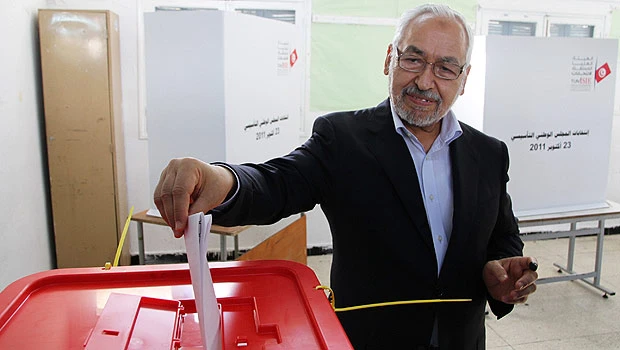
- TUNIS: The Arab Spring bore its first fruits on Sunday as Tunisians headed en masse to the polling stations in the country’s first free elections ever.
- Turnout of the 7.2 million potential voters in the 10 million nation has been massive.
Despite the bitter rivalry between the more than 110 competing parties, the voters were calm to the point of serenity about the process — but immensely proud that it was taking place. There was great confidence, too, that regardless of which party gains the largest number of votes, the foundation stone for Tunisia’s future as a democratic nation has been laid.
None of the voters that Arab News spoke to had ever voted before. “I’m almost 80,” said Abdullah Ben Amor. “I’ve lived under the French, the Bey (the hereditary ruler of Tunisia), Bourguiba and Ben Ali and this is the first time I’ve voted.” He triumphantly waved his left index finger, marked with black ink to show that he had voted. He was clearly very proud.
Claiming to be a first-time voter was the universal refrain throughout the day, although the calm and dignity surrounding the event almost suggested that this was something the Tunisians were well used to.
Najda, 42, and her husband Habib, 45, had been waiting at a polling station off Tunis’ downtown Avenue Bourguiba for two and a half hours. The queue behind them stretched at least a couple of blocks. They had arrived at 8 a.m. Neither had voted ever before. “Before, it didn’t mean anything. It was useless,” said Najda.
“It didn’t change anything,” joined in 43-year-old Hadi Hamrouni, another first-time voter standing in front of her.
Najda’s parents, whom she had just phoned and knew were standing at that very moment in a queue outside a polling station in Bizerte, 60 km north of Tunis, had not voted previously either. The election, she said was “very important” and it was very important that people voted. It was a foundation, “the base, insha Allah, of a new Tunisia.” As to the results, it would be “a mosaic” of parties she predicted with a smile. None would dominate.
Jamila Essouri, 45, who had also been waiting patiently in the queue for two and a half hours, was another first-time voter. By mid-morning, as at other polling stations, there were long queues, and they were moving very slowly. “If I had to stand 24 hours in the queue for this, I would,” she said. “It’s a very special day, and I’ve set aside the whole day for it.” It was “the birth” of a new Tunisia.
The same sentiments came from voters elsewhere in the capital.
By 1 p.m. it was getting hot in the bright sunshine standing in the street outside a school-turned-polling station near the Bab Souika in the Kasbah, Tunis’ old city. Businessman Mohamed Selmi, 55, and 40-year-old Feradj, an IT engineer, were holding up newspapers to shield their heads from the sun. But that was not going to deter them. They had only arrived half an hour before — but “I’d wait 24 hours in the sun to vote. Even if I were on fire, I’d wait.”
Everyone is “so happy, so joyful” at having free elections, Feradj said. The freedom to choose is more important than the outcome. “It doesn't matter what party people support,” he said. “It doesn't matter how young or old old they are or whether they are educated or not. We are very proud to do this.”
Like almost all the voters whom Arab News spoke to during the day, he had not registered to vote. He was simply turning up, as was permissible, with his identity card at his local polling station. He was convinced that at least 70 percent of the potential electorate would vote, if not more. As he spoke, a elderly man, pushing his wife in a wheelchair and panting, rushed past. He waved to Feradj in recognition and headed to the end of the queue. He looked desperate to get to the polling station and vote.
Inside another polling station in the Kasbah, where there was a half-hearted attempt to divide male and female voters into different queues, it was also a first time affair for 25-year-old Khalil, the only voter Arab News met who had previously registered to vote. He and three of his friends had been waiting in line for more than an hour. “We’re here for democracy,” he said. All four were of the same view.
Khalil admitted, however, that with over 100 parties on offer it had been “very difficult” to choose, “but we must,” he said. He had made up his mind, as had his three friends, but like all others at polling stations, he would not say who he would be voting for. Nor would his three friends. But that was not the point. The important thing was they were free elections. “It’s going to work out well. I’m sure,” he said, reflecting an almost universal optimism in Tunisia during the day about the process. The others agreed.
Unlike downtown, where at the polling stations there was a roughly equal number of men and women waiting to vote, in the Kasbah, there appeared to be at least twice as many men voting as women.
It was announced by the independent electoral commission during the day that results would be out Tuesday, not Monday as previously said.
"It's quiet today," said a taxi driver on Sunday afternoon. "But that's when the arguing will begin," she added.