
- Most of the famous chocolatiers in the world today are men, but that does not exclude women from the business of making chocolates.
- In fact, the Middle East has its own rising star, Mona Shamma, who concocts some of the most exclusive chocolates in her laboratory, which is nestled in the heart of Beirut.
Everything about her, reminds me of the heroin of the film “Chocolat,” played by Juliette Binoche. The chocolates she made so lovingly transformed all the people who tasted them! Shamma’s passion for chocolate is equally infectious. Her interest dates back to her childhood years in Geneva where she went to school. Every year in December, a festival celebrates the defeat of the surprise attack by troops sent by the Duke of Savoy in 1602 on the city of Geneva. Nowadays, as part of the celebrations, all the chocolate makers produce and sell eye-catching cauldrons made entirely from chocolate.
“I think that this ‘chocolate cauldron’ made me fall in love with chocolate: It is a feast for the eyes!” said Shamma who pays great attention to the taste as well as the aesthetic side of her chocolates. Known for her creativity, she strives to be original, imaginative, artistic and innovative.
“I want to create a chocolate for each season exactly like in the fashion world. It is important for me to keep impressing my clients with new ideas, shapes and flavor.”
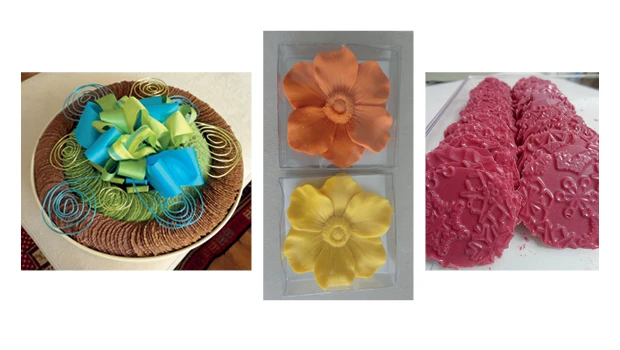
She specializes in the creation of customized chocolates for special events such as weddings, engagements and baby showers. She excels in setting up themes in chocolate. She not only produces all the shapes you can imagine, but the exquisite taste matches the perfection of the chocolate form. Her colorful chocolates of orange, yellow, pink and green have a delightful, fruity flavor of mandarin, lemon and raspberry. Shamma can do the impossible and will make your wildest dreams come true, in chocolate.
She uses the best quality chocolate and never adds butter oil, hydrogenated palm oil or vanillin, as such ingredients turn the chocolate into a pasty texture which gives way to a rather bad aftertaste. “The origin and type of the cocoa bean has an enormous effect on the taste of the chocolate,” she explains.
Indeed, the unique flavor notes found in chocolate are intimately related to its country of origins. The taste of a cacao bean depends on the soil but also on its growing conditions. Types of plants, local harvesting and fermentation practices also affect the flavor.
It is important to know that there are three main kinds of cacao trees: Forastero, criollo and trinitario. Forastero, the main bulk bean, accounts for about 90 percent of all beans, but it does not have fruity or aromatic flavors. The criollo bean is a flavor bean grown mainly in Latin America whereas trinitario, a fusion of the two strains, gets its name from the island of Trinidad where it was first grown. Africa is known for producing large quantities of forastero cocoa beans, but Latin America and the Caribbean grow criollo beans with distinctive tasting notes.
A hundred years ago, flavor beans accounted for nearly half of all cocoa beans. Presently, they account for less than five percent, mainly because the mass production of chocolate in the last century relied on a steady supply of inexpensive beans.
Cocoa beans from Trinidad and Tobago have a cinnamon spiciness, those from Jamaica hint of pineapple; beans from Ecuador have a floral quality redolent of jasmine; those from Venezuela evoke flavors of ripe red plums and dark cherries, those from Madagascar have light citrus flavors like tangerines whereas in Panama, notes of roasted nuts dominate.
Shamma’s best selling chocolates are the “Grand Cru Milk Chocolate,” as well as her very special raspberry and lemon flavored chocolate.
“I think Arabs still prefer milk chocolate because their taste buds are still used to the overstated sugary taste of Arabic sweets. Dark chocolate is an acquired taste. I think that they are on the path of changing toward less sugary chocolate, but it will still take time. I think that in the Middle East area, we still look at chocolate bought from chocolatiers as a gift to others on special occasions. Rarely are there people who will enter into a chocolate shop to savor chocolate for their own pleasure and inquire about its origin,” she explains.
Indeed, the demand for premium chocolate, in Europe especially, is growing. The French have recently rediscovered the art of savoring a “chocolat chaud a l’ancienne,” that is a traditional hot chocolate that is so thick, it pours like custard. Italian hot chocolate is thickened with starch, but the French only use a mixture of milk, chocolate or cocoa powder and sometimes cream.
Jean-Paul Hevin, a Parisian chocolatier, serves a hot chocolate with an oyster emulsion in his trendy chocolate bar! The daring customer ordering this bold combination is advised not to stir the creamy blobs floating like sea foam on the chocolate concoction. The duo of chocolate and salt is pleasant enough. I enjoyed something similar for the first time in Spain, which was a chocolate sprinkled with crystallized salt, made my Valor. However, a hot chocolate served with jellied splotches of oysters! That is farfetched! I prefer his hot chocolate topped with a bright orange froth and spiced with banana-chili pepper. This beverage reminds us of the way the first chocolate-lovers made their hot chocolate. They would grind the cocoa beans into a coarse paste and mix it with spices, water and chilies to create a hot, frothy, bitter drink, or the beans were mixed with corn and flavorings to make a kind of porridge, which is healthy and high in nutrients — a far cry from the chocolate we eat today.
Shamma insists on the health benefits that come with dark chocolate, which is packed with flavonoids, a group of phytochemicals that act as antioxidants in our blood. They improve blood vessel functions and lower blood pressure while also guard our DNA from damage that can lead to cancer.
Chocolate also provides a feel good factor. It gives an immediate blood-sugar fix while its high caffeine levels (a 4 oz bar contains more caffeine than a cup of coffee) will ensure you stay awake.
“Chocolate also affects one’s mood,” says Shamma. “Chocolate causes certain endocrine glands to release hormones that affect your feelings and behavior by making you happy. Therefore, it counteracts depression, and makes me smile while in my mouth and a second time while in my system.”