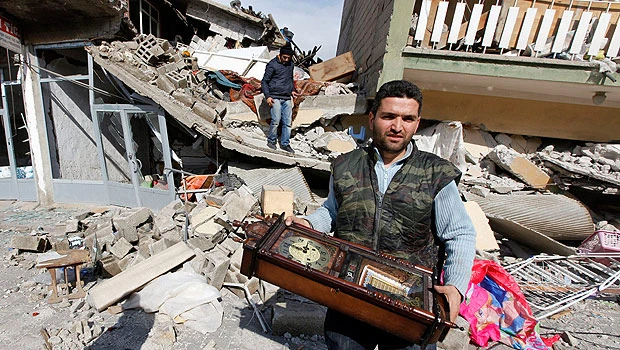
- ERCIS, Turkey: A week after a powerful earthquake in southeast Turkey, hordes of survivors roamed the streets past devastated homes, some complaining their families still had no tents with winter closing in.
On Saturday, the official death toll crept up to 582. The town of Ercis was worst hit by the 7.2 magnitude quake, with 455 people killed. The last person dug out of the rubble alive was a 13-year-old boy in the early hours of Friday, and hopes of finding more survivors were all but gone.
Deputy Prime Minister Besir Atalay told a news conference in Van on Saturday that search and rescue operations at the last five sites in Ercis would be halted in the evening.
Under fire for a slow response in the early days of the disaster, state authorities have declared tents will only be given to families once their home has been deemed uninhabitable.
Overseeing the relief efforts, Atalay said 35,000 tents had been handed out so far, and there was no shortage. But people have complained distribution was chaotic, tents were looted, and some were sold by profiteers on the black market.
“From now on, we are determining the need for tents according to our nightly visits and not according to citizens demands,” Atalay said.
Atalay earlier said the emergency needs for all the affected — at least in the main urban areas — would be met by Saturday night, though supplying outlying villages would take longer.
For people still waiting for the state to help they seemed empty words, after spending a sixth bitterly cold night under whatever shelter they had made for themselves, and accusations of mismanagement and unfairness of handing out tents were rife.
“They give tents to supporters of the government party. Village leaders hand out tents to their friends and relatives. Public servants get the best tents,” 60-year-old Kahraman Kaya told Reuters, tramping the streets of Ercis with other grim-faced, red-eyed and unshaven men.
Relief agencies have established tent cities on the edge of a town that was once home to nearly 100,000.
The state says it has enough tents to meet the people’s needs. The trouble is the people say they need more tents, and the authorities say far less need tents than they think.
People of the region are predominantly Kurdish, and the government is trying to build bridges with the ethnic minority while fighting a long-running separatist insurgency, making it particularly sensitive to any accusations of neglect.
Parades and receptions on Saturday for Republic Day, celebrating the formation of the modern Turkish state, were canceled.
“The government says it is trying to help but aid has not reached us. This is a city of winter,” said Giyasettin Calis, 41, who had constructed a makeshift tent from nylon and canvas to shelter 13 other members of his family.
“The government won’t give us tents so we had to make our own tents ... We are all waiting for the government to come and see our homes for themselves.”
Food distribution centers are giving out water, nappies, bread, hot soup and pasta in plastic trays, but survivors say their main problem is long-term shelter from the cold.
No official figures were available for the homeless.
The International Federation of Red Cross and Red Crescent Societies put the number of “affected people” at 50,000.
In Van, a city of a million people which suffered less damage, there were questions over the water supply with tests being conducted to ascertain whether it was potable.
People fear their homes are too damaged to withstand aftershocks — there have been well over a thousand since the quake, including a few with a magnitude of between 5 and 6.
Lights were switched back on in some buildings in the center of Ercis on Friday for the first time in six days and a pharmacy, a bank and a computer parts shop re-opened, but there was no running water.
Electricity cables were run to the camps so people could plug in whatever appliance they had salvaged next to the tents.
Nezihe Saglam, a 38-year-old housewife, fretted for her children as she sat around a small camp fire with other family members who had pitched three tents in a garden.
“We have a stove in the tent but it’s freezing at night, and the stoves can’t help the freezing temperatures. What if the kids get infections?” she said.
Niyazi Dogac Gucbilek, a senior health official drafted in to run a mobile hospital near a camp in Ercis of more than 330 tents, said the main task now was countering acute respiratory illnesses and blood pressure problems, as winter fast approaches.
“Cold is the biggest problem now. We had many diarrhea cases In the first few days but now it is down to normal levels,” he told Reuters. More brightly, he said 10 babies had been born there in the past five days, all perfectly healthy.
International aid has flooded into Turkey, after it called for help to supply winterised tents, containers and prefabricated housing to shelter the homeless.
The first foreign planeloads of tents have arrived. On Friday, Armenia also sent aid supplies, despite a long history of enmity with Turkey and floundering efforts to reconcile.
The United States said on Friday Turkey had requested its help, and the US European Command would airlift supplies such as blankets and sleeping bags within the next two days.