- DOHA: The Bangladeshi head of a non-governmental organization dedicated to empowering millions of poor people across the world has scooped the world’s first major prize for education in Doha on Tuesday.
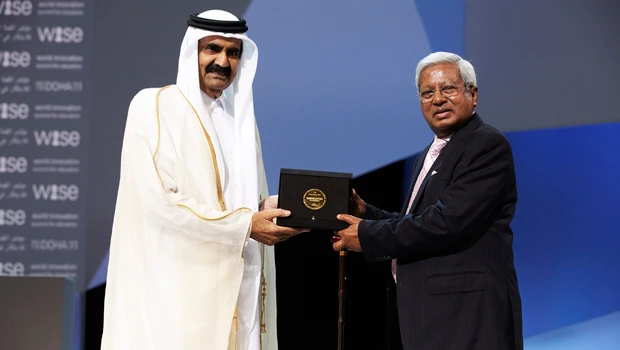
Sir Fazle Hasan Abed of the Bangladesh Rural Advancement Committee (BRAC) was awarded the WISE Prize for Education at the third World Innovation Summit for Education by Qatari Emir Sheikh Hamad bin Khalifa Al-Thani and was given a standing ovation.
Abed said he “humbly” accepted this award on behalf of the staff and teachers at the organization, which currently reaches over 138 million people in 10 countries across Asia, Africa and the Caribbean.
“I am guided by an ideal of a world free from all forms of exploitation and discrimination. Education is the answer to this quest,” he said in his acceptance speech following the summit’s opening plenary session on Tuesday morning.
“I should like to thank (WISE organizers) the Qatar Foundation for instituting this magnificent prize and for honouring me and BRAC with its first instalment. I have discovered time and again in my four decades of work with BRAC that education is the fundamentalist catalyst for change.”
The plenary session featured a panel discussion with Qatar Foundation Chairperson Sheikha Moza bint Nasser, Carnegie Corporation of New York President Dr. Vartan Gregorian, South African Minister of Science and Technology Naledi Pandor and Director of the Earth Institute Jeffrey Sachs.
All were, unsurprisingly, unanimous in their view that innovation in education was the way forward to ensure youths had the chance to realize their potential.
Sheikha Moza, in particular, stressed that the prevailing challenge in education was whether the world could “offer our youth a meaningful future they very much need.”
She said unemployment was the highest in the Middle East and North Africa region and in order to alleviate it, an extra 50 million jobs would need to be created.
It was revealed that Gregorian in an open letter to US President Barack Obama appealed to him not to neglect education, reminding him that “you get what you pay for.”
“Most politicians know the price of everything, but not necessarily the value of everything,” he added.
Sachs singled out governments in the Western world for particular criticism, adding that they were in a “moral crisis.” By this he meant countries in the region were focused on solving their own problems, meaning it was time for emerging nations such as China and those in the Middle East to step up.
He was particularly scathing of the US, claiming that its government spends 30 times more on its military.
He reminded delegates that every society needs a good education system. “(It will provide) the highest return for the economy, and the highest return for society.”
Born in 1936, Sir Fazle Hasan Abed completed his secondary education in Dhaka and went on to study at the University of Glasgow. He returned to the UK during the 1971 Bangladesh war of independence from Pakistan where he lobbied and raised funds for his country.
The conflict left the country in ruins, prompting Abed to establish BRAC, which concentrates on bringing education to children and young people not reached by the traditional system. Over more than 40 years it has contributed directly to the education of more than 10 million students at a variety of levels.
For his tireless work, Abed was knighted by the British crown last year.