- ISTANBUL: A decade after the Taleban were ousted from power, regional leaders Wednesday pledged to find ways to improve security and economic development in Afghanistan as international combat forces prepare to leave by the end of 2014.
The one-day conference in Istanbul followed the September assassination of an Afghan peace envoy and other high-profile assaults in Afghanistan that have diminished prospects for a negotiated settlement and intensified suspicion of Pakistani support for the insurgency, an allegation that Pakistan’s government denies.
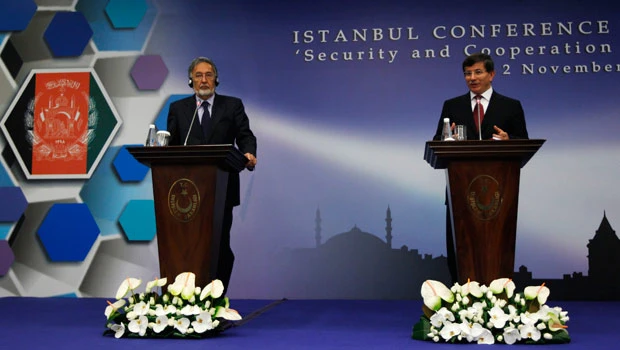
In an opulent hall on the shores of the Bosporus Strait, delegates delivered speeches promising support for Afghan sovereignty, and endorsed a transition to Afghan security leadership, efforts for a political solution to the war and economic development.
As a show of solidarity, the meeting was a success, but it was also a reminder of how much remains unsolved.
“The terrorism, extremism, as well as drugs and human trafficking that Afghanistan is struggling against are not problems that one country can deal with on its own,” Turkish President Abdullah Gul said.
“It is our duty as neighbors to contribute to Afghanistan’s unity, stability and prosperity,” Gul said. “It is also a necessity for the sake of our common interests.”
Afghan President Hamid Karzai and his Pakistani counterpart, Asif Ali Zardari, discussed a joint inquiry into the Sept. 20 killing by a suicide bomber of Burhanuddin Rabbani, a former Afghan president and peace council leader. But the relationship is strained. Afghan and US officials want Pakistan to crack down on militants who operate on its territory and cross into Afghanistan to conduct attacks.
Pakistan denies it shelters militants and notes the deaths of many Pakistani soldiers in battles with such groups. Its leaders bristle at US criticism that they play a double game, fighting militants in some areas and supporting them in others where they might be useful proxies in a future conflict with India, its archenemy.
China, India and Iran were among countries with envoys at the conference. The United States and other Western countries with troops in Afghanistan also sent representatives.
“Ten years of conflict in Afghanistan have taught us that military means alone are not sufficient to solve this crisis,” German Foreign Minister Guido Westerwelle said in a speech to the delegates. “We need a political solution with active support from the region.”
In a message ahead of the Eid Al-Adha holidays, the Afghan High Peace Council, which had been led by Rabbani, urged the country’s neighbors to stop meddling in Afghan affairs and support talks.
“It is time that our neighboring countries stop their interference, and rather than increasing violence in Afghanistan, allow the Afghan people to live in peace and prosperity,” the council said in a statement.
It said it was continuing work to open negotiations with the Taleban, but would not talk to anyone whose identity could not be verified or who appeared to be pushing the political goals of other countries.
“The Council requests that Pakistan be honest and take some practical steps toward peace in Afghanistan,” the statement said.
Afghan officials seek regional support for the idea of a “New Silk Road,” an integrated trade and transportation network that would run through Afghanistan. The nation was at the crossroads of the historic east-west trade route known as the Silk Road.
The US has also pushed economic cooperation as a way to wean Afghanistan off international assistance and undercut the appeal of extremism.
Amnesty International said Afghanistan should work with neighboring countries to protect human rights in the run-up to NATO’s withdrawal and afterward.
Sam Zarifi, Asia-Pacific program director for the group, said progress had been made since the US-led invasion that toppled the Taleban in 2001, citing a decrease in discrimination against women and better access to education and health care. But advances have faltered in justice and policing, and in improving conditions for some 450,000 people displaced by the conflict, according to Zarifi.