
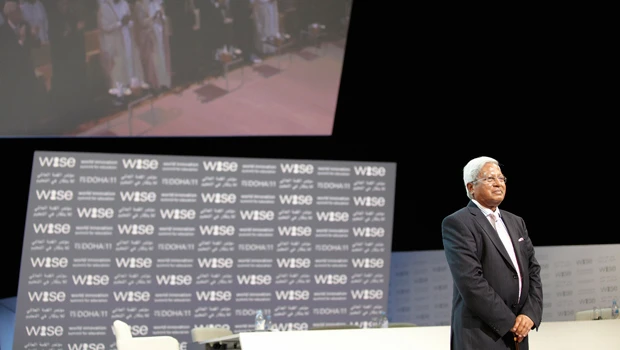
- DOHA: The winner of the first major world education prize in Doha praised Saudi Arabia on Wednesday for investing heavily in its educational system, but warned women in particular would need to be given more opportunities to put their learning into practice.
Sir Fazle Hasan Abed, who heads the Bangladesh Rural Advancement Committee (BRAC), won the inaugural WISE Prize for Education at the World Innovation Summit for Education in the Qatari capital on Tuesday.
In an interview with Arab News, he said the biggest challenge Saudi Arabia and the Middle East as a whole face in the education domain is ensuring the gender gap is closed significantly.
“(Saudi Arabia is) getting some of the best teachers or the best professors coming in from outside to teach,” he said.
“The only thing I would worry about is the education provided to women, the quality of it and what (Saudi Arabia) wants to do with women’s education. Do you want to get women to be also operating in the arena of men? If you are going to keep them separate or out of the business or work, then you are not using them, even if you educate them.”
He said only by closing the gender gap dramatically between men and women would Saudi Arabia benefit from its investment in education.
Abed described the feeling of being honored at the summit as a “wonderful experience,” adding that he was delighted not only for himself, but also that the hard work carried out by staff at BRAC had been recognized in such a manner.
He said the award was important as it meant his organization would gain further exposure and help it to continue empowering poor people all over the world to improve their lives. He praised WISE for setting up the prize in the first place, adding that similar world-class awards such as the Nobel Prize did not recognize education.
“(The prize is) special in the sense that it is a world-class prize, it’s not just a local thing. Qatar, it aspires to be known in the world as the capital of educational discussions,” he said.
He added that education has been important for many years, especially with regard to producing eminent leaders past and present.
“But education has now become democratized. It is not just leaders that need to be educated, but human beings; all citizens need to be educated,” he said. “So education has brought a much more wider, more democratic interest.”
He said governments’ legacies would depend more than ever on how educated their citizens were.
BRAC currently reaches over 138 million people in 10 countries across Asia, Africa and the Caribbean, but currently none in the Middle East region are covered by the organization.
However, it has of late focused its operations on post-war countries such as Afghanistan and Sri Lanka, suggesting a move into the Middle East is not far off.
“We have had plans to expand into Yemen, but the situation there suddenly deteriorated into almost civil war conditions,” said Abed, suggesting that once the unrest in the country resolves itself, BRAC would re-examine plans to set up offices there.
He expressed hope that his and BRAC’s legacy would continue to endure for centuries.
“Societies are not going to be poor forever. Poverty will go and there will be evolving needs. The needs could be higher education, the needs could be social development, it could be all kinds of needs that will continue to evolve in societies,” he said, adding that BRAC would be there to meet those challenges.
When asked whether it was too optimistic a view that poverty would eventually be eradicated, he replied no one thought slavery would be abolished even though that is exactly what happened in the 19th century.
He was in no doubt about how education needed to improve throughout the world.
“Most countries now are waking up to the fact that education investment means investment for their future,” he said.
“I am sure that we are seeing more investment in education than there ever was in history.”
He added that there was a need to ensure societies became more focused on learning as a continuous process, rather than something that ends once youths leave school or university. He said learning also needed to be more active and engaging, rather than memory-based.
Born in 1936, Sir Fazle Hasan Abed completed his secondary education in Dhaka and went on to study at the University of Glasgow. He returned to the UK during the 1971 Bangladesh war of independence from Pakistan where he lobbied and raised funds for his country.
The conflict left the country in ruins, prompting Abed to establish BRAC, which concentrates on bringing education to children and young people not reached by the traditional system. Over more than 40 years it has contributed directly to the education of more than 10 million students at a variety of levels. For his tireless work, Abed was knighted by the British crown last year.

