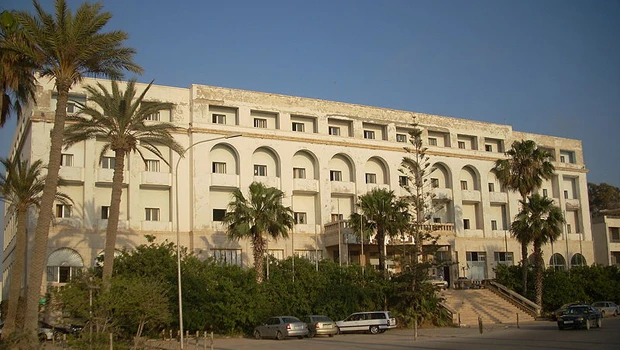
- BENGHAZI: Benghazi’s Grand Hotel has been closed for some time, but it is one of the city’s major historic buildings.
- However on Thursday, a demolition team arrived and started to knock it down.
The attempt to raze the sea-front hotel built in 1936 has produced a wave of anger in Benghazi along with allegations of corruption in the local city council. Permission to demolish the building was signed by the head of the city council, Salih Al-Ghazal, ignoring the campaign to save it and an earlier ruling that nothing will happen until after an enquiry into its safety.
“Someone on the council must have been paid,” claimed a Libyan journalist. “This is vandalism.”
The allegations come on the back of a number of other protests across the city. Saturday saw continuing protests by local troops who again blocked the road outside city’s only five-star hotel, the Tibesti, demanding pay. Down at the port, truck drivers are on strike demanding the right to work for customers direct and not have to go through agents. Other groups of workers have also gone on strike. There are also growing allegations that the new authorities are following in Qadaffi’s footsteps and ignoring the city now that the National Transitional Council (NTC) has moved to Tripoli.
The company responsible for the hotel demolition claims that it has done everything legally. However, the issue could easily focus all the various resentments and become a serious challenge for the TNC. Outside the Grand on Saturday, protesters were in place to prevent any further action by the developers and there was a queue of cars on the road as drivers stopped to find out what had happened. They were handed photocopies of the permission to demolish signed by Al-Ghazal and the shock on their faces was evident.
“We going to organize a mass protest against the city council,” said Mohamed Shimbush, a spokesman for the preservation group determined to save Benghazi’s heritage, in particular its old Italian city center. “If this is what they do, how can we trust them? They will have to be thrown out.”
He alleges skulduggery. The demolition team came in on Thursday, just as the weekend and the Eid holiday were starting. He claims it was deliberate. “They came in hoping no one would notice, when everybody would be out shopping for Eid.”
According to Shimbush, the art-deco hotel used by the British RAF as its headquarters during the later part of World War II and where many famous personalities stayed, including Britain’s wartime prime minister Winston Churchill, was sold by the Qaddafi regime to a consortium, including the Libyan Foreign Investment Company and the Malta-based hotel group Corinthia. It plans a multi-story, 360-bedroom hotel on the downtown site.
The Corinthia operates the top hotel in Tripoli. There have been allegations that it was also an assault on the country’s heritage. It was built the top of the city’s Jewish cemetery.
Permission to demolish the Grand was initially given, Shimbush says, but in January it was revoked by the then Prime Minister Ali Baghdadi after the heritage group’s engineers challenged a report, commissioned by the owners, stating the hotel was a dangerous structure. The engineers said that was untrue and demanded an independent report. Baghdadi agreed. (The building certainly seemed in sound state when this reporter visited it at the end of September. Although largely gutted, there was no sign whatsoever of any structural damage.)
The heritage group are incensed that the head of the city council ignored the January decision and gave the go-ahead when almost nothing is being down to look after the rest of the city. “The council had no authority to make such decisions,” said Shimbush, himself an engineer. “They are a transitional authority.”
It is certainly bizarre the city council can occupy itself with such a matter or that demolition teams can get to work so efficiently knocking down a seemingly sound historic building when so much else in Benghazi for which the council is responsible does not work. Benghazi is beginning to sink under a growing mountain of trash and, downtown, drains are blocked and raw sewage leaks onto the streets. Many traffic lights don’t work, the police do nothing about traffic offenses, the mobile network is breaking down, SMS are impossible, increasingly so are international calls on mobiles and, generally, Benghazi is in poor shape. Yet one of the city’s most beautiful buildings, in the best location and in seemingly good state, can apparently be knocked down.
The demolition team managed to destroy the best part of the hotel, the portico and entrance, before the protesters managed to get NTC leader Mustafa Abdul Jalil to sign a warrant on Thursday stopping the work. On Saturday, they brought in equipment to shore up the building on the front of which a banner reads now: “Benghazi’s historic buildings are not for sale.” “It can be restored. It will be,” insists Shimbush. “It’s our heritage.”
Whether that happens remains to be seen. But this emerging scandal is likely to have serious and damaging consequences for the TNC — even more so for Benghazi’s city council.