- BENGHAZI: At the entrance to the supposedly four-star Uzu Hotel in Benghazi, as in other hotels and restaurants in the city, there is a sign indicating guns must not be brought in.
- Another sign, also plastered around the city, exhorts men not to fire off guns in the air for the very good reason that what goes up must come down.
Both signs are completely ignored.
It is disconcerting to be in one of the city’s smarter restaurants, as was the case last week, and see a couple of well-dressed young men saunter in, Kalashnikovs in hand, greet friends and then sit down and order a meal. The weapons were casually put on the table as if they were briefcases or mobile phones
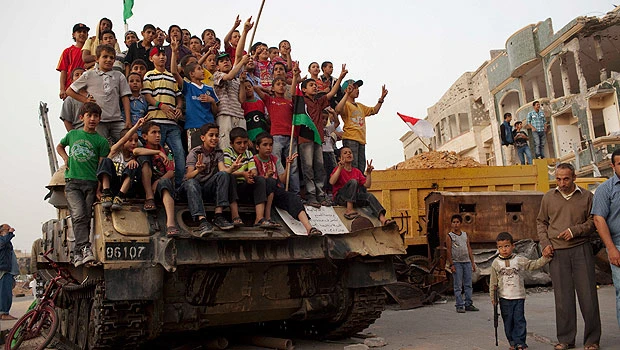
That is because men wandering around with sub machine guns are a daily sight in present day Libya, even though it is 10 months since the city rose up and threw out Qaddafi’s forces and two and a half since Tripoli was liberated. The fact that the conflict is well and truly over means nothing. Militiamen have not been disarmed nor militias disbanded — and there are tens of thousands of them. The Union of Revolutionary Forces based in eastern Libya accounts for 25,000 militiamen. In the west, the Misrata Brigade has at least 6,000 men, the Jadu Brigade from the Berber Nafusa mountains reportedly has over 4,000 and the Tripoli Brigade is said to number 10,000.
In the lobby of the hotel, the friend of a member of staff points his machine gun to the ceiling as if about to fire off a round. In the small grocer shop where Arab News buys bottled water, the shopkeeper has a machine gun next to the till and a couple of cartridge cases.
One thing is for sure: no one is going to rob him.
As for shooting off guns, it is a daily event. Whereas before, wedding processions of cars would blast away their horns, now they blast away into the air with machine guns. Every night, as soon as darkness falls, the sound of gunfire starts. There is no fighting; it is just exuberant young men showing off. Over Eid, there was even more of it than usual. Sometimes, it is heavier ordinance.
Last week, there was a couple of massive explosions near the house of someone Arab News was interviewing. It sounded like a rocket-propelled grenade. We all rushed out to see what had happened. On the large expanse of waste ground opposite three youths insisted that someone else had been firing. But there was no one else around, there were no other tire marks and they looked distinctly sheepish, avoiding eye contact. They could not get out of the place fast enough.
It is not just at night-time. On Monday afternoon, in a narrow street in the old city center, this reporter almost jumped out of his skin when someone started firing a machine gun just behind him. Faces peered out from windows overhead to see what was happening. A boy, probably no more than 12 years of age, was having fun with the machine gun just handed to him by an older friend or relative. Those faces quickly pulled back inside and this reporter ducked under a balcony as the boy held up the gun to fire again.
It seems that a machine gun is the “must have” fashion accessory for the young man about town in Libya today. And they seem prepared to let anyone handle it or fire it off. As Arab News drove past a block of flats in Benghazi Tuesday, a boy on a balcony was wiping a machine gun with a cloth; presumably his brother or father is in one of the Benghazi brigades. He then pointed it in our direction and before training it on other vehicles. Of course he did not pull the trigger, but it was unnerving.
There is international concern at the vast arsenal now in private hands in Libya — a combination of arms seized from Qaddafi’s forces, weaponry and ammunition provided by foreign supporters of the revolution and the machine guns distributed to the public by the Qaddafi regime. It hoped to create an armed public as its defense. It never realized the arms would be turned against it.
The danger is that with all these guns available, militiamen will be tempted to take the law into their own hands. There have been reports of individual militiamen using their weapons to settle private scores.
The main concern at present, however, is not about the country being awash with guns. It is about heavy weapons, particularly mines and shoulder-held missiles, falling into the hands of militants in the wider region, especially Al-Qaeda in the Arab Maghreb. It is possible that it has already happened. According the UN envoy in Libya, Ian Martin, "much has already gone missing from unsecured locations and that there are still locations which have not been properly secured."
There are certainly reports of weapons getting through to Mali, Niger and Egypt, even as far as the Gaza strip.
Stores of chemical weapons have been found which Qaddafi did not destroy, despite saying he did. Seven thousand drums of raw uranium are also reported to have been found. Fortunately, according to the UN, there is no evidence that any such material has fallen into terrorist hands.
Other than the posters encouraging Libyans not to shoot into the air, there has been no attempt to gather in the mass of weapons held by ordinary Libyans. “Action is needed on this”, said a European diplomat, “but neither the will nor the authority is there.”