
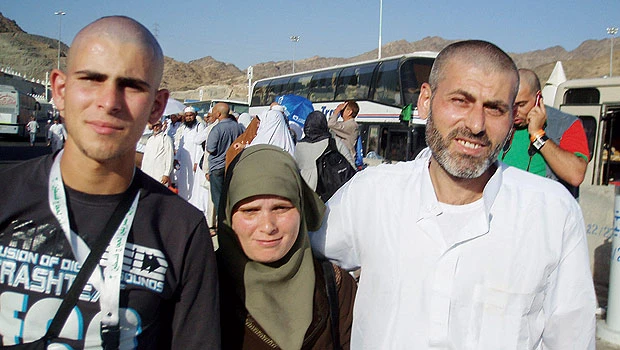
- MINA: Among the 3 million pilgrims at Haj 2011 are more than 400 Palestinians recently released by Israel in exchange for Israeli soldier Gilad Shalit’s freedom.
- They had been invited by Custodian of the Two Holy Mosques King Abdullah.
Arab News visited them at their camp near the Kuwaiti Mosque in Mina. Tears rolled down their cheeks as they narrated their stories of life behind prison and Israeli atrocities.
Despite being incarcerated for 10 to 20 years, the fire to attain freedom from the occupiers is burning bright in their hearts and minds. Their relatives who met them at the Haj just could not believe that they would be free one day. They keep hugging their relatives and cried softly while trying to hide their emotions.
Mahmoud Idrees is from Jerusalem. He was sentenced to 20 years in prison for being a member of Hamas. He always thought he would be released one day but his wife Abeer had lost all hope. His son, Abbas, was two years old when his father was jailed; he is now 14. He had not seen him for a decade. Both mother and son could meet Mahmoud only at Arafat, because Mahmoud was freed in Gaza, and his family was residing in the West Bank. King Abdullah invited Idrees and his family along with other Palestinians to Makkah for Haj.
“I met my husband for the first time in 10 years at Arafat. I just could not believe it. I thought it was a dream and I had a weird feeling that this dream might be fleeting. The feelings were mixed. There was extreme happiness and also fear that all this wasn’t real,” Abeer told Arab News while crying profusely and resting her face on her husband’s right shoulder in a show of affection.
Their son was holding both of them and trying to convey through his body language that he is around and that there was nothing to worry about. The family was oblivious of what was going around them among the throng of pilgrims at Mina.
Idrees said his hopes of freedom were brightened when Shalit was arrested. “We heard about it in the jail cell on television. I knew he would be used as a bargaining chip by our fighters. I was sure that Shalit would be treated well. That is what Islam teaches us about captives. Shalit himself acknowledged that he was treated well,” said Idrees.
He held his son, now grown into a tall man, with pride. “They paid a heavy price,” he said. “But all this is for the cause of our land — our country.”
Forty-nine-year-old Waleed Zakariya also was among those arrested by the Israelis and sentenced to 20 years. The charge against him was that he was a founder of Al-Qassam Brigades, the military arm of Hamas. He says he did take part in what he called an operation to avenge the assassination of Hamas founder Sheikh Ahmed Yassin. “Two of my companions lost their lives. They attained martyrdom.”
Zakariya has one boy and four daughters. His children are married, and he has 12 grandchildren. Since he was arrested a lot has changed, he says. “The world is no longer the same. Only the enemy remains the same. It still occupies our land,” he said. “We lost many leaders in the years since I was incarcerated.”
He says life behind bars has only strengthened his resolve to continue the struggle for freedom. “Israel does not want peace. It is not interested in any peace agreement. It does not believe in peace,” Zakariya said. “On our part we know, and we are convinced, that this is our land, and the rightful owners do not leave their land. The usurpers shall be removed,” he said clenching his fist.
Basil Al-Haymoon is a young man aged 32. He was sentenced to 23 years in prison but had to be released after seven as part of the Shalit deal.
He said he is a proud member of Hamas. “Ours is an Islamic party, and we take our instructions from our religion. I knew I would be released one day. I had full faith in my party and its followers. Islam says that we should expend all our money to free our men.”
Zuhair Salah Shishniah was jailed for 22 years. His sister Suma sobbed as she narrated the last time she saw her brother 17 years ago at an Israeli jail. “That was the only visit allowed by the Israelis. Now we met at Jabal Al-Rahmah on Saturday. What a beautiful feeling it was. How can I describe it in words? For us it was God’s greatest gift. It was unbelievable,” she said. “Time stood still on the plains of Arafat when I first saw my brother. I kept crying and crying. I held him tightly. Oh my brother, what did they do to you? They will face divine justice, sooner or later.”
Shishniah is a Fatah member. He says Israel does not understand the language of peace. “If it were not for Shalit then we would not have been released,” he said. “There are more than 5,000 Palestinians languishing in Israeli jails. We are waiting for their release. Insha Allah, they will be out of the prison soon. Our release has given hopes to their relatives as well,” he said.
Even when he was in solitary confinement, Zuhair said the flame of hope was always alive. “There were extremely bad moments and frustrating moments in jail, but we had complete faith in Allah. That kept us going despite all the hardships.”
All of them showered praise on King Abdullah. “After Allah, we thank him for his touching gesture. He is a father figure. He rules our hearts. He means the world to us. God bless him. We prayed a lot for him and Saudi Arabia here in Mina and Arafat,” one of them said.