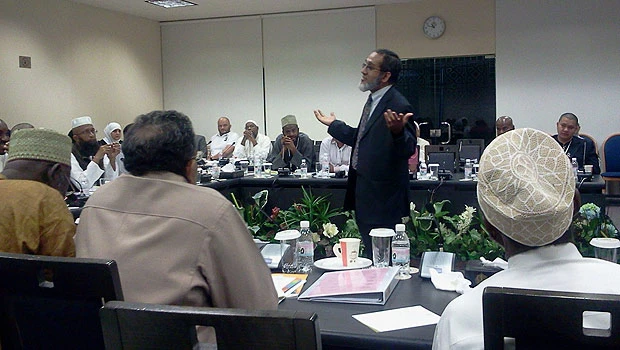
- JEDDAH: The Islamic Development Bank’s community development workshop aims to empower Muslim NGOs in different parts of the world by providing them with necessary training to boost their leadership skills, said Awadh Alassaime, director of the IDB department for communities in nonmember countries.
Speaking to Arab News after opening the three-day workshop on Sunday, he said the program offers a good opportunity for Muslim community leaders to meet one another and exchange their ideas and skills. “It shows the IDB is concerned about all Muslims in the world, not only those in the member countries,” he added.
The program is being attended by prominent leaders of Muslim organizations and institutions in 14 countries including Australia, Bangladesh, Brazil, China, India, Pakistan, Nigeria and the Philippines who had come to the Kingdom to perform Haj this year, including professor Siddique Hassan, vice president of Jamaat-e-Islami Hind.
Alassaime, who holds a Ph.D. in mechanical engineering from the US, said his department has been supporting educational, health and training projects of Muslim communities. “We encourage our Muslim brethren in these communities to become good citizens in their respective countries,” he added.
He emphasized the importance of education, saying it would help change the situation of Muslims all over the world. The department’s annual budget varies from one year to the other, he said, adding that it finances about 50 projects every year. Since 1983, the department has provided grants of nearly $400 million for Muslim communities in 110 countries.
“Since many senior members of Muslim NGOs come for Haj each year, the IDB decided to utilize their presence in the Kingdom by bringing them together to exchange experience, develop new ideas, increase knowledge, sharpen skills and establish a global community development network,” Alassaime said.
Indian Muslim leader Hassan commended IDB’s efforts for community development. “Lack of effective leadership is one of the main problems facing Muslim communities,” he said and proposed the setting up of leadership training centers and institutes in various countries with IDB backing. Alassaime welcomed the proposal and pledged his department’s support.
Ismail Maritheri of King Abdulaziz University in Jeddah presented a paper on the concept of social services in Islam while Shams-ur-Rahman Toor of Islamic Solidarity Fund for Development spoke about “Effective Islamic NGO leaders.” Maritheri urged Muslim leaders to set up Zakat funds to finance various charitable projects while Toor told them to work hard with strong faith in God to realize their set goals and maximize results.
Nigerian Rabia Muhammad, a former Roman Catholic, spoke about her experiences in Islamic propagation. “We extend a lot of humanitarian and health services to bring other people closer to our religion,” she said. Her organization’s activities helped 120 people accept Islam. Madinatu Salihu from Abuja urged participants to convey what they have learned from the workshop to community members back home.
Filipino Alexander Ali, an elected provincial board member from Mindanao, was another active participant. “We have to learn more about the Islamic concept of leadership,” he said and urged the IDB to reward potential leaders by giving them projects to run. About 4,500 Filipinos performed Haj this year and Ali was one of their supervisors.
Earlier Abdullah Mamoon Al-Azami, a community development specialist and chief organizer, welcomed the participants. Malek Shah Yusoff, manager scholarship division and Adel Sindi, senior program officer, attended the opening session. Rabih Matar spoke about how to raise and manage financial resources.