
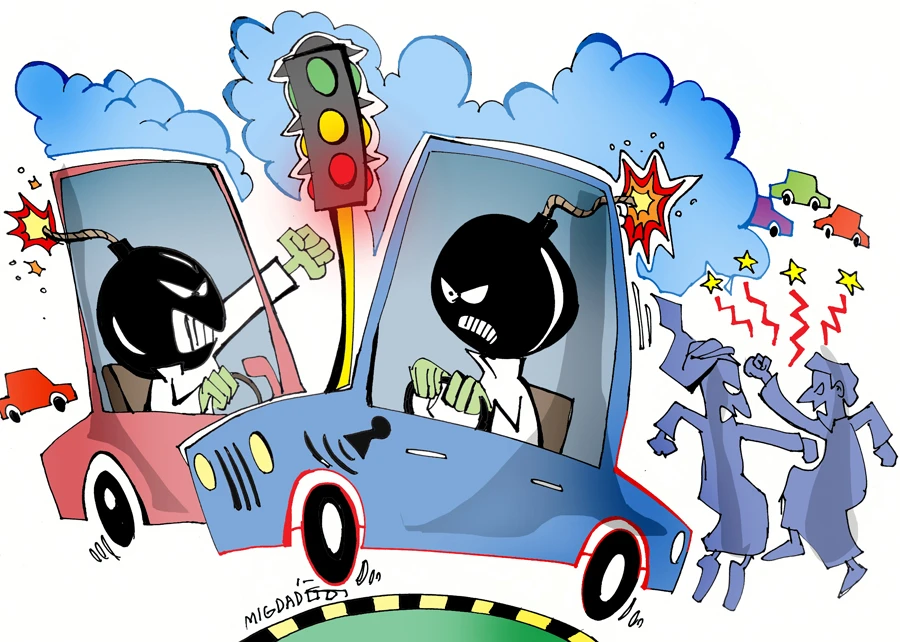
- JEDDAH: Road rage is increasing alarmingly in the Kingdom resulting in violent incidents and a greater death toll.
It is triggered by traffic violations, soaring tempers, aggressive driving, sudden acceleration and braking and tailgating.
The most common scenarios leading to such incidents are drivers speeding, cutting others off in a lane, deliberately blocking the right of way, not using indicators or not adhering to fundamental traffic laws.
“The result of this is almost barbaric,” said Mohammed Omar, a 30-year-old engineer in Jeddah. “It is common to see drivers insulting, yelling, using rude gestures like the middle finger in vain and abusing each other left right and center early in the morning. At night, it switches to flashing lights excessively, loud honking or driving in the middle of two lanes to keep the other drivers in a constant state of fear and alarm.”
Mohammed told Arab News he sees cases of collisions and physical abuse more often than not, even as early as dawn. “Once I was waiting at a red light and this car came and stopped on my right. The driver behind us had the right of way and constantly honked until he was shown the middle finger. In no time this verbal abuse turned into physical violence right in the middle of the main road.” A Riyadh-based scientific research group at King Abdul Aziz City for Science and Technology (KACST) warned Saudi Arabia would have over 4 million traffic accidents a year by 2030 if the problem was not cured.
The report concluded that almost a third of traffic accidents in Riyadh were due to drivers ignoring traffic lights and up to 18 percent of accidents were caused by illegal U-turns. The most dangerous driving activities were speeding, sudden stops and use of mobile phones while driving.
Many residents living in the Kingdom complained to Arab News about the lack of strict laws and their implementation.
“You can see heavy loaded trucks speeding on the highway or in the industrial area. There are no designated lanes or times for them like they have in neighboring Gulf countries, Dubai being one of them,” said Hussein Ali, an Indian businessman living in Jeddah. “You have to have your guard up and guess the moves of other motorists on the road. You don't know where the guy in front of you may decide to turn or stop last minute. You can't even rely on your gut feeling because the drivers here cannot drive adhering to regulations,” he added. “Everyone is a born Schumacher here. Whether they drive a Ferrari or Corolla is irrelevant too.”
Najla Shami, a 25-year-old training psychologist at a local hospital in Jeddah, said road rage is deliberate misconduct with violent behavior occurring under the influence of heightened emotions such as frustration, stress and anger.
“People hate waiting in congested traffic during peak hours in the city and the last thing they need is an amateur honking and trying to speed while changing lanes, going where he is not supposed to. That usually makes a driver snap and in most cases people tend to vent all their woes and frustration by swearing, abusing both verbally and sometimes physically.”
She says she has witnessed major accidents where SUV's and cars flip over due to a slight collision while speeding on the highway. “In most cases there is irreparable damage or instant deaths. People don't realize speeding can kill. Especially when they are distracted by mobile phones, drivers need to realize they are responsible for the lives of their passengers and should avoid all risks that may endanger lives.”
According to the World Health Organization (WHO) Saudi Arabia has the world’s highest number of deaths resulting from road accidents. Road accidents are the primary cause of death in adult males aged 16 to 36.
Mohannad Qasim, a 34-year-old businessman in Jeddah, told Arab News: “I blame the traffic department because it is their duty to implement the traffic laws and make sure assaulters are punished.” Hassan Bilal, a 29-year-old banker in Jeddah, said: “ Not only does it cause mental and physical fatigue, the rash driving is maddening. It is insane to drive on these roads, with fuming tempers.” He says it is common in Jeddah to see young people chasing motorists, driving at high speeds and switching lanes without using indicators.
“They drive as if they own the roads and overtaking is imperative. I think it gives them a high or sense of empowerment and that mentality is sick. Rash driving is a cheap thrill for their ignorance,” he added. He said in most collision cases, traffic slows down as people park their cars on the main roads and wait for the police and watch the incidents as spectators.
An average of 17 Saudi Arabian residents die on the country’s roads each day, according to the Kingdom’s General Directorate of Traffic.