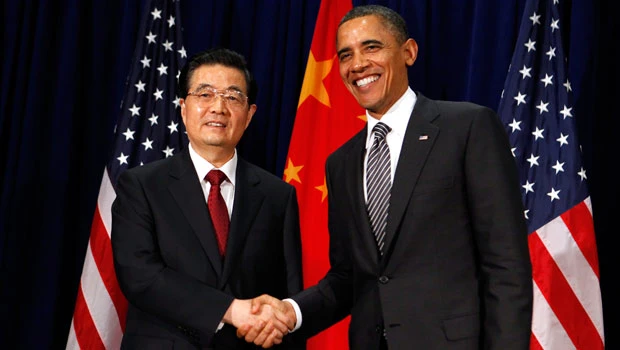
- BEIJING: China appeared keen on Tuesday to avoid a quarrel with the United States over trade and currency stances, stressing that the world’s two biggest economies share a stake in stable ties.
Assistant Chinese Foreign Minister, Liu Zhenmin, did not directly address US President Barack Obama’s comments in Hawaii on Sunday that the United States was fed up with China’s trade and currency practices.
“The meaning of President Obama’s comments is a question that you should ask the White House and the State Department spokespeople,” Liu told a news briefing.
“China and the United States are also economic partners each of which is important to the other,” Liu said at the briefing about Premier Wen Jiabao’s attendance at regional summits in Indonesia this week. Obama will meet Wen during the meetings.
“I think that along with the development of economic globalization, and the development of Asia-Pacific regional cooperation, China and the United States have massive potential to further strengthen economic and trade cooperation.”
China has sought to put its relationship with the United States back on track, mindful that more feuding could complicate a handover of top posts among China’s Communist Party leaders in 2012.
Using some of his toughest language yet against China, Obama, a day after face-to-face talks with President Hu Jintao, called on China to take on the responsibilities of a “grown up” economy, stop “gaming the system” and create a level playing field for US and other foreign businesses.
China, America’s biggest foreign creditor and its fastest-growing major export market, shot back that it refused to abide by international economic rules that it had no part in writing.
Tension had been building in the lead-up to the annual Asia-Pacific Economic Cooperation (APEC) forum gathering over a proposed US-led free trade deal that Washington wants as a counterbalance to Chinese influence but which China sees as an attempt to force it to play by US rules.
The currency dispute between China and the United States has been at the heart of tension between the rivals.
Washington has long complained that Beijing keeps its yuan currency artificially weak to give its exporters an advantage. China counters that the yuan should rise only gradually to avoid harming the economy and driving up unemployment, which would hurt global growth.
At the APEC meeting in Hawaii, Hu told Obama that even a big appreciation in the yuan against the dollar would not help US trade and unemployment problems. But Obama later said the undervalued yuan gave Chinese goods a 20-25 percent price advantage in global markets.
Liu said Wen would meet Obama during his visit to the Indonesian island of Bali for meetings with Association of South East Asian Nations (ASEAN) leaders and an East Asia Summit on Nov. 19.
“China and the United States both have a major impact on the Asia-Pacific region,” Liu said. “For the two countries to carry out cooperation and mutually benefit in Asia suits not only their interests, but also helps regional peace and development.”
US-China relations have been beset by a series of disputes, including disagreements over China’s trade and currency practices, US arms sales to Taiwan, China’s military build-up in the Pacific and its human rights record.
The East Asia Summit gathers senior officials or leaders from Southeast Asia, China, Japan, India, Australia, South Korea and New Zealand.