
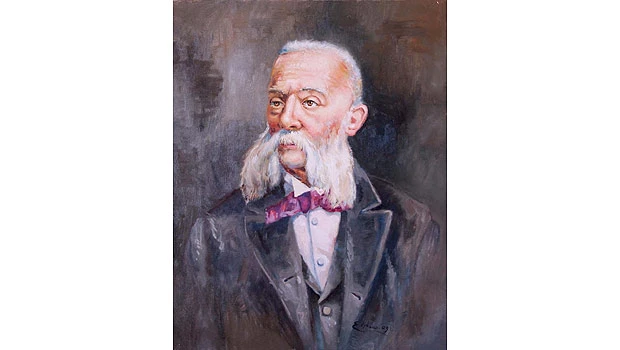
- In 2011, Italy does not only celebrate 150 years of political unification, but also commemorates the centennial anniversary of the death of Pellegrino Artusi, the man who inspired the Italian “gastronomic Risorgimento.” The “pasta al pomodoro” (pasta with tomato sauce) and other Italian culinary specialties that are considered today traditional Italian dishes, owe their national dimension and status to the work of this gastronomist, writer and retired merchant who collected culinary information over long years and numerous travels.
In 1891, two decades after Italy’s unification, Artusi published his masterpiece “Science in the Kitchen and the Art of Eating Well," the first cookbook to include fundamental recipes of all Italian regions, from Piemonte to Sicily, and give a unitary vision to Italian cuisine. Filled with humor, convivial spirit and passion for good food, Artusi’s homemade recipes contributed to the spread of knowledge about various regional specialties of the Italian peninsula and developed a feeling of national belonging.
The worldly Giuseppe Garibaldi, who led his thousand “Red Shirt” troops across Italy to bring about its unification, is often quoted as saying, “It will be spaghetti, I swear to you, that unifies Italy.”
“If he was correct that the acceptance in the northern regions of this staple food of the south helped to bring a common thread to the twenty disparate regions that became one nation, than we must credit Pellegrino Artusi for having provided the recipe,” writes Michele Scicolone in his foreword to the 2003 edition of Artusi’s cookbook.
Initially ignored by Italian publishers, Artusi’s volume represents the most read Italian cookbook of all times and a milestone of 19th century Italian popular culture together with “Promessi Sposi,” a novel by Alessandro Manzoni; “Pinocchio,” a tale by Carlo Collodi; and “Cuore,” a novel by Edmondo De Amicis. Thanks to their friendly and humorous tone addressing simple housewives and domestic helpers, Artusi’s 790 recipes became a source of knowledge and inspiration for Italian middle-class families and great chefs throughout the last century.
Artusi was born in 1820 in Forlimpopoli, a small village in Romagna, where he lived until 1851 while taking care of the family business. After being brutally robbed, his family transferred to Florence, where Artusi was particularly successful in his trades and able to retire soon. From 1865 onward, he began to dedicate himself entirely to his gastronomic and literary passions, writing some works of literary criticism and travelling all over Italy to collect information for his recipes and experiment them with the help of his servants, Francesco Ruffilli and Marietta Sabatini.
“Science in the Kitchen and the Art of Eating Well,” an expression denoting a positivist approach to the craft of cooking, was in fact the result of various culinary experiments following Artusi’s praise for the scientific method. His professionalism combined with an enjoyable prose and sense of humor, as the following receipt for Polpettone (Meat Loaf) shows, decreed the book’s success:
“Dear Mr. Meat Loaf, please come forward, do not be shy. I want to introduce you to my readers. I know you are modest and humble, because – given your background – you feel inferior to many others. But take heart and do not doubt that with a few words in your favor you shall find someone who wants to taste you and who might even reward you with a smile.”
“His writing style is relaxed and never pedantic. The recipes are more like a conversation with a favorite uncle rather than a mere list of ingredients and instructions,” explains Scicolone in his foreword’s opening lines. “If Artusi were alive today, he would surely be the star of a popular cooking show on television. He laced ‘Science in the Kitchen’ with anecdotes about people who, while largely unknown to readers a hundred years later, inevitably resemble someone they know.”
Translated by Murtha Baca and Stephen Sartarelli for an English-speaking public, who included quotes from historian Pietro Camporesi’s 1970 Einaudi Edition, this classic Italian cookbook contains hundreds of Italian recipes divided into chapters: broths, soups, pasta dishes, appetizers, sauces, eggs, doughs and butters, stuffings, fried foods, boiled meats, entrements, stews, cold dishes, legumes, fishes, pastries, cakes, ice-creams, preserves, etc.
Some of the most famous recipes are Cappelletti Romagna Style, Tortellini Italian Style, Macaroni Neapolitan Style, Roman Style Dumplings, Veal in Tuna Sauce, Cacciucco, Stuffed Artichokes, and Sienese “Little Horses.”
In order to celebrate the father of Italian cuisine on the occasion of the 100th anniversary of his death, the city of Forlimpopoli and Florence organized a schedule of prestigious events throughout 2011. Forlimpopoli’s squares and streets were transformed during spring into a huge open restaurant for the traditional “Festa Artusiana,” whilst Florence is getting ready to start the “Artusi Week” in November with special cooking classes, guided tours in major Florentine museums, and other initiatives.
As Scicolone explains: “Artusi’s readers have changed in many significant ways, but the book remains timeless, because the author focuses on simple things that do not change. He offers recipes for both simple meals and celebrations, dishes to please children or to nurture someone who is not feeling well. He frequently worried about his digestion and recommends and condemns certain foods.”